

Learn the best ways to replant a lawn and care for young grass in this expert DIY guide, which covers the use of seed, sprigs, plugs, and sod.
If your lawn suffers from acute soil compaction, rampant weeds, heavy thatch, or nutrient and organic matter deficiencies, you may have to remove your existing turf and replant your lawn. That’s a big job, but, like a new roof, your new lawn will last a long time. There are four ways to replant a lawn: by applying seed, planting sprigs, planting plugs, or laying sod.

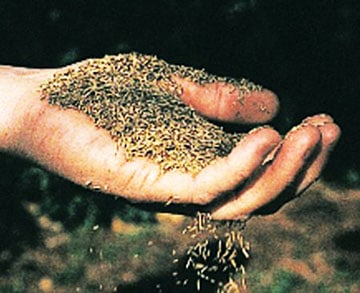
Seeds are applied to soil from which all the turf has been removed.
Sprigs are typically planted by machine over large areas; in small areas, they can be planted by hand. Sprigs consist of cut-up lengths of underground or above-ground runners, called rhizomes or stolons, on which there are typically two to four joints, or nodes, from which the new grass blades emerge. Sprigs can be broadcast and then pressed into the soil or planted in shallow furrows.
Plugs—round or square pieces of sod that measure about 2 inches across—are planted in holes evenly spaced throughout the site. After several months, the grass plants from the plugs spread and fill in the gaps.
Sod is available in carpet-like sheets that are usually about 3/4 inch thick, 1 1/2 feet wide, and about 6 feet long. Pieces should be laid perpendicular to a slope in a staggered pattern, as you would lay bricks.
If you need to replant, choosing the right grass for your yard can make the difference between having a low-maintenance, environmentally friendly lawn and one that is susceptible to disease, pests, and weed invasion, and that requires a lot of upkeep. The type of seed, sprigs, plugs, or sod you choose for either a new or restored lawn should depend on several factors.
1) What do you want your lawn to look like? Grasses vary in color, leaf width, habit (characteristic appearance), and density of growth.
2) How much time and money are you realistically willing to spend tending your lawn? Higher maintenance grasses mean a higher cost and time commitment.
3) Your seed choice will be affected by your site’s growing conditions—the amount of sun and shade your site gets, the soil type and its level of fertility and dryness or wetness, and your climate.
4) Consider how your lawn will be used—for decorative landscaping, for erosion control, as a play area.
After considering these issues, read the other pertinent articles in the Lawns & Ground Covers section to learn more about variations in different grasses’ growth and appearance.
Caring for Young Grass
Your work to this point will have been in vain if you don’t care for the young grass plants as the seeds germinate and grow. The most critical need is to apply water at least twice a day, assuming no rain. If the soil is allowed to dry out, the seedlings won’t germinate or will soon wither and die.
To maximize the germination rate, soak your lawn on the same day you sow the seeds. On the next day, assuming no rain, lightly sprinkle or mist the lawn for about five minutes morning and afternoon. Be sure you have moistened the soil to a depth of 1 inch. Keep the overseeded lawn moist until the young grass plants are 2 inches tall by repeating a light watering every day during periods without rain. This will take four to six weeks. When the grass is 2 inches tall, resume normal watering patterns.
If the weather is dry, warm, or windy, spread a layer of hay mulch to protect the seed. Use clean mulching straw that’s free of seed. Evenly spread about 100 pounds per 1,000 square feet. Avoid putting down a heavy layer that would inhibit grass growth.
Begin mowing once the new grass reaches 2 inches. Use a sharp blade; a dull one may tear up young grass plants. Otherwise, stay off the seeded areas except to fertilize. If needed, apply the rest of the fertilizer as recommended by your soil test, or apply a second dose of 1/2 pound of nitrogen per 1,000 square feet six weeks after germination.
Courtesy Yardcare.com