How to buy the best bathroom faucet for your home, with information on faucet finishes, types, fittings, valves and styles.

Faucet Quality
Bathroom Faucet Types
Bathroom Faucet Finishes
Beyond its role as a conduit for delivering water to a sink, a faucet can set the tone for a bathroom’s personality and style. However, if you are in the market for a new bathroom sink faucet, it’s important to look beyond style. Sure, appearance is important. But durability, ease of care, convenience, and safe use are more so.
Price is a pretty good measure of quality but not necessarily the best measure of whether a faucet will be right for your bathroom.
To choose wisely, it’s helpful to understand the inner workings of faucets and the types of features that are worth the extra money. That’s what we’ll look at in this article.

If you have ever shopped for a new faucet, you’ve probably discovered that your options are seemingly limitless.
Many different styles, finishes, technologies, and price points are available.
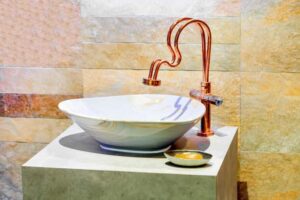
Options vary from high-arching goose-neck faucets to wall-mounted spouts and wide-set models.
And faucets come in materials and finishes that vary from silvery chrome to brilliant brass. Find more about all of these options below.
Faucet Quality
Most faucets are used repeatedly, day after day, for many years, so it’s important to select a faucet that’s more than great looking. It’s easy to mistakenly think that a shiny brass finish designates quality, though this isn’t necessarily the case.
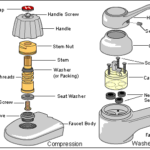
It’s important to have a clear idea of what to look in price, finishes, internal workings (the differences between ceramic-disc, compression, and cartridge faucets), and more.
With a quality valve, water temperature will not change abruptly as you turn the handle from cold to hot. In fact, to prevent burns (especially to children or the aged), a temperature-limit or scald-guard feature on single-control faucets is critical. With this type of faucet, you can adjust the highest water temperature the faucet will deliver. Many plumbing codes require scald-guard valves in new home construction.
To help conserve water, faucets must deliver no more than 2.5 gallons per minute; some models have additional adjustable-flow-rate restrictors.
Warranties on faucets vary by manufacturer. The best warranties provide lifetime protection against drips and leaks.
Bathroom Faucet Types
Contemporary bathroom faucets are manufactured in three basic styles:
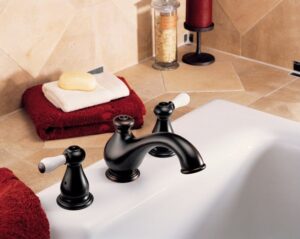
1) A widespread faucet has the spout, cold water valve, and hot water valve all mounted separately on the countertop. Widespread sets are considered by some to be more elegant and offer more-flexible placement. Then again, you will pay a premium for a widespread faucet—as much as twice the price as the same faucet with center-set styling.
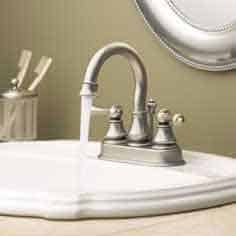
2) A two-handle center-set faucet has a spout and both valves combined on a single base.
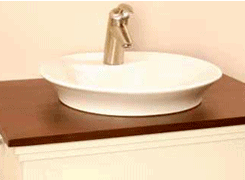
3) A single-handle center-set faucet has hot and cold controlled by a single lever or knob that may be part of the spout. A single-control faucet is handy in a bathroom because it more easily adjusts to and maintains a given temperature.
Whether a faucet is or isn’t right for your bathroom will depend on your budget, preferences, and the sink or counter where the faucet mounts.
Bathroom pedestal sinks and vanities may be designed for all three styles.
Before buying a given faucet, be sure you know the sink or countertop’s hole configuration or you can drill the countertop to accommodate what you want.
Bathroom Faucet Finishes
Most bathroom faucets are made from brass. Their parts are either cast in molds or machine-stamped. Of the two methods, cast faucets are better.
During manufacture, faucets are given any of several finishes, including chrome, brushed chrome, polished brass, pewter, stainless, gold plating, or powder-coated enamel.
Powder coating is a baked-on finish that should last as long as the faucet. It can be produced in any number of colors, including white, black, red, gray, and almond.
A brass-finished faucet is first nickel-plated and then plated with brass that can be polished to a sheen. A high-gloss brass finish is easiest to maintain if it receives a factory-applied clear coat. You can also buy brass faucets that retain their brass shine and are almost impervious to scratching—Delta’s Brilliance brass finish is one example of this new technology.
Although a chrome faucet is also nickel-plated before the chrome plating is applied, it can be left uncoated because the chrome will not tarnish the way brass does.
As a rule, manufacturers tend to offer better finishes in their higher-priced models. On the other hand, some, such as Kohler, may apply the same processes and performance requirements to the entire line.
Featured Resource: Get a Pre-Screened Local Plumbing Pro