Is noise at home driving you crazy? Here you will learn how to soundproof your noisy house, apartment, or condo. Includes information on how noise travels, and how to block or muffle it with soundproofing materials and methods.

Let’s face the reality of noise: Thanks to lightweight home construction, open floor plans, and a multitude of noisy machines and loud entertainment gear, today’s houses are noisier than ever. Unless a house is equipped with some form of soundproofing, it can be insufferable at times.
And then there is the neighbors. Trying to quiet noisy neighbors in apartments and condos—or noisy neighborhoods—is even harder. How do you soundproof a room to block outside noise?
In this comprehensive, expert guide, we’ll help you answer these questions and more.
But first, let’s look at the dynamics of sound so you can effectively control it.
How Sound Works
Fundamentally, sound comes from the energy that is produced when an object vibrates, creating waves in the air around it. The sensitive membrane in our ears, the eardrum, detects these vibrations in the air and registers these frequencies in our brains as different types of sound.
Bass frequencies have long wavelengths and treble frequencies have short wavelengths. These sounds are affected differently by the materials they contact. You’ll find it’s much harder to block the pounding bass of your neighbor’s subwoofer than it is to silence a mid-range conversation.
The uniformity of a surface also affects sound transmission characteristics. Hard flat surfaces tend to bounce sound waves around, sometimes creating a lasting echo effect if the surfaces are parallel walls. The softer and less uniform the surface, the less opportunity sound has to bounce off. If two walls are not parallel, sound is less likely to ping pong back and forth.
What Is Noise?
Noise is simply unwanted sound. In the home, most people consider noise to be just about any sound other than the sound made by what they’re doing.
For example, if you’re on the phone, the television in the next room may be noise. Conversely, if you’re watching television, a phone conversation nearby can be noise. Your teenagers’ music is noise—period. You get the idea.


How to Soundproof a Room
In brief, here is how to soundproof a room:
- Determine what noise you want to control.
- Opt for soft, sound absorbing materials such as rugs and upholstered furniture.
- Consider sound absorbing acoustic tiles for walls.
- Install sound-blocking doors.
- Install soundproof window inserts or acoustic quilts.
- Explore sound-blocking wall, ceiling, and floor construction techniques.
Now let’s dig into the details.
Soundproofing is about controlling noise. So ask yourself, “What noise do I want to control?”
Broadly speaking, noise control falls within two camps:
- Controlling the quality and nature of sound generated within your home, and
- Blocking noise that you don’t want to hear.
Both of these involve stopping the unwanted movement of sound from one place to another and dampening echoes.
Two soundproofing techniques are used for controlling the movement of sound:
Sound absorbing soaks up sound so it doesn’t bounce from one place to another.
Sound blocking relies upon materials and methods that stop or reduce the transfer of sound.
To soundproof a room effectively, you can use a combination of noise blocking and sound absorbing materials and techniques.
You can use sound blockers to prevent noise from traveling through the walls, ceiling, floors, doors, windows, and openings such as doorways, and also employ materials that absorb noise both inside and outside of the room.
What Is An STC Rating? (This is a key measurement!)
When you’re dealing with noise, it’s important to measure the effectiveness of soundproofing.
The ability of a material to block sound is measured by a Sound Transmission Class (STC) rating.
This rating roughly reflects the decibel reduction in noise provided by a partition or object.
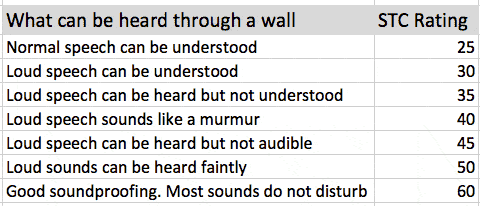
Sound absorption is measured by a Noise Reduction Coefficient (NRC) rating or a Sound Absorption Average (SAA).
In both cases, the higher the rating, the more effective the materials and methods are at doing their job.
To block loud speech, a wall needs an STC rating of at least 40 to 50. For excellent noise blocking, you’ll need an STC rating of from 50 to 60.
In each of the soundproofing sections below, we discuss the STC ratings you’ll want to achieve.
Sound Absorbing Materials and Techniques
To dampen echoes and reverberations that cause noise, absorb sound with soft surfaces and materials. In a typical room, these materials include carpeting, padded curtains, and upholstered furniture. If you want to minimize sound bouncing around a room, avoid hard materials like hardwood, tile, and laminates.
Acoustic Tiles and Foam
But you can do more. Sound absorbing materials such as acoustic foam can greatly improve the quality of sound in a room. Typically porous, lightweight, and soft to the touch, sound absorbing materials stop noise from bouncing around inside rooms. That’s why they are used for deadening distortion from reflected sound in a home theater, music room, podcasting booth, or recording studio. They work equally great to soften the sound in a noisy kitchen or recreation room.
The following educational video explains how sound travels and why reflected sound creates echoes, distortion, and interference. It shows how a combination of sound absorbers and diffusers make a room sound less noisy and more natural.
So, acoustic tiles work great for controlling echoes. But people often ask if putting foam acoustic panels or tiles on walls will help reduce noise from neighbors or the neighborhood.
The answer is: They keep sound from bouncing around but, beyond deadening the sound, they won’t be very effective at blocking outside noise.
Sound deadening acoustic panels offer studio-quality sound proofing. These home-theater style soundproof foam tiles are available in lots of colors. Shop for sound proofing acoustic deadening sound tiles on Amazon.
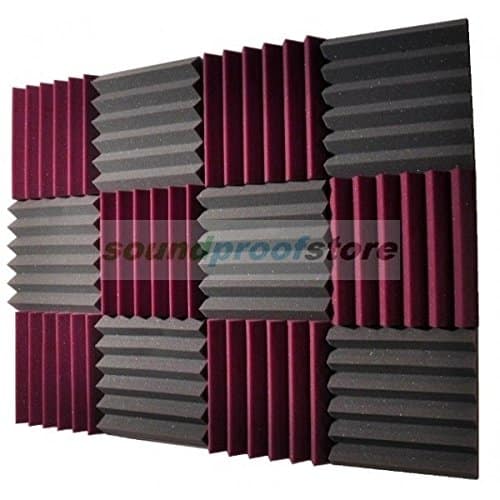
Because foam acoustic panels and tiles are often applied to surfaces as a finish material, they come in a variety of colors and styles. Cost for acoustic soundproofing tiles ranges from about $15 to $40 for a pack of twelve 12-by-12-inch tiles.
Soundproofing for Recording or Podcasting
If two walls are not parallel with one another, sound is less likely to ping pong back and forth. This explains why uneven, angled, curved, or ridged soundproofing materials are popular in environments where noise reduction is key such as recording studios, home theaters, and music practice rooms.
For people who are building a home recording studio, soundproofing is an art.
A good place to start is with soundproofing acoustic panels or sound deadening tiles like the ones shown and discussed above.
If you’re building a serious recording studio where you don’t want any sound bleeding through the walls, check out this video:
How to Build Acoustic Panels
If you want to make you own acoustic panels for absorbing unwanted noise at a cost of less than $20 each, watch this detailed, easy-to-follow video:
Minimizing Uniform Surfaces
The uniformity of a wall or ceiling surface affects its sound transmission characteristics. Flat surfaces tend to bounce sound waves around, sometimes creating a lasting echo effect if the surfaces (or walls) are hard—and especially if they are directly parallel to each other. The less uniform the surface, the less opportunity the sound has to bounce.
Sound Blocking Materials and Techniques
To block noise coming from outside a room, such as traffic noise or noisy neighbors, you need materials that have a lot of mass. They will work as a sound barrier to minimize sound transmission.
In addition, you may use materials or methods that separate or “decouple” the parts of a wall or floor so that sound waves don’t vibrate right through them.
Sound blocking materials prevent noise from traveling through walls, ceilings, doors, windows, and floors. Materials that stop sound are typically dense, heavy, thick, or—in some cases—flexible. Generally speaking, they are too dense for noise to travel through them.
A 12-inch-thick brick wall is a good example of a sound blocker. But thick brick walls are rare. Most of us must turn to other materials and methods to achieve effective sound blocking.
As you’ll find in the information below on how to soundproof rooms, walls, and more, extra-thick layers of drywall, special acoustic “green glue,” and mass-loaded vinyl (MLV) are among the best materials for stopping the movement of noise through walls, ceilings, and floors.
The principle that greater mass increases sound blocking holds true for windows and doors, too. Using double- or triple-glazed windows or solid-core doors dramatically increases their ability to block sound.
Sound blocking methods. The most effective sound blocking methods involve building what are effectively double walls. The idea is to have these double walls separated so vibrations can’t pass through them.
Staggered stud configurations, special clips for holding drywall, and multiple layers of ⅝-inch drywall are popular methods decoupling one side of a wall from the other. More about these below in Soundproofing a Wall.
But here is the problem: Unless you’re doing a major remodel or building a home with sound control as a priority, employing serious sound-blocking strategies like these can be very expensive and involved. It’s best to take on these measures when walls and ceilings are already opened up. If walls are closed up, you may need to tear them open to modify or retrofit them.
If you own your home, the effective, permanent solutions discussed below are possible if you have the budget. We’ll walk you through a variety of sound blocking solutions.
If you’re renting, on the other hand, you’ll need affordable, workable alternatives. See Apartment Noise Solutions.
Best Soundproofing Doors
Doors play an integral role in controlling the movement of sound through a house. Selecting the right doors is one of the easiest and least expensive soundproofing measures you can take to block sound.
Doors are typically the thinnest barrier in a wall. Because they don’t benefit from the thicker—sometimes insulated or layered—construction of walls, they generally do a poor job of blocking noise. Noise just easily passes right through them.
Following we’ll look at the best doors for blocking sound, as well as ways to prevent noise from leaking in around them.
Solid Doors Block Sound Better
You can add significant sound control simply by replacing a hollow-core door with a solid-core door.
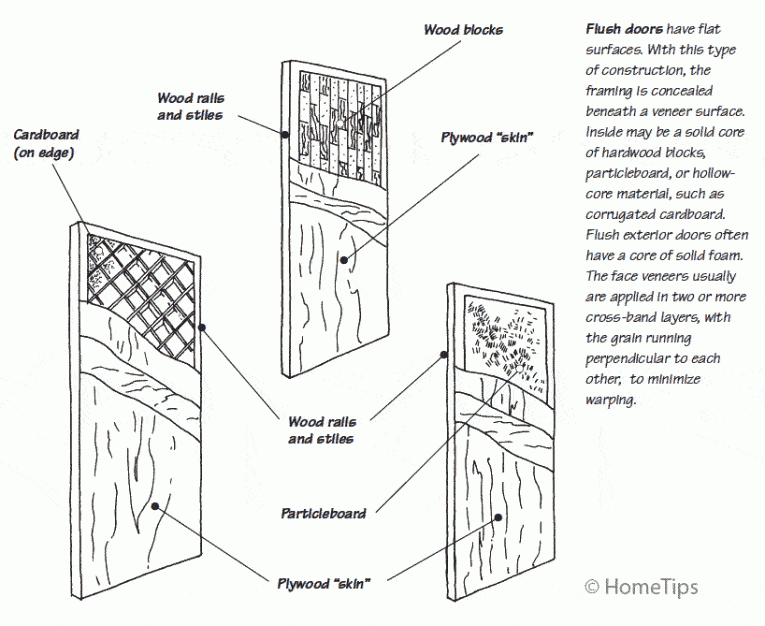
Hollow-core doors are the most typical, ordinary flush interior doors in houses. Beneath a hollow-core door’s surfaces, an inner cardboard honeycomb core is surrounded by a softwood frame. The surfaces are faced with very thin wood veneers. Considering the thin surfaces and the air-filled core, there isn’t much to block the movement of sound.
Solid-core exterior or interior doors have, as their name suggests, a solid core of wood or composite material. They will block noise more effectively because of their density. Manufacturers sell many types, ranging from expensive hardwood to more affordable Medium Density Fiberboard (MDF) doors.
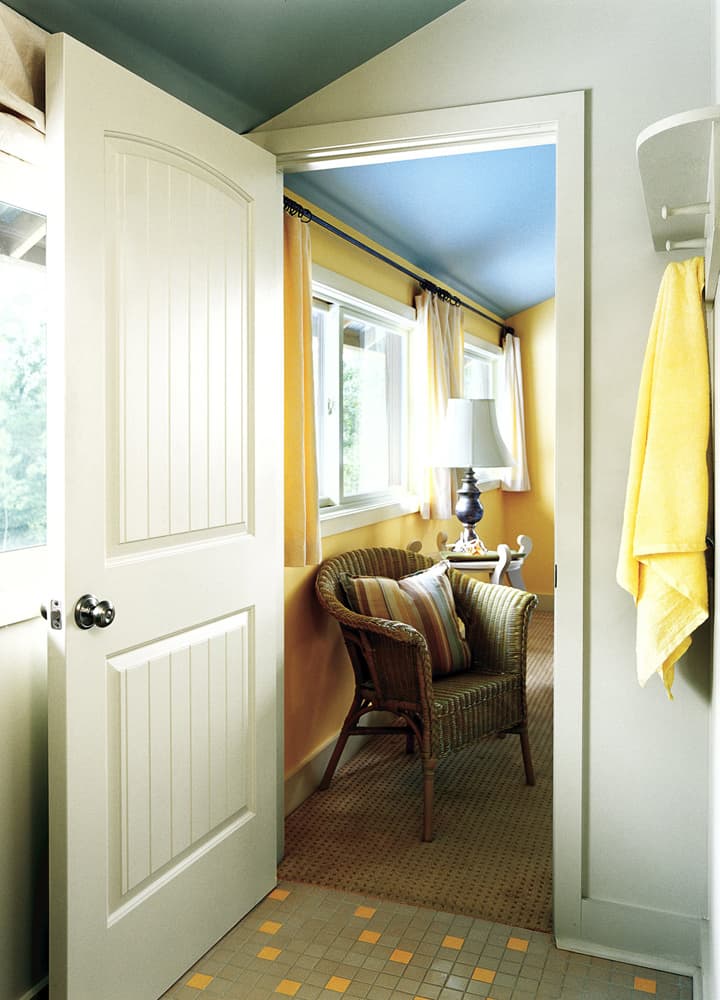
When shopping for a sound-blocking door, you’ll see they all have an STC rating that measures their performance. Please see What Is An STC Rating?
A hollow-core interior door has an STC of less than 20. If you were to replace that door with a solid-core door that is properly weather stripped, you would end up with an STC rating of 34 to 36. This would block low speech, but not loud speech or other noise.
Though most interior doors are 1 3/8-inch thick, exterior doors are typically 1 3/4-inch thick. The thicker the door, the better it reduces noise transfer. Just be aware that replacing a 1 ⅜-inch door with a thicker one will involve some carpentry modifications to the door jambs.
Sound-blocking doors. You can actually go one step further than a solid-core door and buy a sound-blocking door. Doors made specifically for blocking sound typically have a construction that sandwiches 1/2-inch-thick particle board sound board with an interior layer of lead or another super-dense material. (A door that contains lead will be much heavier than a conventional door.)
They are often sold as kits that include jambs and integral interlocking thresholds and sweeps to keep sound from leaking-in around them.
Weather Stripping for Doors and Windows
Of course, it doesn’t matter how a door is built if it’s open, right? Similarly, if gaps exist around the edges or between the bottom of the door and the floor, sound easily sneaks in around the door.
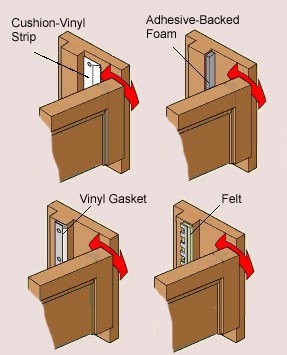
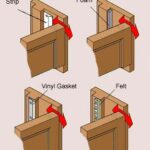
So the door should fit the jamb tightly. Use weather stripping to seal around its edges. Rubber or vinyl bulb door weather stripping and a door-bottom weather stripping sweep do a good job of sealing around the perimeter of a door to block noise.
Shop door weather stripping and door sweeps on Amazon.
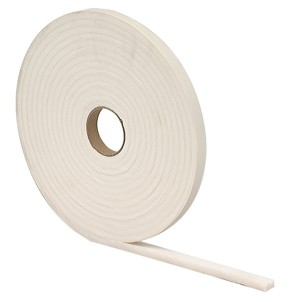
If you need a door sweep that doesn’t drag along the floor, investigate an automatic door sweep that seals the bottom of the door only when the door is closed.
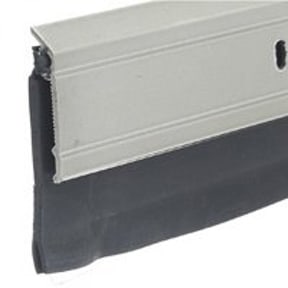
You can buy recording-studio-grade door noise-reducing materials online as an acoustic door seal kit.
Soundproofing a Wall
Whether you want to control the noise within a room or block it from traveling into a room, your home’s walls are key. Keep in mind that most soundproofing techniques used for walls also work for ceilings.
Unfortunately, conventional walls and ceilings are only marginally effective at blocking noise because they are built like drums.
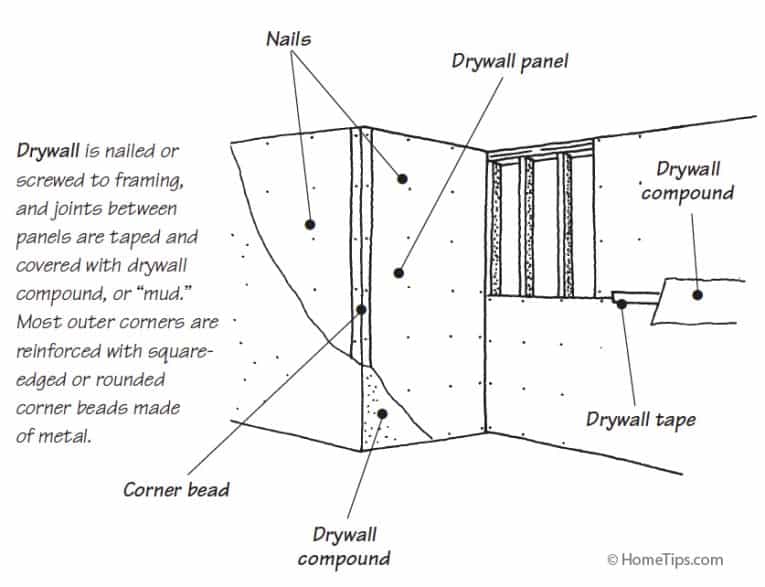
They have surface membranes (typically ½-inch-thick drywall) attached to a structural framework of wall studs or ceiling joists. The spaces between the studs are filled with air or, in some exterior walls, insulation.
When sound waves strike one surface, they are conducted through the surface material and framework to the other surface where they’re broadcast as audible noise.
Of course, where wall surfaces are thin or nonexistent, such as at an open window or doorway, noise flows freely.
STC Ratings for Walls
As a standard for comparison, a “paper-thin” conventional house interior wall made of 2-by-4 studs with 1/2-inch drywall on both sides has an STC rating of between 15 and 33. The variance depends upon construction and whether the wall contains fiberglass insulation.
A 2-by-4 stud wall, insulated, with slightly thicker ⅝-inch drywall on each side will give you an STC rating of about 40. (See What Is An STC Rating?)
Many condos or apartments have partition walls built with staggered double 2-by-4 stud framing and, in some cases, one or two layers of ⅝-inch drywall on each side. These have STC ratings from 40 to the high 60s, depending upon the number and thickness of drywall layers and the addition of insulation between the studs.
Mass-loaded vinyl, discussed below, contributes an additional STC rating of from 25 to 27.
Soundproofing Insulation
If you are building or remodeling a home, you have an excellent opportunity to install significant noise control measures, including insulation between the studs and several acoustic construction techniques discussed below.
During building or remodeling, an effective and affordable way to improve the soundproofing performance of walls and ceilings is to put batt or blanket insulation between studs or joists. Insulation absorbs the sound that would otherwise easily travel through the air pockets between wall framing.
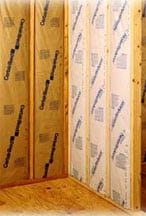
Major insulation manufacturers, including CertainTeed, Johns Manville, Knauf Fiber Glass, and Owens-Corning, market 3 1/2-inch-thick fiberglass or rock wool “acoustic batts” specifically for sound control. These products are excellent at absorbing the sound that would otherwise travel through the air.
Designed to fit between studs, acoustic batts are 14 1/2 inches or 22 1/2 inches wide and 3 1/2 inches thick. Most are the same as R-11 or R-13 energy insulation batts.
Kraft-faced batts are friendliest to handle and easiest to fasten in place (a vapor barrier is not needed for interior walls). They should be installed tightly between framing members, and snugly around pipes, electrical boxes, wires, and heating ducts with as few hollows or gaps as possible. Any gaps or hollows will allow noise leaks.
Leaving only a small portion of a wall or ceiling uninsulated can dramatically reduce its sound-reducing performance. Batts can be friction-fit in wall cavities. If temporary support is needed, two or three bands of drywall tape may be stapled horizontally across studs.
In ceilings, batts should be installed just above the backside of the ceiling material.
Construction Methods for Acoustic Walls
Boosting the sound-blocking performance of walls and ceilings to higher STC levels calls for additional measures during wall construction. Here are a few options:
Metal wall studs. Using metal wall studs helps. A wall built with 2 1/2-inch metal studs yields an STC rating of 45.
Two layers of drywall. Another way to achieve better performance is to apply a second layer of 5/8-inch drywall to one or both sides of the wall. This gives the surface more mass, making it less prone to vibrate and transfer sound waves.
Adding a layer of ½-inch drywall to one side of an insulated wall increases the STC rating to 40; adding it to both sides pushes the STC to 45. By moving up to ⅝-inch drywall and adding insulation you can get an STC rating as high as 60.
Sound isolation systems. An even more effective way to build an interior wall is to mount 1/2-inch gypsum wallboard on special resilient channels or clips that across the wall. These channels or clips absorb sound so it isn’t conducted through the wall studs, resulting in an STC rating of about 46.
Typically, the drywall is screwed to a flange on the channels, not to the studs. Combining insulation, channel-mounted wallboard, and a dual layer of 1/2-inch gypsum on one side achieves an excellent STC rating of 52.
This video shows how to install drywall on the CertainTeed noise-proofing clip system:
Staggered wall studs. In roughly the same category is a wall with staggered wall studs. Though this requires more labor and framing material, a wall of 2-by-4 studs, staggered along 2-by-6 bottom and top plates with two thicknesses of fiberglass insulation, produces an STC of about 50. Because the wall surfaces are each fastened to an independent set of studs, noise can’t travel through the studs from one surface to the other.
Fireblocking. Where codes and safety allow, consider eliminating fireblocking in interior walls. These short blocks, mounted horizontally between wall studs, transmit noise readily from one wall surface to the other. If you’re thinking about eliminating them, be sure to check with your local building department.
Mass Loaded Vinyl (MLV)
Mass Loaded Vinyl (MLV) barriers offer a serious step-up in blocking sound, with an STC addition of from about 25 to 32. Made of high-density organic sands and salts, as well as minute metal particles, these 1/8 to 1/4-inch-thick flexible products are sold in 4-by-8-foot sheets and 4.5-by-20-foot rolls. The material can be cut with a utility knife.
MLV can be Class A E84 fire rated when it has a foil facing on it.
Prices run from $1 to $2.50 per square foot. You can buy self-adhesive types, but this adds to the price.
At about 2 pounds per square foot, they are heavier than they look. Depending upon the surface you’re attaching them to, you can use construction staples, nails or screws with big washer-sized heads, or adhesive. A power nailer loaded with staples is easiest to use. Because of the weight, MLV must be installed so that the fasteners don’t pull through the material.
You can even install grommets and hang the sheets like curtains (a good solution if you live in an apartment or rental).
The following video shows how to install Acoustiblock, one of the available MLV systems.
Sealing Up Wall Penetrations
Electrical switches and outlets are set into plastic or metal boxes in a wall. These boxes, because they are hollow, act as holes that allow noise to easily pass through the wall.
This is where Putty Pads or Quiet Pads can help. If you can gain access, wrap the back side of electrical boxes and similar penetrations with putty pads. These create an air seal and add mass to the box that sound can’t bypass.
This video shows how to use the pads. The host also discusses applying a double layer of ⅝-inch drywall and filling cavities between wall studs with fiberglass insulation.
How to Soundproof Between Floors
In an existing home or apartment, controlling the noise that travels from the floor above to the room below (or vice versa) can be very difficult, particularly if you don’t own or control the room above. For more about this, please see How to Soundproof an Apartment.
If you own the room above, you can install padded carpeting to minimize the sound of shoes above or foam speaker isolation pads to deaden the rumble of speakers. You can also undertake repairs such as silencing floor squeaks.
How to Build a Soundproof Floor Video
If you’re building a new home or undertaking a major remodel, and you want to make sure that the noise above is not heard in the room below—and vice versa—you can build a soundproof floor.
You do this by pouring a 1½-inch slab of lightweight concrete on the floor. This, of course, will be major construction that involves pumping and troweling concrete. Be aware that this technique will raise the floor level by at least 1½ inches, so this must be taken into consideration during your planning.
Here is a video that shows you what is involved in building a soundproof floor:
A floor-ceiling construction that produces an STC of 53 is achieved by mounting 1/2-inch gypsum wallboard to resilient channels fastened to 2-by-10 ceiling joists with 3 1/2-inch-thick batts between the joists. In this scenario, the floor above has a plywood subfloor, particleboard underlayment, carpet pad, and carpet.
Basement Ceiling Soundproofing Video
Below is an excellent video that shows you four different methods for soundproofing a basement ceiling so you don’t hear the noise above, and the people above don’t hear the noise in the basement.
The first, easiest and probably best method he illustrates is to apply to layers of ⅝-inch drywall with “green glue” to create a super-dense ceiling with an STC rating of about 40, which is ample in most situations. This option doesn’t involve installing insulation.
He explains that you can add more sound dampening by adding fiberglass insulation. Note: We recommend wearing a long-sleeve shirt, gloves, a dust mask, and safety glasses when installing fiberglass insulation.
Ceiling Sound Absorption
To help quiet the noise of a room that is below other rooms, you can install an acoustic ceiling.
Companies such as Armstrong World Industries have a wide range of acoustic ceiling materials that are particularly popular for deadening the sound within a room and can help cut down on noise transference to and from basements and other activity areas.
Acoustic tiles and drop-ceiling systems offer excellent acoustical properties.
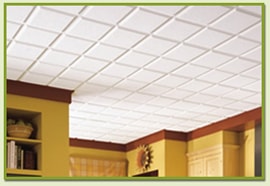
You might be pleased to find that they don’t have to look like an office ceiling. People who think the conventional styles of acoustic ceilings are a bit too institutional will like some of the newer styles available.
For example, Armstrong offers 2-by-2-foot and 2-by-4-foot acoustic ceiling panels that have a step-edged detail or look like embossed or molded plaster. “These are very good for blocking noise generated in the basement and keeping it from invading upstairs,” says a spokesperson for Armstrong’s residential ceilings. “They will give your basement ceiling an STC rating of about 35 and even better performance if you install batt insulation between floor joists,” he adds. (For more about STC, see What Is An STC Rating?)
With ceilings, as with the entire house, the most effective way to minimize noise is to combine a number of different sound-blocking and sound-reduction methods.
Soundproofing Windows
Noisy neighbors, traffic, animals, leaf blowers, lawnmowers, pumps, airplanes, construction: these are just a few of the noises that can interrupt your home’s peace and quiet.
But what can you do about them?
The answer is that it may largely depend on the type of noise and the work and expense you’re willing to go to block the noise.
Replacing Windows with Soundproof Windows
Replacing old single-pane windows with special soundproofing windows can be a huge—though expensive—step.
One important note is that energy-efficient windows and soundproof windows are two different things. Glazing that has argon gas and low-E coatings doesn’t change a window’s acoustic features. The thickness of the glass, the amount of space between panes, and the integrity of the frame do.
Because conventional single-pane windows do very little to block noise, they are a significant target when it comes to soundproofing to shut-out exterior noise. A single-pane window has an STC rating of 18 to 27. (See What Is An STC Rating?)
A dual-glazed (or “double-glazed”) window has an STC rating of 28 to 32. Dual glazing may be a significant energy improvement for your home, but as a soundproofing improvement, the change is only slightly audible. You need to move up to a higher performer to significantly block noise.
Laminated dual glazing steps up the STC to about 35, but this difference over basic dual glazing doesn’t justify the additional high cost of laminated glass. The same is true of triple glazing.
A better choice is choose double glazing that has two different thicknesses of glass. These windows do a better job of filtering out various frequencies of noise and will deliver an STC rating of about 34.
Most major window manufacturers offer special soundproofing windows, so check around. And be sure to get multiple bids if you’re thinking seriously about this type of major investment.
Installing Soundproof Window Inserts
If you live in an airport flight path, a noisy downtown area, or just a subdivision with too many leaf blowers, you’re going to want windows with an STC of 38 to 40 or more.
In this case, investigate special soundproofing window inserts. These are far more affordable than completely swapping out windows.
Soundproof window inserts are custom-made to fit and be installed inside many types of existing windows.
When installed, these windows leave a hefty space of about 4 inches between the existing window and the insert. As a result, they achieve very high STC ratings of 38 to 42.
They are made in a variety of operable styles by companies such as CitiQuiet, Indow Windows, and Citiproof Soundproof Windows. Certain brands are sold through major home improvement retailers.
Window Soundproofing Panels and Acoustic Quilts
Sound reducing acoustic curtains are an inexpensive way to absorb some interior room sounds and can marginally minimize outdoor noise. You can buy buy sound-blocking curtains on Amazon for under $40. But keep your expectations low—they are not going to do an exceptional job of keeping out the noise.
Noise-reducing curtains absorb indoor sound and help block outdoor noise.
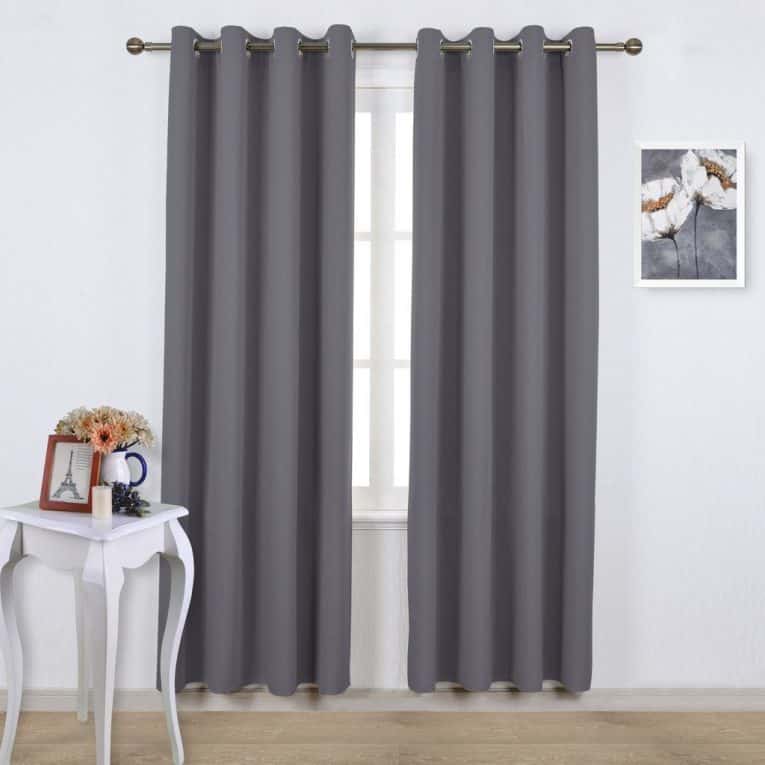
Acoustic curtains will be most effective if you choose sizes that will reach from ceiling to floor. At the very least, they should extend a few inches beyond the perimeter of a window.
This video shows how one brand of soundproofing panels is easy for a do-it-yourselfer to buy and install.
Caulk and Weather Strip Windows
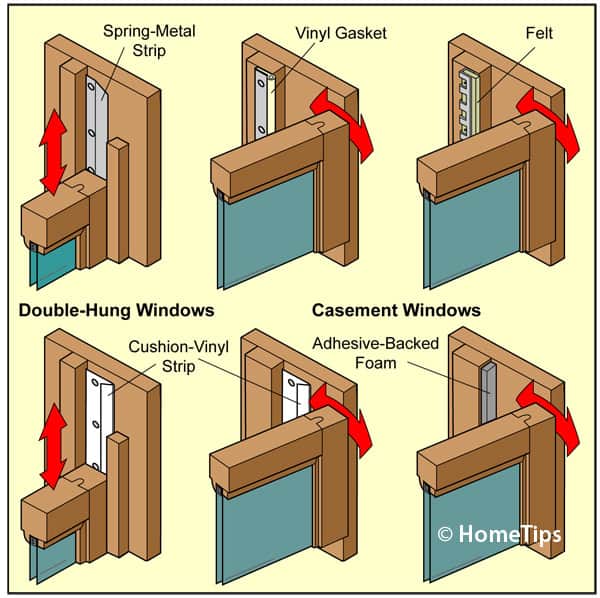
Gaps and spaces around windows allow noise to pass freely. One of the cheapest but most effective soundproofing measures you can take is to weather strip and caulk windows. For more, see How to Weather Strip Doors and Windows.
Soundproofing A Garage
If your home has a room next to or above the garage, street noise can travel right through the garage into your house. In this situation, the makeup of your garage door is also a consideration.
The typical garage door is built with an open interior framework and faced with a sheet of plywood, steel, vinyl or aluminum on the outside.
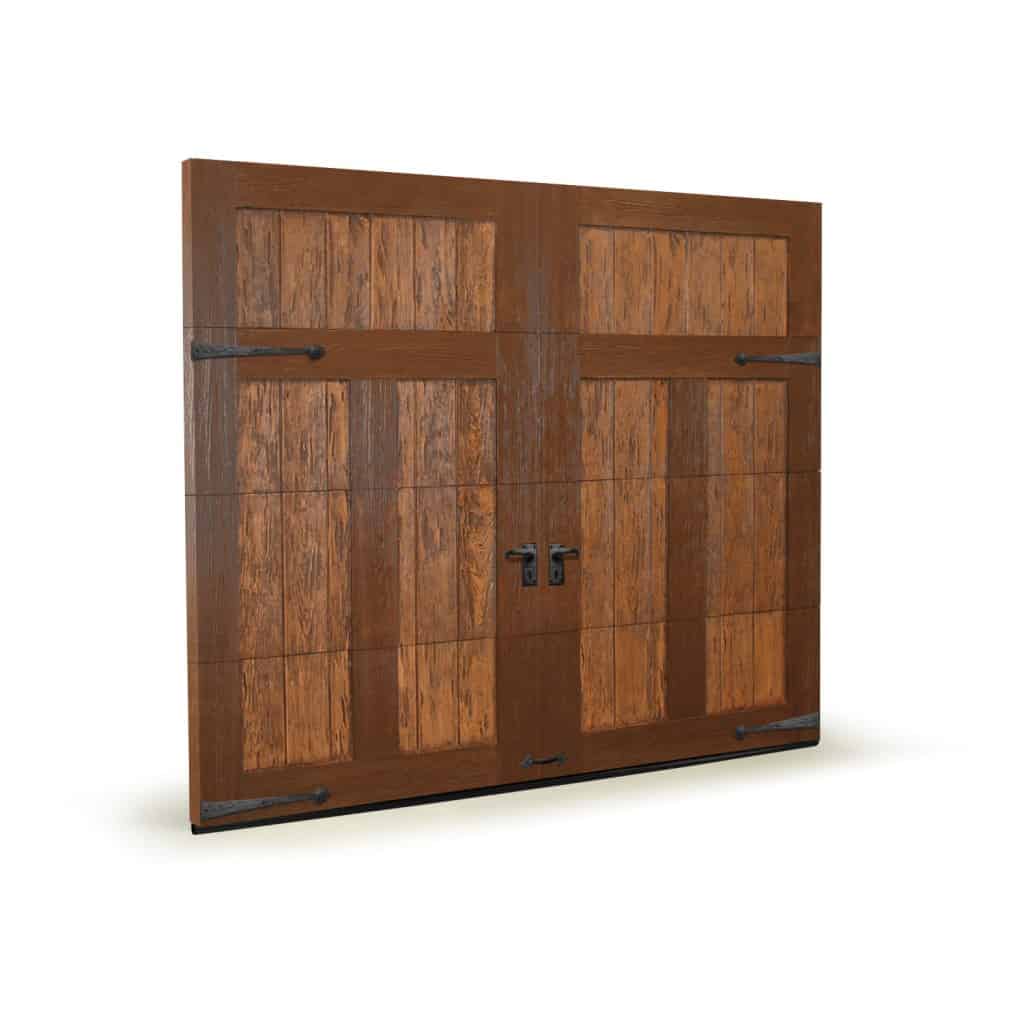
But you can buy premium garage doors that are filled with foam insulation and have an additional facing on the inside. These are particularly good at keeping street noise from entering through the garage.
For more, see the Garage Doors Buying Guide.
Soundproofing An Apartment
Some sound control issues are not easy or affordable to solve completely because they can involve opening up and reconstructing walls, ceilings, and floors. Obviously, if you live in a rental or apartment, these methods are not practical.
But what can you do to cut down on noise from next-door neighbors or an apartment above or below you?
Your best measures are going to be those with neighbor compliance or participation. If you have a positive relationship with your noisy neighbors, discuss the issue and see if you can work out a solution together. For example, if their subwoofer is pounding your ceiling with bass tones, maybe you can offer to buy them a set of acoustic foam isolation pads for their speakers.
If the sounds of clicking heels or heavy foot falls are pounding the ceiling, see whether they might put padded carpeting or rugs in the most problematic rooms.
If the problem is floor squeaks, talk to your landlord.
If the noise is coming through walls, try to arrange furniture to control it. For example, consider putting a floor-to-ceiling wardrobe or bookcase against a noisy wall. You might even put mass loaded vinyl (MLV) behind it on the wall or the back of the bookcase or wardrobe.
Be sure to check out the sections above on Best Doors for Sound-blocking and Acoustic Panels and Quilts in Soundproof Windows.