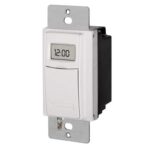
If you often forget to turn lights off when you leave a room, timer light switches can be great energy savers.

They can also increase safety, allowing your lighting to turn on and off automatically, and to give the appearance that someone is home when you’re away.
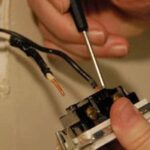
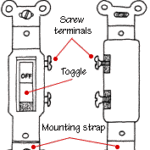
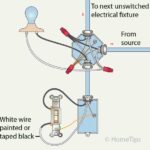
Timer light switches are designed to replace conventional light switches—you just remove the standard switch and install the timer switch in the same electrical box.
In this article, we discuss timers generally used for indoor applications. For information on outdoor varieties, see Energy-Efficient Outdoor Lighting.
Types of Timer Light Switches
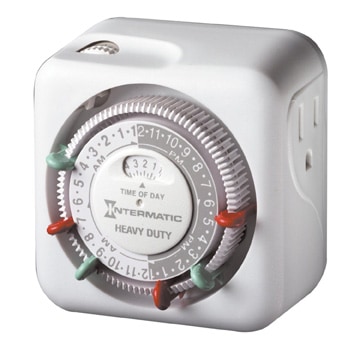
Electronic and mechanical timers are made as both switches and plug-in modules.
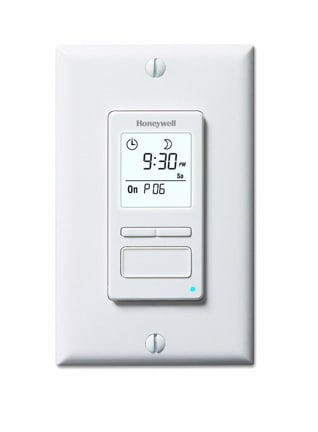
Electronic programmable timer switches are digital devices that have up to seven daily “on” and “off” settings, as well as a random setting that mixes up the times your lighting turns on and off while you are away, making it seem more probable to intruders that someone is home. Electronic switches are far more versatile than mechanical timers but can be a little more challenging to program.

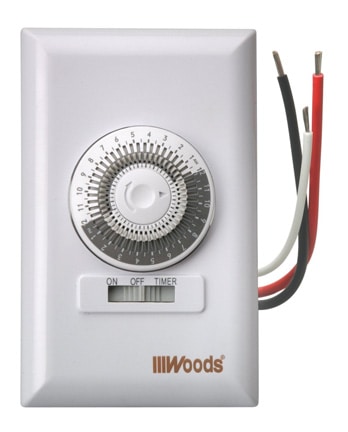
Mechanical spring-wound timer switches have a dial that you wind to turn on a fixture. Depending on where you twist the dial, you can set the light to stay on anywhere from one to 60 minutes. This type of timer is often used for bathroom heat lamps or fans.
Plug-in timers. If you want to automatically turn on a lamp or two but you don’t want to replace a light switch with a timer switch, you can opt for a simple timer that plugs into a wall outlet and controls lamps that are plugged into it. Or you can buy a screw-in timer that fastens directly into a lamp’s light socket—you insert a bulb into the timer itself.
Buying the Right Timer Switch
To purchase the right timer for your lights or fixtures, be aware that all switches have wattage ratings—you must add up the wattage of the light bulbs and appliances the switch will control, and then be sure the switch is rated to handle that total.
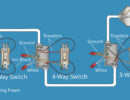
Also consider the lighting configuration: Most switches will work with standard single-pole switch setups, where one switch controls lights. But not all will work as three-way or four-way switches, where lights are controlled from two or more locations, such as from opposite ends of a hallway.
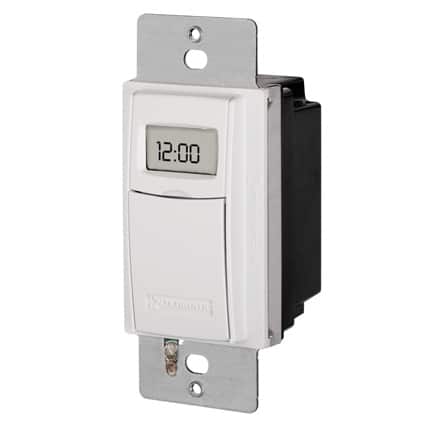
Next, consider the types of lights or devices the switch will handle. If you’ll be controlling fluorescent lights, compact fluorescent bulbs, LEDs, or low-voltage lights, you’ll need a special switch that can handle these types. Be aware that some timers will work for lights but not for motors, such as bathroom fans.
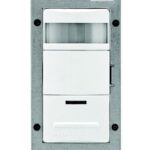
You can buy any of the timer light switches shown here—and many more—online, at major home improvement centers, or from lighting retailers. Both mechanical timers and electronic timers tend to cost from $25 to $50, though some mechanical switches are priced as low as $12, and you can buy plug-in receptacle timers for about $8.
For information on wiring switches, see How to Install a Light Switch. Or, if this job is beyond your skill level, get a pre-screened local electrical pro.