Lightweight Solid Concrete Blocks

For environmental friendliness, no other building material quite compares to concrete block.
The utilitarian concrete block has gained new respect in recent years. Now called “concrete masonry units,” or “CMUs,” blocks are used increasingly as substitutes for conventional wood-framed, above-grade exterior walls.

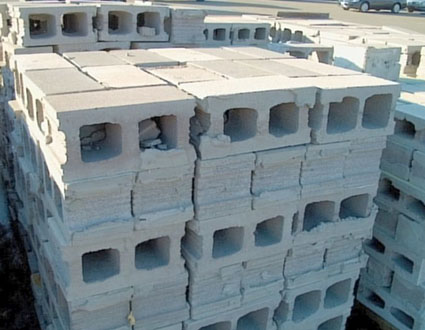
Concrete masonry construction may cost slightly more, but builders and homeowners like its durability, strength, and heat-retention qualities. Insulation can be foamed or inserted into the hollow cores or applied as a rigid board to the surface to increase resistance to heat flow.
Concrete block won’t burn, rot, or be eaten by termites. And it produces a wall that is secure, sound-deadening, and effective at reducing thermal swings. “If you want permanence, security, resistance to fire, wind, and insects, you ought to consider concrete masonry,” says a spokesperson for the National Concrete Masonry Association. In addition, “concrete masonry has a life that extends into the hundreds of years. It is still one of the most environmentally friendly products on the marketplace.”
The cost of concrete-block construction varies from one region to the next. A concrete-block house can run from 5 percent to 10 percent more than a wood-frame house where builders aren’t familiar with the material. The blocks themselves cost from 60 to 90 cents each.
Lightweight Solid Concrete Blocks
Successfully used to build houses in Europe for many years, “precast autoclaved, aerated concrete” (PAAC) blocks are now being manufactured in Georgia by Matrix PAAC, LP (formerly Hebel Southeast). This building system employs an over-sized, lightweight solid block that is laid up with very strong, thinset mortar.
During manufacture, the raw material is mixed from cement, fine aggregates, and a natural expansion agent. Once molded, it is given a moisture and heat treatment under pressure, called autoclaving. As a result, the material rises like bread dough, with thousands of tiny air pockets. The resulting block is durable, lightweight, and a relatively good insulator. Even more impressive is the fact that it can be cut and drilled like wood, using ordinary carpentry tools, and receive nails or screws.
Technically, these blocks have an insulation value of about R-10, but a wall built of these effectively offers about three times that because it blocks air infiltration and provides thermal storage mass.
The 8-by-8-by-24-inch-long blocks weigh about 28 pounds (conventional poured concrete weighs about 150 pounds per cubic foot). They’re laid with a tiny, 3mm mortar joint between blocks; the latex mortar is troweled on like a thick paint.
Cement-based stucco can be applied directly to the block surface. Or the block wall can be finished with any conventional siding on the exterior or drywall over furring strips inside. Channels for wiring are carved out with a router.
This system is currently available only in the Southeast. Finished inside and out, this system runs about $2.50 to $3 on average—about 1 percent to 5 percent more than conventional wood-stud or masonry construction with insulation but, as a Hebel spokesperson points out, “It’s like buying a good HVAC system—you get a return on your investment over time.”