Take advantage of soundproofing techniques when doing remodeling or new construction. Includes batts, construction techniques, and more.

As discussed in the article 8 Soundproofing Secrets for a Quieter Home, you can employ a variety of soundproofing measures to minimize the problem of household noise. That article looks at options you can use after your home is built. Here we look at soundproofing measures that are best done during construction.
When thinking about soundproofing, it’s important to clarify whether you’re trying to block noise or sound—for example, from your neighbor’s sound system—from coming into your room or home, or whether you’re trying to improve the quality of sound (or reduce the noise) within a space, such as a recording studio or home theater.
Soundproofing materials and sound blockers keep noise from traveling through walls and floors from one space to another. Sound blockers are typically hard, heavy, thick, or—in some cases—flexible materials that reflect noise. To keep noise from entering a room, they are typically installed in walls, ceilings, floors, and doors.
Sound absorbing materials and methods keep noise from bouncing around inside a room, improving sound quality in a room. Sound absorbing materials are typically porous, lightweight, and soft to the touch—foam panels are a familiar form. Because they are often applied to surfaces as a finish material, they come in a variety of colors and styles.
Understanding sound ratings. The ability of a material to block sound is measured by an Sound Transmission Class (STC) rating, whereas sound absorption is measured by a Noise Reduction Coefficient (NRC) rating or a Sound Absorption Average (SAA). In both cases, the higher the rating, the more effective the product.
As a standard for comparison, a “paper-thin” house interior wall with 2-by-4 studs and 1/2-inch drywall on both sides has an STC of from 15 to 33, depending upon construction and whether it contains fiberglass insulation. Partition walls in many condos or apartments with double 2-by-4 stud framing typically have STC ratings from 40 to the high 60s, depending upon drywall layers and insulation.
Soundproofing Insulation
During building or remodeling, an effective and affordable way to improve the soundproofing performance of walls and ceilings is to put batt or blanket insulation between studs or joists. This absorbs the sound that would otherwise easily travel through the air pockets between wall framing.

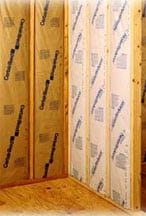
Major insulation manufacturers, including CertainTeed, Johns Manville, Knauf Fiber Glass, and Owens-Corning, market 3 1/2-inch-thick fiberglass or rock wool batts specifically for this purpose. They are both excellent at absorbing the sound that would otherwise travel through the air.
Designed to fit between studs, acoustic batts are 14 1/2 inches or 22 1/2 inches wide and 3 1/2 inches thick. Most are the same as R-11 or R-13 insulation batts.
Kraft-faced batts are friendliest to handle and easiest to fasten in place (a vapor barrier is not needed for interior walls). They should be installed tightly between framing members, and snugly around pipes, electrical boxes, wires, and heating ducts with as few hollows or gaps as possible.
Leaving only a small portion of a wall or ceiling uninsulated can dramatically reduce its sound-reducing performance. Batts can be friction-fit in wall cavities; if temporary support is needed, two or three bands of drywall tape may be stapled horizontally across studs. In ceilings, batts should be installed just above the backside of the ceiling material.
Sound Wall Construction
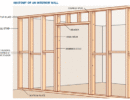
Boosting the sound-blocking performance of walls and ceilings to higher STC levels calls for additional measures during wall construction. Here are a few options:
Metal wall studs. Using metal wall studs helps; the same wall, built with 2 1/2-inch metal studs, yields an STC rating of 45.
Two layers of drywall. Another way to achieve better performance is to apply a second layer of 1/2-inch gypsum wallboard to one side of the wall. This gives the surface more mass, making it less prone to vibrate and transfer sound waves. Adding this layer to one side of an insulated wall increases the STC rating to 40; adding it to both sides pushes the STC to 45. Using 5/8-inch-thick gypsum wallboard is even better for soundproofing.
Sound isolation systems. An even more effective way to build an interior wall is to mount 1/2-inch gypsum wallboard on special resilient channels or clips that across the wall. These channels or clips absorb sound so it isn’t conducted through the wall studs, resulting in an STC rating of about 46. Typically, the drywall is screwed to a flange on the channels, not to the studs. Combining insulation, channel-mounted wallboard, and a dual layer of 1/2-inch gypsum on one side achieves an excellent STC rating of 52.
This video shows how to install drywall on the CertainTeed noiseproofing clip system:
Staggered wall studs. In roughly the same category is a wall with staggered wall studs. Though this requires more labor and framing material, a wall of 2-by-4 studs, staggered along 2-by-6 bottom and top plates with two thicknesses of fiberglass insulation, produces an STC of about 50. Because the wall surfaces are each fastened to an independent set of studs, noise can’t travel through the studs from one surface to the other.
Fireblocking. Where codes and safety allow, consider eliminating fireblocking in interior walls; these short blocks, mounted horizontally between wall studs, transmit noise readily from one wall surface to the other. If you’re thinking about doing this, be sure to check with your local building department.
Mass Loaded Vinyl (MLV) barriers offer a serious step-up, with an STC addition of about 32. Made of high-density organic sands and salts, as well as minute metal particles, these 1/8 to 1/4-inch-thick products are sold in 4-by-8-foot sheets and 4.5-by-20-foot rolls. At about 2 pounds per square foot, they are heavier than they look.
The following video shows how to install Acoustiblock, one of the available MLV systems. Note: Some products are adhesive backed for easy installation.
Ceiling and Floor Construction
A floor-ceiling construction that produces an STC of 53 is achieved by mounting 1/2-inch gypsum wallboard to resilient channels fastened to 2-by-10 ceiling joists with 3 1/2-inch-thick batts between the joists. In this scenario, the floor above has a plywood subfloor, particleboard underlayment, carpet pad, and carpet.
Featured Resource: Find a Local Soundproofing Contractor