Expert advice on septic tank problems, including how a septic tank works, and tips on septic tank pumping and replacing a failed septic tank.

Although sewers serve most city and suburban homes, many homes in small towns and remote areas rely on septic tanks for on-site treatment of waste water. In fact, according to the National Onsite Wastewater Recycling Association (NOWRA), nearly one-third of the U.S. population rely on septic tanks.
For homes that utilize septic tanks, the septic system arguably may be the most important part of the inner workings—just ask any homeowner who has had septic tank problems or failure.
The septic system should responsibly remove and dispose of all waste material from the home. As an organic machine, it breaks down wastes and, when working right, safely distributes the processed effluent into a drainfield on the property.
More than 1 trillion gallons of waste flow through septic systems each year. Considering that volume, the environment and public health rely on tanks operating correctly. Malfunctioning tanks can pollute ground and surface water with dangerous bacteria. Consequently, in developing countries, this type of contamination is responsible for outbreaks of disease, including hepatitis A, typhoid, and gastrointestinal illness.
As a result, proper maintenance is essential, and a full understanding of how your septic system works can put you way ahead of the game in avoiding septic tank problems.
Below you will find information on various septic tank and septic system issues, illustrated diagrams of how a septic system works, and helpful advice on buying a new septic tank.
How a Septic Tank Works
A septic tank separates and processes wastes. From the waste that flows into the tank, heavy solids settle to the bottom, forming a layer of sludge. Greases, oils, and lighter solids rise to the top, creating a layer of scum. The area between these two layers fills with liquid effluent that can flow through the outlet pipe to the drainfield system.

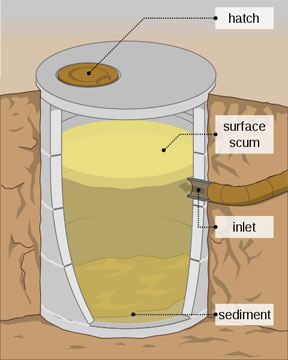
Inside the tank, anaerobic and facultative micro-organisms feed on the solids in the sludge and scum, breaking down their volume. This process creates gases—carbon dioxide, hydrogen sulfide, and others—that exit through the vent stack at the roof.
The proper size of a septic tank relates to the number of bedrooms in a house. The tank will typically store solids for three to 12 years. The tank should be watertight—built so that groundwater cannot leak into the tank and seepage cannot leak out. If groundwater leaks into the tank, it will raise the dissolved oxygen level in the tank, which will inhibit the biological treatment, cause septic tank problems, and lead to early failure of the drainfield.
The Septic Drainfield
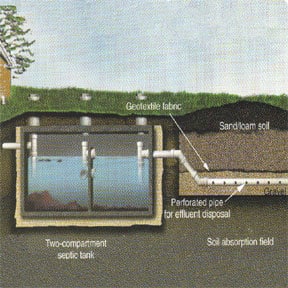
The drainfield should disperse a septic tank’s effluent. Many drain systems have a series of trenches that branch out from a distribution box. Some have a single, larger bed. Others have a seepage pit or a similar means of distributing tainted water back into the ground (the right one for your home depends on local codes, conditions, and practices).
The absorption qualities of the soil dictate the drainfield’s design. To gather information on how readily the soil will absorb water, a soils engineer or septic contractor conducts ‘perk’ (percolation) tests by digging holes in several places in the yard and filling them with water.
A conventional gravel-and-pipe drainfield begins with a level-bottom trench located from 1 to 3 feet beneath the ground, but at least 2 feet above the groundwater table. A perforated drainpipe runs along the center of the trench over 6 to 12 inches of gravel. A few more inches of gravel cover it.
A silt barrier—a synthetic fabric—covers the gravel and pipe, rejecting silt and soil, and then soil backfills the trench. Once effluent reaches the drain system, the gravel and soil act as a natural filter to strain and remove harmful bacteria, viruses, and other toxins so the water is clean by the time it reaches groundwater sources.
A newer type of drainfield system, made by Infiltrator Systems, utilizes a series of lightweight plastic chambers instead of pipe and gravel. These are easy to use and treat more water with greater efficiency.
The 3-by-6 1/4-foot ribbed sections fit together and run along a 3-foot-wide trench. A special end plate caps the end of each run. You insert the inlet pipe into the main section, and backfill the trench.
Septic Tank Pumping & Care
It pays to care for your tank (see What Not to Flush, below) and invest in septic tank pumping periodically so the necessary bacteria don’t die, shutting down the biological machine. When this happens, sludge builds up and flows into the drainfield, where it clogs up the system. Before you know it, you have a sewage backup, septic tank problems, and a major headache.
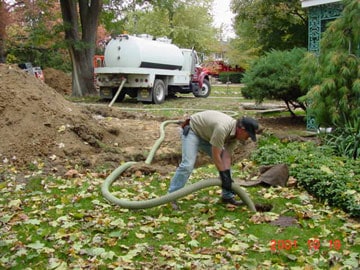
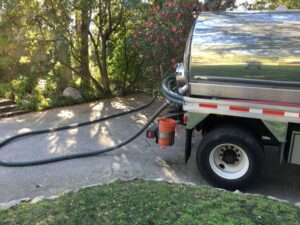
Because only a portion of the sludge and scum are broken down (about 40 percent), a septic tank must be pumped periodically.
Otherwise, accumulated solids fill the tank and flow out into the drainfield, where they hinder the soil’s ability to percolate.
Frequency of pumping depends on the size of the tank and the number of people using it. Most tanks require pumping every 3 to 5 years.
Don’t wait too long. You cannot pump the drainfield. If the drainfield is ruined because you pump the tank too infrequently, you may have to install a new septic system at the cost of several thousand dollars. With proper care, a system should last well more than 20 years.
Where Is the Septic Tank?
You’ll need to know where your septic tank is buried for inspection and pumping, and so that you can avoid driving over the tank or leachfield with heavy equipment or doing other work that might damage the system.
If you don’t know where it is, you may be able to obtain records from your town or city hall. Otherwise, you can hire a septic contractor, who may find it with an electronic detector or by probing the soil with a long metal rod.
Once you’ve located your septic tank, make a map that shows its location and put the map where you’ll be able to find it in the future. In addition, mark the tank’s location with a permanent stake or stone.
Tank Inspection
Have your tank inspected by a septic tank professional every three to five years—more frequently if your family uses a lot of water and a garbage disposer. You can reduce the strain on your septic system by using less water and staggering showers, clothes washing, bathing, and other heavy usage.
What Not to Flush
Be aware that what you flush or wash down the drain can damage the system. Don’t flush dyed or heavy toilet tissue or paper towels, feminine hygiene products, condoms, or disposable diapers.
Though some disinfectants, ammonia, and cleaners are not likely to significantly damage a system, avoid washing quantities of chemicals—particularly chlorine bleach—into the system.
Never pour chemical drain cleaners, solvents such as paint, motor oil, pesticides, poisons or chemicals into drainpipes. Minimize use of a garbage disposer and don’t put fat, grease, or coffee grounds into it.
Beware that commercial flush-down septic treatments may not work and, in fact, may damage it. They can promote the flow of sludge into drain lines, clogging the drainfield. Before using such a product, check with your health department to see if it has received state approval. Periodic inspection and pumping of your septic system are the best ways to ensure it operates for many years.
Septic Tank Problems or Failure
Take some of these steps if your septic tank continually displays problems or is clearly in full failure mode.
To Minimize the Strain on Your Septic System
• Increase the size of the absorption field. This will help if the original field was too small for the size of your family or if the soil does not allow water to percolate very well.
• Conserve water in your home on a long-term basis. The smaller the amount of water flowing through your system, the longer the system will last. For systems that perform marginally or leak nutrients into nearby lakes and streams, this is a good alternative.
• If periodically saturated soils are a main cause of problems, consider installing perimeter drains. This system involves installing tile drains underground at a specified distance around the absorption field to help lower water levels. This works in some but not all situations and requires the assistance of a qualified contractor. Your system’s location should also be evaluated by your local health department.
• Connect to a community sewage system, if one is available. Although the long-term costs may seem high, the benefit of reduced worry is often worth the price.
• If septic system failures are common in your area, consider participating in the development of alternatives. There are systems designed for small communities and some rural areas that are generally much more cost-effective than large sewer systems.
To Deal with Septic Tank Failure
• First, call your local health department. Health department staff members can expertly assess your situation quickly and offer advice on how to cure the problem.
• Have your septic tank pumped. This will help the problem temporarily. The empty tank can hold several days of waste. Pumping won’t solve a problem created by a clog located between the house and the septic tank. Neither will it help if very high groundwater levels are causing the problem.
• Conserve water. If your system has not failed completely, using less water can help lessen the problem for a short time. Water-saving devices and reduced consumption, especially in your bathroom, can have a significant effect.
• Fence off the area. If liquid waste is seeping to the surface, prevent people and pets from getting in contact with the toxic effluent.
Tips for Buying a New Septic Tank
In many cases, redesigning and replacing the system in a new location is the only practical long term solution to chronic septic problems. For this type of work, hire a qualified septic contractor. Local health department usually require a permit before construction can begin.
As explained above, a septic system is a self-contained water-recycling system. Located underground in the yard, a watertight tank receives and stores wastes from the house. Bacteria in the tank decompose the waste, sludge settles in the tank, and effluent flows into the ground through a drain system. The effluent eventually filters back down to groundwater sources.
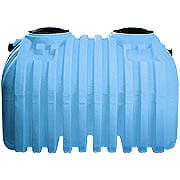
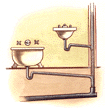
A septic system consists of a waste pipe that is connected to the house’s drain-waste-vent system, a watertight septic tank, and a drainfield (or “leachfield”) or other subsurface infiltration field such as a seepage pit or a leaching chamber.
Codes dictate the minimum distance a tank and drainfield may be located from the house or a well and the size and makeup of the tank and drainfield.
To prevent overloading the septic tank and drainfield, runoff from the roof and foundation drains and other ‘clear’ water is usually routed to a separate drain or seepage pit. Where codes permit, it’s a good idea to route water from washing machines to such a pit, too.