
This guide will teach you how rainwater collection works, a way to collect rainwater for reuse in your home. Learn about the different types of rainwater collection systems available, how to choose the right system for your needs, and how a rainwater collection system is installed.

Rain barrels and rainwater collection systems are making a stylish and functional comeback in America. With the uncertainty of climate change and continuing drought problems plaguing many parts of the country, capturing and using rain is a practical way to conserve resources.
Rainwater Collection Basics
Collected rainwater can be used for watering gardens and even for non-potable applications such as flushing toilets. Whether it is to offset high water bills in the summer, keep the garden green during drought cycles, or simply lessen the burden on storm drain systems, catching and using rain around the home makes sense.


Most homeowners use treated municipal water for drinking, dishwashing, cooking, bathing, and watering yards. In fact, it is estimated that from 8% to10% of the water used annually by Americans is poured onto gardens and lawns. But treated water is increasingly scarce and expensive, and it’s not even the best for plants—especially native plants—because it may contain fluoride, chlorine, and certain impurities. Rain provides the best, purest water for your landscape.
Assembling a rainwater harvesting and storage system can be as easy as setting up a rain barrel or investing thousands of dollars in an intricate rainwater retrieval, filtration, and storage system. Regardless of the size and complexity of the system you want, understanding the basics can make your decision much easier. And, if you intend to do some or all of the assembly, this knowledge can help you design a manageable project.
The amount of rain you can collect in a rainwater collection system is determined primarily by the rainfall in your region and the size of your roof. The accepted rule of measurement is to determine the cubic feet of water that will fall on your collection surface and then convert the cubic feet to gallons by dividing the monthly average of rainfall by 12.
Once you have that number, simply multiply it by the square feet (width x length) of the roof. The equation looks like this:
Inches of rain ÷ 12 x square feet of collection space = gallons of water
So, by measuring the size of the collection area (that part of your roof that will drain into your storage container) and finding out the local monthly average rainfall, you will be able to figure out how fast your storage containers will fill up.
For example, Los Angeles receives, on average, .72 inches of rain in the month of April. With a 60-by-30-foot collection surface (1,800 square feet), a Los Angeles homeowner can expect to collect about 108 gallons in April. However, during the month of July, when rainfall averages only .01 inches, the same system will collect less than 1 gallon of water. Having a storage system that can hold several hundred gallons of water can help that homeowner make it through the dry season without having to use municipal water.
Equipment for Rain Water Collection
A full rainwater harvesting system consists of several parts that together capture, move, and store the water. Perhaps the most important of these is the collection system.
Fortunately, homes already have a rainwater retrieval system in place—the roof, gutters, and downspouts. Equally fortunate is the fact that tying into this system is easy and affordable, which is why most rainwater harvesting systems are designed to capture water that falls on roofs. Of course, rainwater can be harvested from other areas, too, such as driveways, open-air patios, and other non-permeable surfaces.
Storage containers are really where spending the money matters in a rainwater harvesting system. The more water you want to store, the more expensive the system will be. In arid areas where rainfall is light and drought is common, large storage systems that may include underground storage tanks or large cisterns can be expensive but well worth the money.
If water falls often in your region, you might consider a smaller system to handle your watering needs during the occasional dry spell.
Aesthetics play an important part of selection, as well. If you are seeking the classic look, you can readily find used whiskey barrels online.
Make sure that rainwater collection devices are covered and tightly sealed. This helps minimize mosquito populations and prevent them from becoming a drowning hazard to small children. Also, tightly lash or stake your storage device to the ground so that it won’t easily fall over. One gallon of water weighs over 8 pounds, so even a half-full 55-gallon drum can be a crushing hazard.
If you want your system to last, it must be drainable for winterization. Water expands when it freezes—one cold winter can spell the end to your whiskey barrel. Likewise be wary of a storage device that doesn’t allow you to easily clean it. Even with mesh screens and filters, chances are good that dirt and debris will eventually make their way into your container. Being able to completely empty the storage unit will allow for easier cleaning.
Rainwater Filtering & Distribution
With a rainwater harvesting system, once you have filtered water in the storage tank, there are three ways to get it out—with a hand pump, electric pump, or gravity.
Most of the rainwater storage tanks available to homeowners come equipped with a standard garden spigot near the bottom of the tank where you can quickly hook up a garden hose (this is the option that takes advantage of gravity to provide the necessary pressure for watering).
But for larger irrigation systems or systems where most water is stored below grade, a pump—either hand or electrical—is generally required to get the water out of the storage tank.
A hand pump saves on energy (except for the human kind), while an electric pump include costs for materials, installation, and operation. On the other hand, an electric pump will enable you to water plants in a raised or hanging location without a struggle.
For standard roof-collecting systems, gutters are the first part of the conveyance stage. Almost all residential systems rely on gravity to move the water. This means that from the point where the rain lands on the collection surface to where it is deposited in the storage tank, the water must flow downhill.
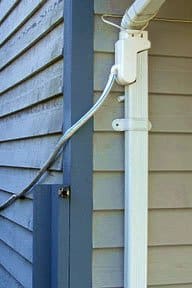
The most common place to tap into a conventional gutter system is at the downspouts. From there, water can be diverted directly into a rain barrel or storage container. You can either cut the existing downspout and attach it directly to a filtering device or install downspout diverters that allow for more flexible rain barrel placement.
Once the barrel is full, excess water must be directed down and away from the house, so the system must accommodate this. A helpful product for this job is a rain barrel diverter spigot that is designed to divert excess water when the container is full.
How do you clean the debris out of rainwater that you want to use for watering your lawn or garden? Even though rainwater is relatively free of chemicals and toxins when it leaves the clouds, it can be plenty dirty by the time it gets to a rainwater storage container.
Any dust, leaves, bird droppings, or bugs on your roof will likely be washed into your conveyance system (the gutters and downspouts) with the first strong storm. Keeping your storage tank free of this gunk is critical if you want to maximize water pressure and the longevity of the rainwater system.
A simple metal mesh screen is ideal for filtering out larger debris, and a second fine screen at the mouth of the storage tank will help keep critters out of your watering supply. Be sure that the filtering screens are readily accessible to make cleaning and maintenance easy.