
Expert advice on how to fix a dehumidifier that’s not working, does a poor job of dehumidifying, or has other problems.
Some homes—especially those without air conditioning—rely on a dehumidifier to reduce uncomfortable, muggy humidity in room air. A dehumidifier uses refrigeration principles the way an air conditioner does, to pull moisture out of the air. But it doesn’t cool the air—in fact, it warms it slightly. If your dehumidifier doesn’t work right, a simple cleaning of its condenser and moisture-collecting (evaporator) coils may be all that’s necessary to fix it. Then again, it may take a bit more—that’s what this article will walk you through.
How a Dehumidifier Works
A dehumidifier is a box that contains cold evaporator coils, warm condenser coils, a fan, and a reservoir or drain to catch water. The fan blows moisture-laden room air over the cold coils, where water condenses and drips into the pan or drain. The drier air then blows across the warm coils and back into the room.

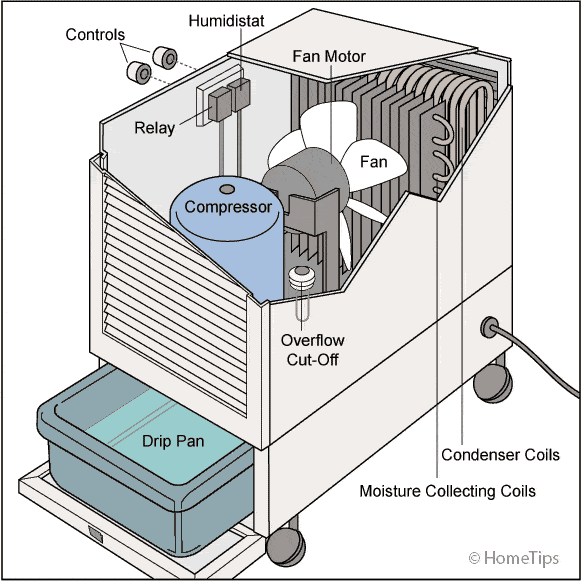
Although a dehumidifier does not cool the air, it makes it more comfortable because it decreases the humidity. But a dehumidifier does not function well under about 65 degrees F. A dehumidifier’s fan must have electric power, the evaporator coils must contain a proper charge of refrigerant, and the controls must work for the dehumidifier to operate. In the same way that a thermostat controls a heater or air conditioner, a dehumidifier is cycled off and on by a humidistat that measures a room’s humidity.
How to Repair a Dehumidifier
Here’s how to fix a dehumidifier that shows no signs of life whatsoever:
1 Check the power. Be sure it is plugged into a working outlet and is turned on.
2 Unplug the dehumidifier unit and check the power cord. If necessary, replace the appliance power cord.
3 Remove the cover panel and look for ice. If you see any ice blocking parts, let the ice melt and do not use the unit until the room temperature exceeds 65 degrees Fahrenheit (most dehumidifiers are not designed for use in colder spaces and may freeze up). Many people find that by unplugging the unit and waiting about 30 days into the season the problem is solved.
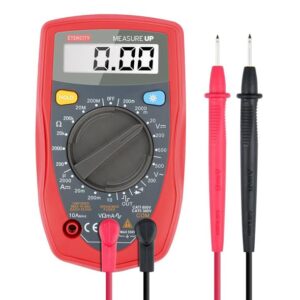
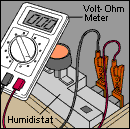
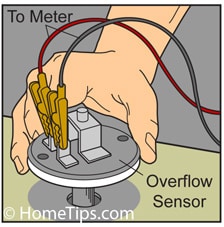
4 Remove and test the overflow cutoff switch. You can do this with a volt-ohm meter. Clip the leads to the terminals on the switch. Depress the bar or trip lever on the switch. If the meter’s needle does not show continuity and also no continuity as the switch is clicked back and forth, the switch is probably faulty and will need to be replaced.
5 Remove the humidistat and check it. You can test a dehumidifier humidistat fairly easily using a volt-ohm meter. Also using a volt-ohm meter, you can tell if the overflow switch works or not. Just set the meter to the RX1 scale and attach its leads to the humidistat’s terminals.
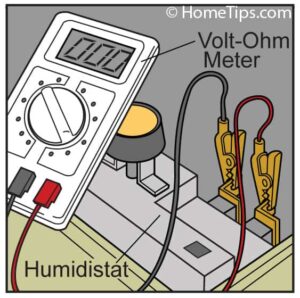
Rotate the humidistat’s knob as far as it will turn in both directions. If the volt-ohm meter registers zero ohms through only part of the humidistat dial’s range, the humidistat is working. If it registers zero through the entire range, it’s broken and must be replaced.
6 If the unit still doesn’t work, decide whether you’re better off replacing the appliance or calling a repair person (this decision will depend upon the value of your dehumidifier)—the dehumidifier compressor motor or the relay and overload switch may be the problem. It’s usually best to replace the dehumidifier.
Dehumidifier Not Working Well
If your dehumidifier seems incompetent, it may be undersized for the space. Check the unit’s specifications to be sure it can handle the room size. If you don’t want to replace it with a larger one, try closing doors and dehumidifying the space a section at a time. After disconnecting the power cord, you can also:
1 Remove the cover and clean the condenser and moisture-collecting (evaporator) coils.
2 Lubricate the fan motor bearings with a couple of drops of lightweight household oil (such as 3-in-One) if the motor has oil ports (some dehumidifiers don’t need to be oiled). While you’re at it, make sure that the condenser isn’t clogged with dust or dirt.
Amazon
3 Finally, make sure your humidistat is functioning properly by testing it with a volt-ohm meter. Just set the meter to RX1 scale and attach its leads to the humidistat’s terminals. Rotate the humidistat’s knob as far as it will turn in both directions. If the volt-ohm meter registers 0 ohms through only part of the humidistat dial’s range, the humidistat is working. If it registers 0 through the entire range, it’s broken and must be replaced.
4 If it still operates poorly, call an appliance repair person for advice or take the unit into an appliance repair shop, or buy a new dehumidifier.
Dehumidifier Overflows or Leaks
Many dehumidifiers have a float switch that prevents the unit from spilling over with the water that has been drawn out of the air. Sometimes this switch goes bad and must be replaced. If your dehumidifier is overflowing, you can test the overflow prevention switch with a volt-ohm meter.
1 Unplug the dehumidifier and remove the switch.
2 Disconnect the leads and clip the leads of the volt-ohm meter to the terminals on the switch.
3 Check the pan or reservoir and empty it if necessary, or make sure the drain isn’t clogged.
4 Straighten any kinks or bends in the unit’s hose.
5 Set a volt-ohm meter to the RX1 scale (or to K-? or ? resistance on a digital meter) and depress the bar or trip lever on the switch. If the meter’s needle shows no continuity as the switch is clicked back and forth, the switch is probably faulty and will need replacement.
Dehumidifier Freezes Up
Is your dehumidifier freezing up? If your dehumidifier ices up, it’s important to solve the problem—running a dehumidifier that’s totally iced up can damage the compressor.
A dehumidifier will often frost up if room temperatures are colder than about 65 degrees Fahrenheit. Though some “basement humidifiers” are designed to work in temperatures below 65 degrees F, conventional humidifiers are not.
Buy on Amazon
If your room temperature isn’t overly cold, airflow to the unit may be restricted or blocked, the unit may have a faulty de-icer switch, the refrigerant gas in the unit may be too low, or the compressor may be failing.
To troubleshoot a dehumidifier that freezes up:
1 Take a look at your room temperature, as previously stated. If the room temperature is lower than 40 degrees F., the dehumidifier will definitely freeze up. A clear indicator of this is an evaporator coil that is frosted up completely and evenly (see Step 5 for information on opening the unit).
If you suspect that your room temperature may be too cold, try setting the dehumidifier on a table so that it circulates slightly warmer air. You can also try aiming a small blower or heater at the unit—if this solves the problem, consider raising the room temperature slightly.
2 Be sure the unit is set far enough from the wall so that airflow isn’t restricted. Anything that prevents room air from freely moving through the unit can cause the dehumidifier to freeze up. (However, do not place it in a drafty spot.)
3 Be sure the fan is working. If you don’t hear the fan blowing air across the coils when the unit is turned on and supposed to be operating, the dehumidifier will freeze up.
4 Clean the filter if it has one. If your dehumidifier has a filter, follow the manufacturer’s instructions to clean it. In most cases, you use a vacuum cleaner to do this; foam filters can be cleaned with spray from a faucet.
5 Vacuum the condenser coils. If the coils inside the unit are dirty, they cannot operate efficiently. Unplug the dehumidifier and open it up by removing the screws that secure the outer cover.
Note whether the coils are completely iced up or only partially iced up. If only certain sections of the coils are iced up, the problem is likely to be caused by low refrigerant or a failing compressor (see Step 8).
Allow all ice to melt and excess moisture to evaporate from the coils. Then, using a brush attachment on a vacuum cleaner, remove all dust buildup, being careful not to damage the coils.
6 If vacuuming the coils doesn’t do a good enough job of getting them clean, take the unit outside, cover the motor and electrical parts with plastic sheeting, and spray the coils with water. Drain the unit and allow it to dry completely before putting it back together and plugging it in.
7 Test the unit. After plugging the dehumidifier in, turn it on to see if it freezes up again.
8 Make a decision. If it still doesn’t work, it is probably low in refrigerant. Now you have to make a decision to either take it into an appliance repair shop or toss it and buy a new one.
Before taking your dehumidifier into a repair shop, get a phone estimate of the cost of recharging and/or repairing it. Then evaluate whether or not it’s worth doing. If you decide to buy a new one, please see the free Dehumidifiers Buying Guide.
Dehumidifier Smells Bad
Does your dehumidifier smell bad? If your dehumidifier stinks or smells musty or like sulfur or mold, this expert advice will help you troubleshoot and solve the problem.
Dehumidifier odors are generally caused by stagnant water that has pooled in a hose or by chronically dirty condenser coils. Though you might be tempted to clean it with some type of disinfectant or household cleaner, resist the temptation! You should not use any type of chemicals in a dehumidifier—the residue is too difficult to remove and some chemicals can be caustic.
Instead, use vinegar (its smell with be strong at first but will dissipate with time), hydrogen peroxide to clean the reservoir, coils, and filter. Use these two non-toxic chemicals in sequence, applying and removing the vinegar first, and then the hydrogen peroxide, which helps remove the vinegar’s odor.
How to Clean a Dehumidifier
After unplugging the dehumidifier, take it outside to work on it. Here’s how to clean it to rid it of odors:
1 Fill one spray bottle with full-strength white vinegar and another spray bottle with full-strength hydrogen peroxide.
2 Clean the reservoir / drip pan. Start by completely emptying it and mopping up any damp areas. Then spray the inside of the reservoir /drip pan with vinegar, allow to sit for 10 minutes, and then rinse thoroughly with clear water. Use a clean rag or new sponge to wipe it out and repeat the rinse and wipe process. Follow up with the hydrogen peroxide, following the same methods.
3 Clean the coils with an inexpensive coil-cleaning brush (available online or at hardware stores) and a garden hose. Be very careful not to damage the coils. Then spray them with vinegar and allow to sit for 10 minutes.
Rinse thoroughly with water, wipe clean, and repeat with hydrogen peroxide. Allow the unit to dry in a warm place for at least 24 hours.
4 Clean the filter. To clean a dehumidifier filter, remove it and spray it with vinegar. Allow this to sit for 10 minutes, then rinse it thoroughly and spray it with hydrogen peroxide. Let this sit for 10 minutes, rinse again, and wipe it clean with a clean cloth or new sponge.
5 Wipe the fan blades clean. Remove the cover first, then use a damp cloth to clean the fan blades and the area around the motor.
Put two teaspoons of baking soda in the dehumidifier’s tank to prevent future mildew and mold odors. In the future, empty the dehumidifier regularly so that it doesn’t have time to grow mold or bacteria.
Dehumidifier Is Noisy
Is your dehumidifier making strange noises? If it is, the noises are probably caused by loose, vibrating parts. After disconnecting the power:
1 Remove the cover and look for loose screws or vibrating parts and check to see if the rubber compressor mounts have hardened so that they no longer absorb the unit’s movement. If they have, replace them.
2 Wiggle the fan to see if it is loose on its shaft. If it is, tighten the mounting fasteners. Lubricate the motor’s bearings if suggested by your owner’s manual.
3 If it still makes noise, call an appliance repair person or take the unit into an appliance-repair shop.
Helpful Dehumidifier Video
Here’s a video that we found particularly helpful in explaining how a dehumidifier works. The voice-over is a bit robotic, but the information is good.