Expert, step-by-step, illustrated instructions for how to clear a stoppage using a drain auger.

When you have a clog in a drain, sometimes the only way to get it out is to drive it out with a plumbing “snake” (also called an “auger”). In this article, we show you how to use a drain auger to remove a clog from a sink drain. Please note, however, that most sinks have a drain pipe (called a “trap) that you can disassemble to get to the clog. This can be messy if the sink and the pipe are full of drain water, but it is often the easiest way to clear the clog because most sink clogs are due to hair and debris in the trap.
So, before you go to the trouble of snaking the drain, take the trap apart, if it is easily accessible and doing so won’t create a huge mess.
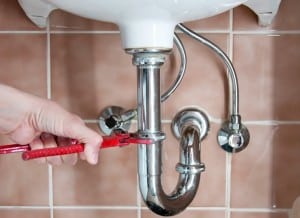
Begin by putting a bucket under the sink to catch the drain water when you open up the pipes. Then use slip-joint pliers to loosen the coupling nuts on both sides of the U-shaped trap. Once loosened, you can turn the nuts by hand until the trap comes apart.
Use a wire coat-hanger to clean out the hair and debris, if necessary, then flush the trap with a hose outdoors. Check the remaining parts of the drain pipe for any visible blockage, then reassemble the trap.

Plumbing snakes are made in two varieties: drain augers and closet augers (named after “water closet,” a plumbing term for toilet).
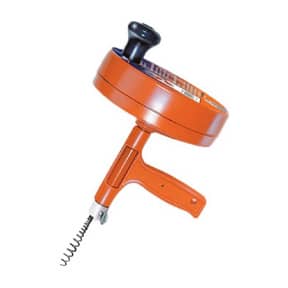
Most people are familiar with the drain auger, a long, tightly wound flexible metal cable with a corkscrew auger at one end and a crank at the other. The closet auger is a little less familiar—it’s a very short version of the snake with a rigid end that is easier to push down into a toilet.
Following are directions on how to use a drain auger for clearing a sink clog. If you’ve already disassembled the drain, skip to Step 5.
1 Wearing rubber gloves, push the cable into the drain while turning the auger’s handle clockwise. Keep repositioning the grip as you feed the snake into the drain.
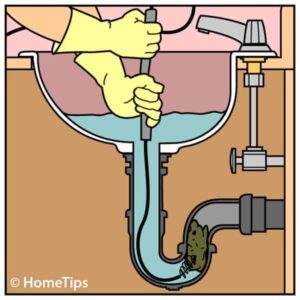
2 When you feel the auger reach the blockage, keep turning and pull back a bit to chew away and dislodge the clog.
3 Push forward again to grind away and, eventually, drive the auger through the clog.
4 If possible, pull the blockage out through the pipe. At this point, the job becomes messy, so have a bucket ready and pull the cable back through a heavy-duty rag.
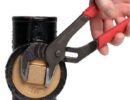
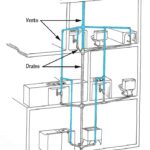
5 If this doesn’t work, try to find a branch clean-out (a sanitary-T fitting with a plug in one fork, located along the drainpipe that runs from the fixture to the main soil stack, often visible in a basement or crawlspace). With a large bucket under the clean-out, slowly back out the plug with a wrench. Be ready: Water and waste may gush out.
6 Run the drain auger in through the branch pipe as described in steps 1 through 4. If there doesn’t appear to be a clog in the branch, the blockage may be in the main waste and vent stack or in the sewer line.
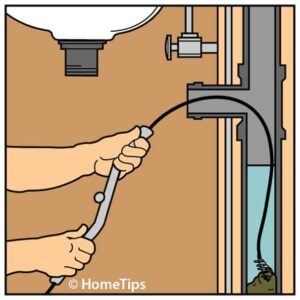
7 You can try to find the main clog and repeat this snaking effort, or you can try running an auger down the vent stack from the roof, although you’ll probably have to rent a long, motorized drain auger for this job. In most cases, it’s better to call a drain-clearing company or a plumber.