This guide will teach you how to plant hedges, a great way to add privacy and beauty to your yard. Learn about the different types of hedges available, how to choose the right hedges for your needs, and how to plant and prune hedges yourself.

Hedges are living walls. Formed by shrubs or small trees, they can be used to block views, delineate boundaries, create garden rooms, or serve as a backdrop for other plantings. Depending on the plants you choose, hedges can be formal with a mass of green foliage or wildly exuberant and covered with blooms.
Foliage, whether accompanied by flowers or not, defines hedges. Plants that make good hedges have close-set branches with lots of leaves that start at ground level and continue to the top of the plant.

Most hedges are evergreen. If you don’t mind or actually want bare branches or complete dieback in the winter, though, you can find good hedge plants that are deciduous.
Hedges fall into three categories: formal, semiformal, and informal. Each has its own place in garden design, and each has its own requirements for pruning and training.
Formal Hedges
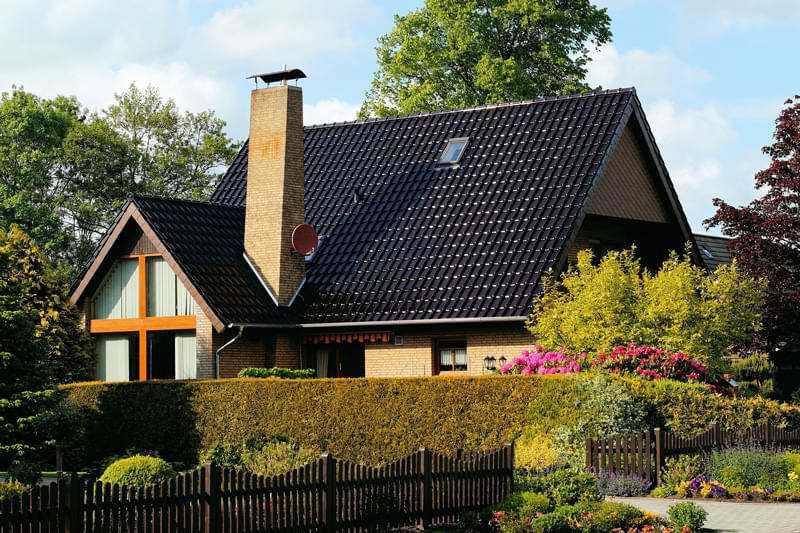
Formal hedges are the neatly trimmed, symmetrically shaped perimeters that most people first think of when they hear the word “hedge.” These hedges are created from a single species or variety with a dense growth habit of small leaves. They can range from just a foot high to well over 6 feet tall. The overall impression is of a solid block of greenery rather than a single plant.
Boxwood (Buxus) is the classic plant for a formal hedge, but other choices include barberry (Berberis), hemlock (Tsuga), holly (Ilex), and yew (Taxus). Bamboo can also be a formal hedge choice, but you will need to buy a clumping variety and keep it well in check.
Semiformal Hedges
Semiformal hedges are also usually composed of a single species or variety of plant. The difference is that the leaves are generally larger and stand out as individuals rather than a mass, and the overall plant form is somewhat less rigid. English laurel (Prunus laurocerasus), firethorn (Pyracantha), and photinia are all good choices.
Informal Hedges
Rather than having a rigid, geometric shape, informal hedges are casual, creating a barrier that may change from tall to short and from wide to narrow. This style works well in natural and cottage gardens, with their emphasis on loose form and a mix of plants. In fact, mixing a number of different hedge plants is a good way to create an informal hedge—a good choice for flowering plants, as they can be pruned and shaped so flower production isn’t inhibited.
Small, informal hedges can be created from lavender (Lavendula) or santolina; medium informal hedges may consist of junipers or weigela; taller hedges might be comprised of oleander (Nerium oleander), osmanthus, or photinia.
Hedge Buying Considerations
Because hedges are grown from shrubs or trees, you’ll find them sold as bare-root plants, as balled-and-burplapped (or b-and-b) plants, with their roots surrounded by soil and wrapped in burlap or mesh, or in containers. The first two are usually sold in late fall and early spring; plant these as soon as you buy them.
Keep in mind that while the combination of roots and soil that form the balls of b-and-b plants can be heavy, the roots themselves are delicate. Handle these plants with care when moving them. Container plants can be put out at any time the ground can be worked, but try to avoid planting during the heat of the day or during a hot spell to avoid stressing the plant.
Choose plants with strong stems and good root systems. For b-and-b plants, whose roots are not visible, be sure the roots are not exposed and the root ball is firm and moist. Container plants should not be root-bound nor too leggy.
Hedge Planting Basics
When you’re planting a hedge, you’re planting multiple plants. One of the most important considerations is how far apart to space them. Too close and the mature plants will be entangled and won’t grow well. Too far apart and you’ll have gaps. The rule of thumb is to plant slightly closer together than you normally would. For instance, if you normally plant 3 feet apart, plant 1 to 2 feet apart instead. If spacing would normally be 6 feet, go for 4 feet.
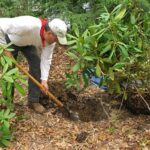
Start with a hole that is twice the width of the roots of the plant and slightly shallower than the root system. Taper the sides of the hole outward slightly at the bottom, and then dig deeper around the edges at the bottom of the hole to allow room for the roots to grow downward and to prevent the soil from settling. Shape the soil in the center of the hole into a rounded cone, which will serve as a base for the plant.
Soak a bare-root plant in water for four hours before planting. Situate the plant so the top of the rootball is slightly above the surrounding soil. Spread the roots over the cone and downward. Hold the plant in place and then begin filling in the hole with the soil you removed. Make sure the soil is firmly in place as you fill in the space.
When the soil is about 4 inches from the top, add water to settle the soil in place. If the plant starts to settle, add more soil under it until it is again at the proper height above the soil. Finish filling in with soil, and then water again. Don’t overwater; the soil should be moist but not soggy.
Pruning & Trimming Hedges
All hedges will require some pruning to remove dead and diseased wood and wayward branches. Other than that, the style of hedge and the plants themselves determine how you prune to shape the hedge.
For a formal hedge, prune deciduous plants back to about half their size in fall, to encourage growth in the lower part of the plant. Fast-growing evergreens with broad leaves can also be pruned back at this time, though not as severely. Small-leafed evergreens don’t need to be cut but can be shaped by pinching or removing branches that are growing out of bounds.
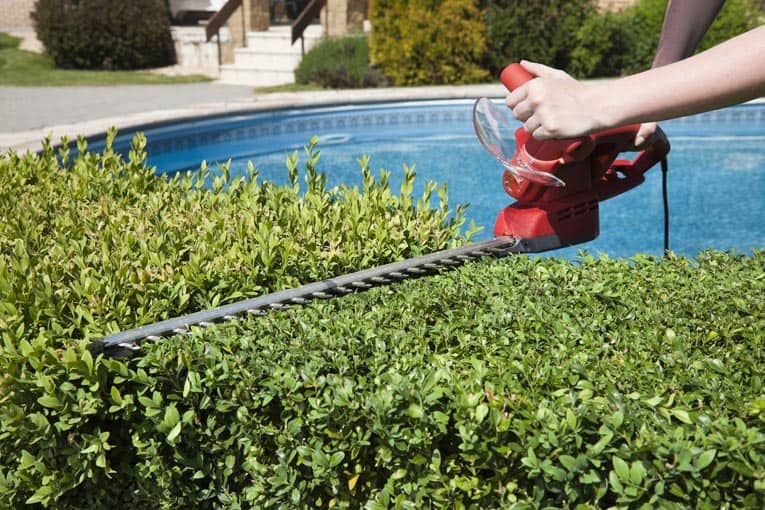
Once established, formal hedges should be pruned while growing in spring. The plants don’t need to be individually cut. Instead, shear the sides and top with hedge clippers or a hedge trimmer to create your final desired shape.
Common shapes include rectangular, cone-shaped, or rounded. In any case, taper the sides so they are wider at the bottom than at the top. This will allow sunshine to reach the lower branches and prevent them from thinning out. Fast-growing plants may need to be pruned again before midsummer, and you’ll always want to remove any wayward branches.
Semiformal hedges are pruned at the same time as formal hedges. Shearing isn’t good for these plants as it will leave bare spots and exposed cuts. Instead, use pruning shears to cut individual branches.
Informal hedges don’t need to be pruned after planting; instead, periodically pinch-back the tips to keep the plants bushy. You may need to continue pinching the second year as well. Beyond that, prune as needed, following the regular recommendations for the individual plants.