Clothes Dryer Troubleshooting & Repairs
Most dryer problems are simple matters that can be fixed by even a moderately skilled do-it-yourselfer.

By +Don Vandervort, HomeTips

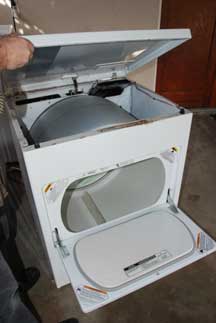
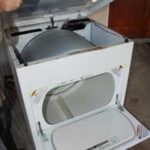
Though the idea of repairing a clothes dryer might seem intimidating, the truth is that some types of repairs are surprisingly easy. Yes, dryers appear to be built like huge, impervious metal boxes, but they are typically pretty easy to open (see How to Open a Clothes Dryer for Repairs) and relatively simple to fix.

A clothes dryer has a motor that turns a big drum containing the clothes, a heat source for blowing warm air into the drum to dry the clothes, and controls for operating the motor and the heat source. Some dryers have an electric element to do the heating while others utilize a gas flame.

Clothes dryer problems generally occur because the heat source doesn’t heat properly or the motor fails to turn the drum. If a gas dryer doesn’t dry properly, first check the pilot light or igniter—it may not be lighting the burner. Second, check the dryer’s vent—if it is clogged with lint, the heating system won’t work properly.

Pay attention to basic safety measures when working on a dryer. Always unplug the dryer and turn off the gas to a gas dryer at the appliance shutoff valve.

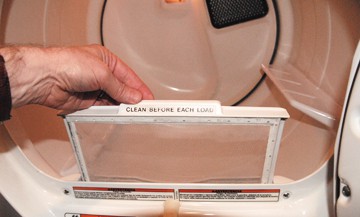
As with most appliances, maintenance will keep your dryer purring. Clean the lint trap after every load, and clean the vent system once a year.

Following are instructions for solving specific problems:
 
Dryer Takes Too Long to Dry

A dryer taking too long to dry is most often caused by the vent being blocked with lint. Dryers need to be properly vented or the moisture can’t be carried away. 

Vents that go out the roof are particularly problematic—the dryer may take far too long to dry clothes, and the vent pipe may even drip water that can’t be exhausted. The minimum size for a dryer’s roof vent is 4 inches. If your dryer is chronically poor at drying, if possible have the vent moved to where it exits a wall near the dryer.

For most drying problems, take the following steps:

1) Check and clean the lint trap.

2) Be sure the dryer isn’t pushed so close to the wall that it pinches off the airflow through the vent’s air duct hose.

3) Check the point where the air duct vents away from the house. Be sure plants or other objects have not blocked it. If the duct vents out the roof, it could easily be blocked with lint.

4) Disconnect the air duct hose from the back of the gas dryer and clean out built-up lint. For safety, first turn off the gas to the dryer, and then unplug the dryer; this means you will have to relight the pilot light (if the dryer has one); read your owner’s manual for the proper relighting method.

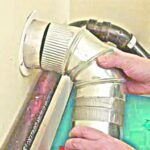
dryer-vent-clogged5) If necessary, clean out the ductwork from the dryer to the exterior wall where it vents; this may involve disconnecting sections. (For more on this, see Clothes Dryer Venting (Ductwork Problems.) One trick that sometimes makes this job easier (but only if the dryer duct is fastened firmly at all connection points) is to blow lint and debris through the duct and out the exterior wall vent using an electric leaf blower.

6) If the dryer still is taking too long to dry clothes, remove the lint filter and use a flashlight to check for internal clogs. Use a vacuum to suction out any blockages.

7) If the above steps don’t solve the problem, you may have a problem with your dryer’s heating element or thermostat. Call an appliance repairperson.
 
Dryer Tumbles but Doesn’t Heat
 
When a dryer goes around but doesn’t produce even, warm air, something has interrupted the heat source. Run the dryer for a couple of minutes, making sure you don’t have the dial or controls on a non-heat setting such as Fluff or Wrinkle Release.

With an electric dryer, no heat may mean that the circuit breaker or fuse that controls the power has blown; reset or replace it. Be aware that a dryer may have two breakers or fuses. The motor will run when one works, but the heating element requires both.

With a gas dryer, check the gas valve behind the dryer to be sure the gas supply is turned on. Also make sure the house’s main gas valve is turned on.

Most modern dryers have electronic ignition instead of a pilot light. If yours has electronic ignition and isn’t heating, call an appliance repairperson. With an older dryer, make sure the pilot light is burning. If it isn’t, relight it. Instructions are often mounted next to the burner.

Dryer Doesn’t Run

If your clothes dryer doesn’t run, perform the following diagnostics to determine the problem:

1) Be sure it is plugged in and turned on. If necessary, check the receptacle it’s plugged into for power, using a working lamp, appliance, or voltage tester. (Be aware that most electric dryers don’t plug into standard 120-volt receptacles; they operate on 240 volts.) Make sure the door is closed completely, the timer is advanced to the proper position, and the correct cycle is selected.

2) If the receptacle is dead, check the circuit breaker or fuse that serves that circuit.

3) Unplug the dryer and check the power cord and the terminal block. If necessary, replace the cord.

4) Open the door and check the door switch. Press and release it; it should click each time. If it doesn’t, it’s probably broken. Remove the switch, test it, and replace it if needed. 

5) If the dryer still doesn’t work, a thermal fuse or other electrical or electronic part may be faulty. The thermal fuse, found in the back cover panel, can stop working if the dryer overheats. (See How to Replace a Clothes Dryer Thermal Fuse.) Call an appliance repairperson if you suspect any other electrical part may be malfunctioning.

Dryer Runs but Doesn’t Tumble

If your dryer runs but doesn’t tumble, this indicates that something is wrong with the door switch, the motor, or the belt. Call in a qualified appliance repairperson to change the malfunctioning part.

Dryer Tears or Burns Clothes

If you are finding that your clothes are getting ripped or scorched in your dryer, you may need to replace one or more parts.

Worn-out rollers can cause your dryer’s drum to drop, creating a space between the back of the dryer and the top of the drum into which your clothes can become pinched. In addition, this gap can cause the dryer’s thermostat to falsely read the temperature setting, which can burn clothes. Damaged glides or drum seals can cause similar problems.

Replacement of these faulty parts is usually best left to an appliance repairperson.
 
Dryer Makes Noises

If your dryer is noisy, scour the interior of the drum for loose objects. Some noises are caused by objects bouncing around inside. If you cannot find any loose objects inside the drum, the noise may be caused by a defective part, such as a worn or defective drum belt, idler pulley, support rollers, glides, or worn motor bearings. It’s best to call an appliance repairperson to replace these parts.

Dryer Smells of Natural Gas

If you smell natural gas near your gas dryer, do not light matches or a lighter, and don’t operate electrical switches or anything that might spark, which could ignite an explosion. Instead, do the following:

1) Immediately shut off the gas valve that serves the dryer.

2) If the smell is mild, ventilate the area, wait until the air is clear, and relight the pilot light.

3) If the smell is strong, move everyone out, leaving the doors open to ventilate the area.

4) Turn off the gas supply valve, located by the gas meter on the gas inlet pipe, by rotating the valve one-quarter turn with an adjustable wrench. The valve’s oblong stem should be perpendicular (at a right angle) to the inlet pipe to stop the flow of gas.

5) Call your gas supplier (or the fire department) from a remote phone.

 

Copyright © 1997-2012, Don Vandervort, HomeTips, LLC. All rights reserved. Reproduction without permission is prohibited.


Related Articles on HomeTips

Repair & Care (7)
DIY & Installation Projects (2)
How It Works (2)
Buying Guides & Reports (1)