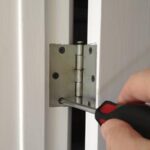
This DIY guide will teach you how to fix a binding or loose door, patch a hollow-core door, and fix other wood door problems.

Time and age cause doors to bind and stick. As your house settles, doors sag in their frames; in addition, repeated painting and dirt create buildup. Or, a door may have been misaligned from the start. The point is: A variety of problems occur with doors. Some, such as damage to their surfaces, can happen to any type of doors. Other problems are unique to the way a door operates. Pocket doors can jump their tracks, bi-fold doors can pop out of their pivot mounts, and hinged doors can become stuck in their frames.
In this article, we’ll help you repair all of these types of interior door problems, beginning with hinged doors. Hinged doors can become balky, sticking in their frame, they can become too loose to seal properly, or their surfaces can become damaged. Please note that many of these fixes also work on exterior doors.
Fixing a Door That Binds
If a door binds or rubs against the jamb, identify the spots where it binds by sliding a thin strip of cardboard or wood between the door and the jambs.
Then mark the areas where the door is binding with a pencil.

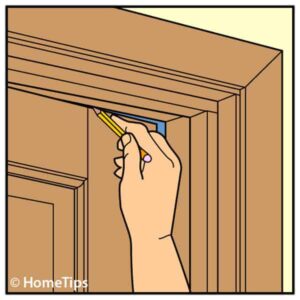
Look for a buildup of paint, which usually is the culprit. Hold a sharp wood chisel flat against the surface, and slice off the excess. Then smooth the surface with fine-grit sandpaper. Coat the door edges and the jambs with paraffin.
If that doesn’t do the trick, try adjusting the hinges. Many doors bind against the upper corner of the jamb or drag across the carpet.
Close the door, and check how it fits in the jamb. Look for tight spots, and make sure the top edge of the door is level. If it appears to be more than 1/4 inch out of level, the cause is probably settling or sagging.
You can usually solve this by replacing the center screw of the upper hinge with a longer, 2 1/2-inch screw, angled slightly toward the jamb’s center.
First, clean off any dirt, and repair or replace any bent hinges. Drive the screw in snugly, and tighten the other screws that secure the hinge. If they can’t be tightened, repair the screw holes by packing them with short pieces of a glue-coated dowel. Then replace the screws.
Another culprit in a door that binds is humidity, which can cause a door to swell and stick. To fix this, you will probably have to remove the door and sand or plane down the high spots. Before removing the door and planing it, first try sanding the areas with coarse, followed by finer, sandpaper.
To plane the door, you’ll need to remove it. For instructions on removing a door, see How to Remove a Door.
How to Plane a Door
Using a pencil, mark the area to be planed on both faces of the door. Typically, you should be able to slide a dime between the door and the jamb along both sides and the top.
Set the door on edge, and, using a jack plane with a sharp blade set to make a very shallow cut, plane in line with the wood grain to avoid gouging the wood.
Plane the top or bottom rail or hinge stile if that’s where the door binds.
Avoid planing the lock stile—not only is the lock side usually beveled to allow for a tight fit, but planing it can also compromise the way the lock set fits.
Hold the plane at a slight angle and flat against the surface.
At the door’s top and bottom, plane from the corner toward the middle to avoid splitting the ends of the stiles.
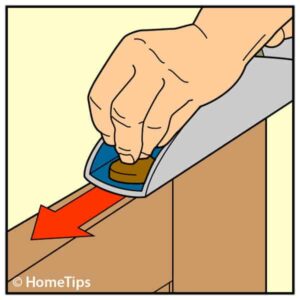
Don’t take too much off—remember, the door will shrink back up when the air is drier. Finish by coating the door edges and jambs with paraffin.
Fixing a Loose Door
This is generally the opposite of sticking in the jamb. When an interior door rattles, this means the door stop and/or the strike plate are not tight enough. If the strike plate has a flange in the center that can be bent slightly to tighten the fit, remove the plate and use a pair of pliers to bend the flange. Otherwise, you may have to adjust the position of the door stop on the latch-side jamb.
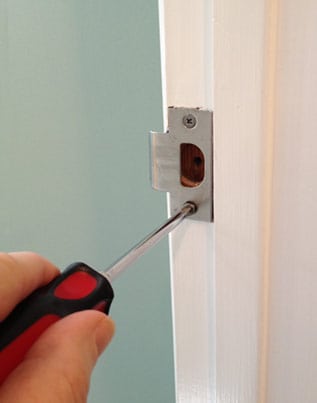
To do this, first use a utility knife to cut the paint seal between the molding and the jamb. Then place a wooden block against the door stop, and hammer the block gently toward the door to provide a tighter fit.
The best way to stop an exterior door from rattling is to install resilient weatherstripping around its perimeter, which also will help insulate your house. Look for the vinyl bulb type and follow package instructions.
Hole In A Hollow-Core Door
If you have a hollow-core door with a serious hole in it, consider replacing the entire door; hollow-core doors are modestly priced.
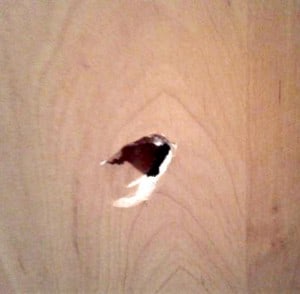
You can repair a hole if you’re willing to paint the door to hide the patch. To do this, you’ll need a can of spray foam insulation. In many cases, you can repair the door without removing it first—just spread a dropcloth on the floor beneath it before you start.
1. Fill the hole with the spray foam insulation, allowing the foam to expand slightly above the door’s surface.
2. Let it dry (and continue to expand) overnight.
3. Use a razor blade to slice off the excess. Shave the mound just slightly lower than the door’s surface.
4. Apply vinyl spackling compound to the patch, using a 3-inch putty knife. Draw it smooth to the door’s surface. Allow the spackling compound to dry.
5. Sand the area lightly with fine sandpaper wrapped around a sanding block.
6. Prime the entire surface of the door, allow it to dry, and then paint.
Fixing Wood Door Problems
There are many methods for repairing or restoring woodwork, and they work just as well on wood doors.
You can sand out minor scratches, fill gouges with wood putty, replace rotted or broken sections with epoxy filler or by gluing in a new piece, and so on.
If a panel in a Colonial-style door is cracked or split, you may be able to reglue it without removing it from the rest of the door.
If you have to remove a panel or replace it completely, try prying off the moldings that surround it and hold it in place. On some panel doors the moldings are routed in and can’t be removed. In this case, one option is to cut away these integral moldings carefully. After you’ve fixed the panel, buy new moldings to match the rest of the door’s trim.
More Door Repairs
For step-by-step methods of fixing interior pocket doors and bifold doors, next please see:
You’ll find the following fixes in the exterior door section of HomeTips: