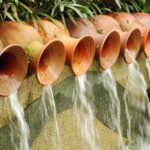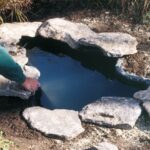
Ponds, pools, streams, fountains—these and other water features are remarkably effective at creating a sense of natural tranquility in a yard. Their harmony and cool, watery ambience are no doubt behind the increasing fascination homeowners have with building and installing these features.


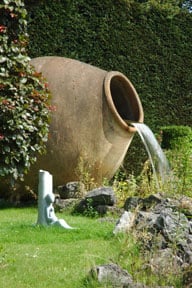
The terms “water feature” and “water garden” encompass a raft of possibilities, from front-yard lagoons to simple birdbaths. Bubbling brooks, artistic Asian spill fountains, wall fountains, fish ponds—these are just a few of the options. You can buy small pools and fountains ready-made or, thanks to state-of-the-art pool liners and water circulation systems, you can make and install your own.
Because a water feature is often a relatively permanent addition to your landscape and may affect your yard’s aesthetic, use, and safety, it’s important to plan for one carefully. Here are seven key considerations:
1. Pick the right location. Before excavating for a pond or similar water feature, check the location of utility lines. Avoid placing a pond beneath trees that will fill it with leaves and debris. If you’re considering a spray fountain, place it in a location that is protected from the wind, which can blow the spray and accelerate evaporation. Zoning codes may govern how close to the property line you can install a large water garden.
2. Consider scale, proportion, and style. These should be in keeping with the house and grounds. In most cases, a water feature should function as an accent, not a focal point. In a small garden, for example, a decorative ceramic pot fitted with a recirculating bubbler may fill the bill. A fountain or pond with geometric lines will look best with a formal house and garden. A water feature that mimics shapes found in nature will complement an informal style.
3. Get a building permit if one is required. In some regions, a water feature that is deeper than 18 inches or that calls for electrical wiring or connection to home plumbing may demand a permit from your local building department.
4. Don’t blow your budget. Even when you do the work yourself, building a water feature can add up, particularly if it involves extensive planting and materials.
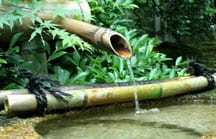
5. Decide whether you want moving water or a still-water garden. Moving water can produce a pleasant murmur and mask the sound of traffic. The tranquility of still water, on the other hand, can create a beautiful reflecting pool. Moving water requires a power source to run the pump. Although most pumps must be wired to conventional 120-volt circuits, low-voltage versions are available for some types of small pumps. These make installation much easier.
6. Determine if your water feature will contain fish or plants. Fish will help keep the mosquito population down. Still water is generally the most favorable for plants; moving water provides more oxygen for fish. If you intend to grow water plants, select a location that will receive at least five hours of direct sunlight a day. Then again, if the pond is shallow, its water will evaporate quickly in direct sun; in this situation, install a float valve that controls the water supply to maintain the proper water level.
7. Think safety. Young children can drown in only a few inches of water. Be sure your water feature doesn’t pose a risk to children or adults. A particularly safe water feature doesn’t contain more than a few inches of water and is located where it cannot be approached by small children. Even better, opt for a wall or pedestal fountain that is completely above the reach of kids.
Outdoor Water Fountains, Garden Pools & Waterfalls
Today, people are rediscovering the ancient joys of water features. Whether cascading down a rocky slope, spraying from a decorative wall fountain, bubbling up to a pool surface, or just lying there serenely with the occasional ripple, the presence of water calms and soothes. Also, a pool can house plants and animals that cannot thrive on dry land.
Before you start to plan a specific water project, spend plenty of time dreaming and exploring possibilities—because the possibilities are indeed many. Your water feature may be the focal point of a small, secluded retreat, an oasis from the hectic world out there. Conversely, it can be a splashy center of attention for parties and entertaining. Or perhaps something in between: a happy meeting place for friends and family, an aid to dining, conversing, and relaxing together.
Don’t forget about the living things. If you love to garden but are getting tired of the same old plants, you’ll find that a pond introduces you to a whole new family of plants that love to soak: tropical floating plants, lotuses, duckweed, horsetails, and a big old group of water lilies are only some of the possibilities. And if you like animals, you can choose among many varieties of goldfish, large koi that become family pets, frogs, turtles, and more.
Your water project may be a simple matter of assembling parts and plants in a pot, or it can be several weeks’ worth of work excavating and installing a large flexible-lined pool, complete with several micro-ecosystems. Many medium-sized projects are surprisingly easy because you can buy pools, fountains, pumps, and other components or even complete systems that are designed for easy installation.