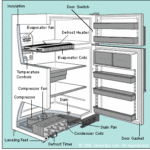
This expert buyer’s guide will help you choose the right type of freezer and the features that make sense for your family.

Is the size of your refrigerator’s freezer compartment less than satisfactory? Are you tired of repackaging the frozen veggies, popsicles, and Grandma’s lasagna over and over again to try to cram everything in? Maybe it’s time to consider investing in a stand-alone freezer.
Stand-alone freezers are available in two types: chest and upright models.
Chest Freezers
Chest freezers are generally less expensive than uprights, but they need a wide space versus a tall space. Because of their width, they also have to be tilted to get through a doorway.
They have a large capacity, but items on the bottom require removal of items on the top for access.
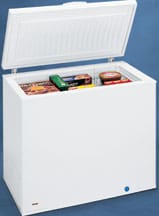
They are more energy efficient than uprights, and if you lose power a chest freezer will keep foods frozen longer if you keep the lid shut.
Because their coils are built into their walls, no fan is required to circulate the cold air, which also makes them quieter.
Keep in mind that the hinges on a chest freezer will begin to wear with heavy usage. Also, all chest freezers have manual defrost, which can take up to 24 hours and get messy.
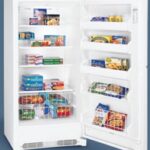
Upright Freezers
Upright freezers generally cost more because they have better organizational features such as drawers and shelves (but which also means they hold less than chest models). They are designed to fit easily through a doorway.

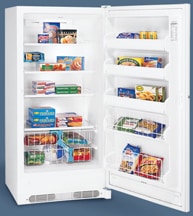
Some models are equipped with a flash-freeze option, which brings down the temperature inside the freezer quickly after its being loaded with food.
The less expensive upright models have manual defrost; the more expensive ones have the convenience of automatic defrost, though this actually increases the potential for freezer burn and requires more energy.
Choosing the Right Size Freezer
Freezers are available in four basic sizes: compact (5 cubic feet), small (6 to 9 cubic feet), medium (12 to18 cubic feet), and large (18 to 25 cubic feet).
When shopping for a freezer, consider not only the capacity of the freezer, but also the size of your family and how you eat. Do you typically buy a lot of frozen foods in bulk? Do you like to freeze your garden fruits and vegetables so you can enjoy them during the winter? Does anybody in the family hunt or fish?
Another issue to consider is your family’s fondness for frozen and/or prepared foods. If you have scant time to cook and can only grocery shop once a week, a freezer can handle the load. Or perhaps you like to take advantage of sales on meats so you can have them available whenever you want to throw something on the barbecue.
As a rule of thumb, the appliance industry recommends 1.5 cubic feet of freezer space for each family member with 1 cubic foot of freezer holding approximately 35 pounds of food.
After considering the optimum size of freezer and amount of frozen foods you plan to store, then study your available space for your new freezer.
How Much Do Freezers Cost?
The average cost ranges from $150 to $700 for a chest freezer. Upright freezers cost from $150 to $700 for manual defrost and $300 to $800 for automatic defrost. And don’t forget that you might want to have your new freezer delivered, which would add anywhere from $40 to $100 to the total cost, depending on the proximity of the vendor to your delivery site.
Many stores offer free delivery; make sure you ask before making your purchase. An extra fee might be charged to hook up an ice-maker feature (you’ll need a connection to a water source).
Typical Freezer Features
As opposed to refrigerators, freezers have limited bells and whistles—no through-the-door water dispensers, no rapid-chill drawers nor high-tech multimedia gadgets. A freezer’s job is simple: to keep foods frozen.
There are several features you might want to consider when shopping for a freezer, though they will all add to the cost:
- A temperature alarm system that sounds if the temperature inside rises to an unsafe level.
- Magnetic door gaskets that provide an airtight seal.
- A door closer feature that ensures the door or lid closes automatically.
- The Energy Star label (be aware that energy savings vary by model).
- An option that will keep the freezer operating efficiently in ambient temperatures between 32 and 100 degrees F.—most important if you plan to keep the freezer in a garage, basement, or other space with an unregulated temperature.
- Easy access controls in the interior so you don’t have to move items to check or change the temperature (or controls on the exterior so you don’t even need to open the freezer).
- Interior lighting plus an exterior power-on light that lets you know that the freezer is in working order without you having to open the door or lid to check the temperature.
- A child-lock device with a pop-out key that keeps the freezer door securely locked and ejects the key to prevent it being left in the lock.
- Length of warranty; most major manufacturers have a standard warranty of one year with an offer of two-year, three-year, and in some cases even four-year extended warranties.
NEXT SEE: Selecting a Freezer Model