This unbiased dishwasher buying guide will help you sort through differences and options to choose a dishwasher that’s right for you.

When shopping for the best dishwasher, you’ll discover a wide range of models at different price points. Competition is heated among manufacturers. Each model is designed to address a different segment of the market. First-time buyers may be attracted to low-priced units with basic features. Move-up buyers may be enticed by stylish, upscale machines loaded with bells and whistles.

What features are worth paying for when seeking the best dishwasher for your home? In this article, we help you decide.
Best Dishwasher Features
According to Consumer Reports, the highest ranking dishwasher manufacturers are the European makers Bosch and Miele and American manufacturers Kenmore and KitchenAid.
The Kenmore Elite series models have been given the highest overall score, although they are pricey at from $1100 to $1350.
The Bosch Ascenta series models are rated slightly lower but, because they are priced in the $600 to $700 range, are considered an excellent buy.
Miele also makes excellent dishwashers in their Futura line, but they’re priced at $1750 or more.
KitchenAid’s Superba products are also highly rated and are priced in the $950 to $1500 range, depending upon features. For more detailed dishwasher ratings information, visit Consumer Reports.
Top Dishwasher Features
You’ll find compact, ultra-quiet units with sophisticated controls, high-efficiency design, stainless-steel interiors, and even built-in water softeners. These dishwashers are truly amazing—and are priced accordingly.
“Smart” dishwashers use sensors to size up and monitor cleaning during wash cycles, smart controls are currently available at the high end of a couple of dishwasher lines. They allow tailoring of a machine’s efforts and energy usage to meet the load’s requirements for optimum efficiency. If you want a dishwasher that truly takes the guesswork out of using controls, one of these would be a good bet.
Because models are continually evolving, before buying a new dishwasher, do your homework. Check out consumer ratings for reliability and convenience, and also assess your needs. Do you put on the dishwasher daily or just once a week?
Look for a strong warranty—one or more years for free parts and labor (Maytag offers three years plus free key parts for five years) and free parts and labor on the tub and door liner for 20 years or more. By combining careful, informed shopping and a strong warranty, you can select a dishwasher that will add style and convenience to your home for years to come.
Stainless-Steel-Tubs
A key trend is stainless-steel dishwasher interiors that are very sturdy and maintenance free.
Stainless-steel dishwashers can employ a lower-wattage heating element for drying, which saves energy and helps protect heat-sensitive items on the lower rack. For example, by combining a stainless-steel interior with good insulation, KitchenAid dishwashers successfully utilize a 450-watt element instead of the 600 to 750 watts needed for dishwashers with plastic tubs.

Many manufacturers now make—or are introducing—models that have durable stainless-steel tubs. Stainless-steel dishwashers can’t compete in price with models utilizing plastic tubs, but they are quieter, easier to maintain, and more efficient during drying cycles because the metal reflects heat better. Stainless-steel tubs also allow for higher water temperatures than the typical 140 degrees F. suitable for plastic. Some operate in excess of 165 degrees F., which truly sterilizes dishes.
Quiet Dishwashers
Today’s hottest dishwasher hot button is quiet. Most of us want the sound of silence, particularly in the kitchen, which, for most families, is the hub of the house.
Families weary of trying to converse over the drone of water pumps and the hum of motors are opting for appliances that work discreetly. This fact has awakened a world of noise-reduction technologies, and dishwashers are toward the top of the silencers’ hit list.
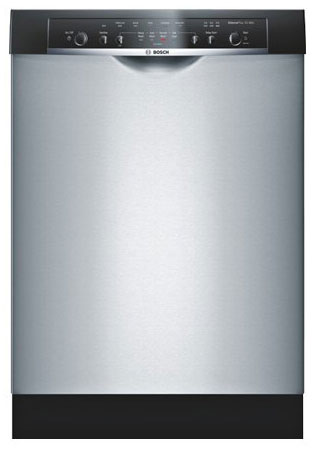
Nearly all major manufacturers are promoting quieter dishwashers, particularly in the higher-priced models. “We have explored new design components and conducted consumer sound evaluations to launch ‘the quietest dishwasher made in America,‘“ says a Jenn-Air spokesperson. Whirlpool says about its Quiet Partner model: “You have to hear it to believe it. We like to say that the Quiet Partner dishwasher quite literally gives you back your kitchen.” Frigidaire’s Ultra-Quiet Insulation Systems models are promoted as “among the quietest you can buy.”
To make their best dishwashers quieter, manufacturers have added sound-dampening insulation, sound-absorbing wash tubs, vibration absorbers, and low-noise pumps. With many brands, these are optional features and will boost the price significantly. For example, KitchenAid offers four different levels of quiet, depending on how much quiet you want and what you want to spend.
Dishwasher Controls & Styling
Across the board, dishwasher controls have become simpler to use. For example, Whirlpool has a One-Touch control that requires just what the name implies—pushing one button.
Although electronic controls are trendier, they are more expensive and don’t offer any particular advantages over mechanical controls. They are the easiest to set but can be slower to reset than a dial. Push buttons are also easy to set but can leave you wondering what part of the cycle you’re on if you have to reset them.
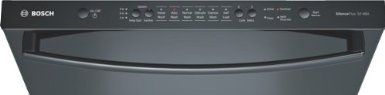
Three basic cycles are important: light, normal, and heavy. People who are brave enough to wash china and crystal in a dishwasher will want a delicate cycle. Delay start is a popular feature because it allows you to set the dishwasher to start automatically at a later time.
European-style models such as Creda’s do a beautiful job of integrating the control panel into the face panel. For the ultimate in clean design, check out the ASKO or Bosch, which have no visible controls on the front—instead, they’re located along the top edge of the door.
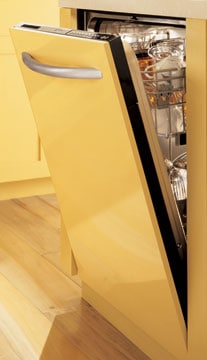
Finishes include stainless steel, white, black, and—with some—custom panels that match your cabinetry. In its Designer Series, ASKO offers deep rose, teal, plum, and slate blue. The company will even paint the control panel to match any color sample provided by a customer.
Dishwasher Capacity
All conventional under-counter dishwashers are about the same size because they’re made to fit under a standard-height counter in a 24-inch-wide space.
If you’re considering a European model, double-check its capacity to be sure it isn’t sized smaller than its American counterpart. With racks, flexibility is the name of the game. When shopping for a dishwasher, match the rack style to the types of things you wash. If your dishes are unusual in size or shape, for example, you may want to take one along to the store with you.
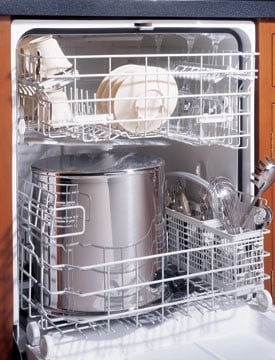
Covered baskets can be helpful for containing small items. Beyond that, watch for options that offer flexibility such as terraced racks, fold-down trays, and adjustable or removable tines.
Energy-Efficient Dishwashers
Energy efficiency is more important than ever. In the 1990s, federal regulations imposed minimum energy-efficiency standards on new dishwashers. As a result, all of today’s dishwashers use about half the electricity needed by dishwashers made back in 1972, and they also use less water. Together, these savings can result in a significant difference in your utility bill.
According to the Association of Home Appliance Manufacturers, about 80 percent of the electricity used to wash dishes goes toward heating the water. Many new dishwashers save energy by heating their own water. Purchasing such a model can achieve savings of up to 20 percent off the total cost of heating water for your house. These dishwashers keep their water temperature at 140 degrees F., so you can also lower the temperature on your water heater.
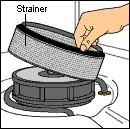
Today’s standard-size dishwashers use an average of 8.11 gallons for a normal cycle compared to the 16 gallons it takes to hand-wash dishes. New dishwashers achieve this efficiency by utilizing high-volume pumps to recirculate a relatively small amount of water through fine-mesh filters. The filters strain particles from the water to ensure thorough cleaning, and the pumps deliver a powerful spray to the dishes. The pump in a Frigidaire Gallery dishwasher, for example, recirculates fewer than 8 gallons of water (for a normal cycle) at a volume of 42 to 50 gallons per minute—up to 2,000 gallons per cycle.
Another benefit of most new dishwashers is that you don’t have to pre-wash dishes before loading them (this boosts overall energy efficiency significantly). Instead, they employ voracious solid-food disposers and sophisticated spray arms to literally blast away food. For instance, Maytag’s Six-Tier wash system has a total of 52 jets that spray from just about every direction you can imagine.
For comparison shopping, each new dishwasher is posted with a yellow Energy Guide label. This rates the average annual cost of using a particular model based on average usage and a median price for gas or electricity. When you compare a few of these, you’ll discover that, annually, most dishwashers cost about $60 to operate in homes with electric-heated water and $40 where water is gas-heated.

Numbers tend to vary only a few dollars per year from one model to the next, and more expensive units are not necessarily more efficient. Most differences are so minimal they’re insignificant unless you compare a truly high-efficiency model such as the GE Profile, which is rated at $44 per year for electric and $24 for gas-heated water.
Dishwasher Energy-Saving Tips
In addition to utilizing water, dishwashers use energy for heating water, drying cycles, running the pump, and powering the controls. When shopping for a new dishwasher, picking an efficient model is the first step to achieving considerable energy savings (see above). In addition, you can save energy by paying attention to how you operate your dishwasher. Here are some tips on how to use your dishwasher to its best advantage:
- Because modern dishwashers are pretty powerful when it comes to cleaning, you can skip hand-rinsing dishes—thereby saving water—and just scrape any leftovers off your dishes.
- Only run your dishwasher when it is full, but do not overfill it; dishes that are packed in too tightly will not come out clean and may get chipped.
- Pick the shortest cycle that will get your dishes clean. Today’s dishwashers come with a plethora of cleaning options. Obviously, the “Power Scrub” function isn’t going to be necessary for every load, so experiment to see what meets your household’s average needs while utilizing the least amount of water.
- Let dishes dry after the wash cycle by opening your dishwasher door, if it will not impede the flow of traffic. Or utilize the energy-saver feature if your model has one.
NEXT SEE: How to Repair Dishwasher Problems