Should you buy seamless aluminum gutters, vinyl gutters, or another type? This illustrated unbiased rain gutters buying guide shows you how to buy the right rain gutters and mounting system for your house.

Rain pounds your roof and torrents of water spill over the eaves. You can’t walk out the front door without passing under a mini-Niagara. And the basement? Better fire up the sump pump. Get the idea?
Before that next storm arrives, it’s a good idea to consider how your house will weather it, which brings us to the subject of gutters.
Rain Gutters Overview
Granted, rain gutters aren’t exactly glamorous, but they handle a critical task: routing the runoff from a very large surface—your roof—to proper drainage away from the house. By doing this, they keep your house high and dry, protecting siding, windows, doors, and foundation from water damage.
Though most gutters are installed on existing roofs, adding them during re-roofing simplifies installation and allows them to be fully integrated into the roof system. If you’re thinking about installing a new roof, your timing couldn’t be better.
Of course, gutters aren’t necessary for every house. Broad overhangs may cast runoff well away from a house, where proper grading and drainage can carry it safely away. If this is the case with your house, save your money for a different type of rainy day.

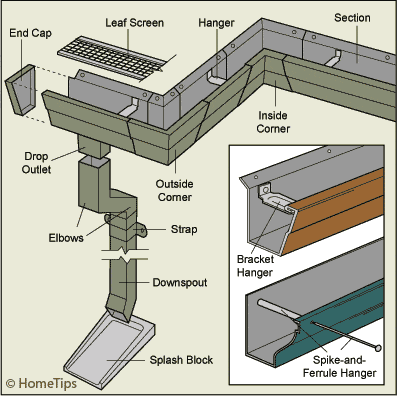
Both do-it-yourself and professionally installed gutters are available. You can buy do-it-yourself gutter systems made of vinyl, sheet metal, and aluminum at home improvement centers. Or you can have professional gutter companies install any of numerous gutters touted as “seamless,” “soldered,” “continuous,” “copper,” “sheet metal,” and more. What type of gutters and mounting system should you choose for your house? The following information will help you sort through the options.
Rain Gutter Sizes & Profiles
Gutters are formed in several profiles and sizes. The standard profiles are a simple “U” shape and a “K” style, which has an ogee-shaped front vaguely resembling the letter “K.”
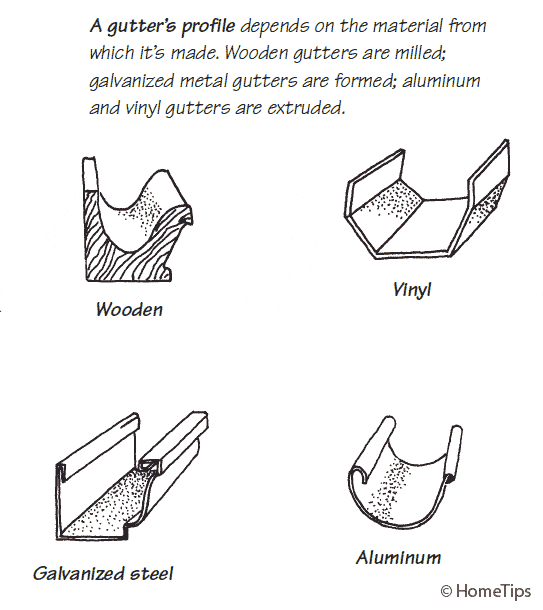
Channels are 4, 5, or 6 inches in diameter; 5-inch K-style gutters are a popular type. Matching downspouts are 2-by-3-inch or 3-by-4-inch rectangular profiles or 3- or 4-inch round (often corrugated) pipes.
The larger systems are generally worth the difference in price because they’re less likely to clog. Especially if trees overhang your house, 3-by-4-inch downspouts are the wisest choice.
How to Choose Gutter and Downspout Size (Chart)
Roof area is the recommended method for choosing size. See the below chart for specific guidance.
| ROOF AREA | GUTTER DIAMETER | DOWNSPOUT DIAMETER |
|---|---|---|
| 100-800 sq. ft. | 4″ | 3″ |
| 800-1,000 sq. ft. | 5″ | 3″ |
| 1,000-1,400 sq. ft. | 5″ | 4″ |
| 1,400+ sq. ft. | 6″ | 4″ |
Professionally Installed Gutters
The most popular kind of installed gutters are seamless, which are custom-fashioned right on-site. Metals such as copper and stainless-steel are generally chosen for high-end installations. And though wood is rarely used anymore, architectural purists will opt for it. Here we take a look at the three types of installed gutter systems.
Seamless Gutter Systems
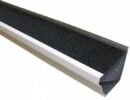
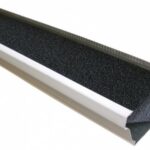
Seamless gutters, today’s most popular type of professionally installed gutter, are extruded from metal “coil” stock, using a special machine that’s brought to your home by a gutter fabricator. Gutters of nearly any length can be made by this machine.
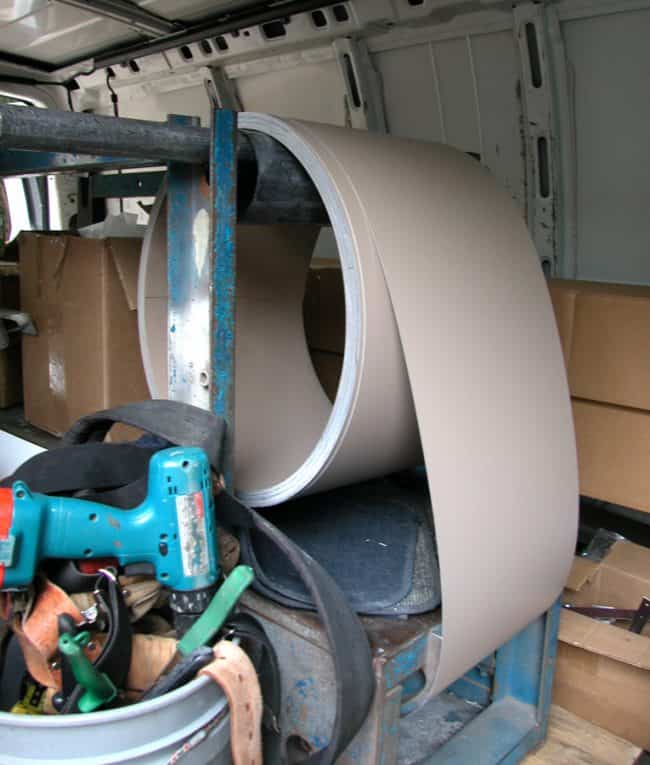
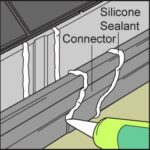
As the name implies, seamless gutters do not have potentially leaky seams along their lengths, which is their biggest selling point. The extra-long troughs are mounted along the eaves and joined at corners—both inside and outside—using special connecting components and downspout outlets.
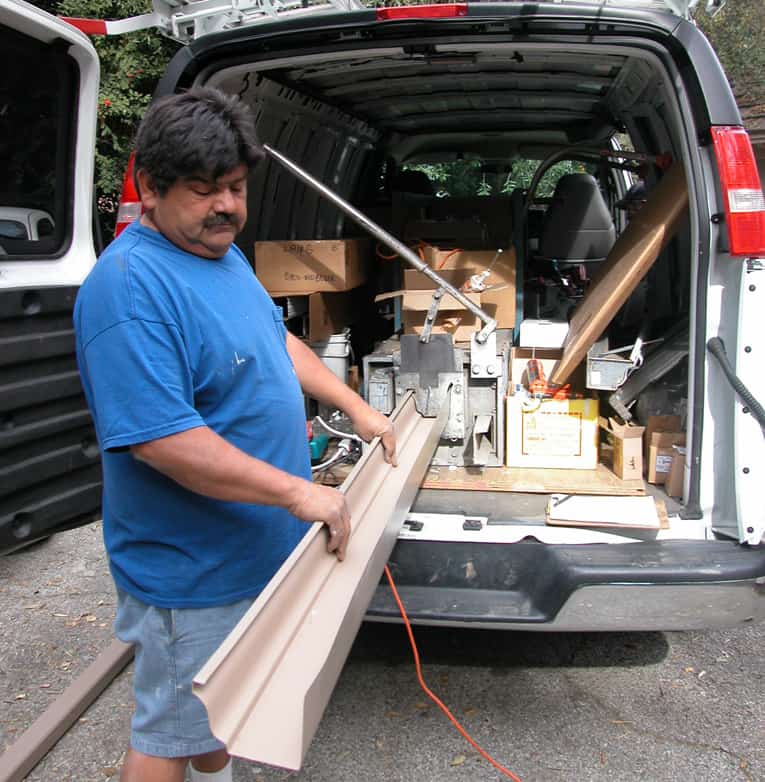
Seamless gutters are usually formed from aluminum that has a baked-on finish, but they may be made from copper or factory-painted steel. The material that is best for your home depends on your situation.
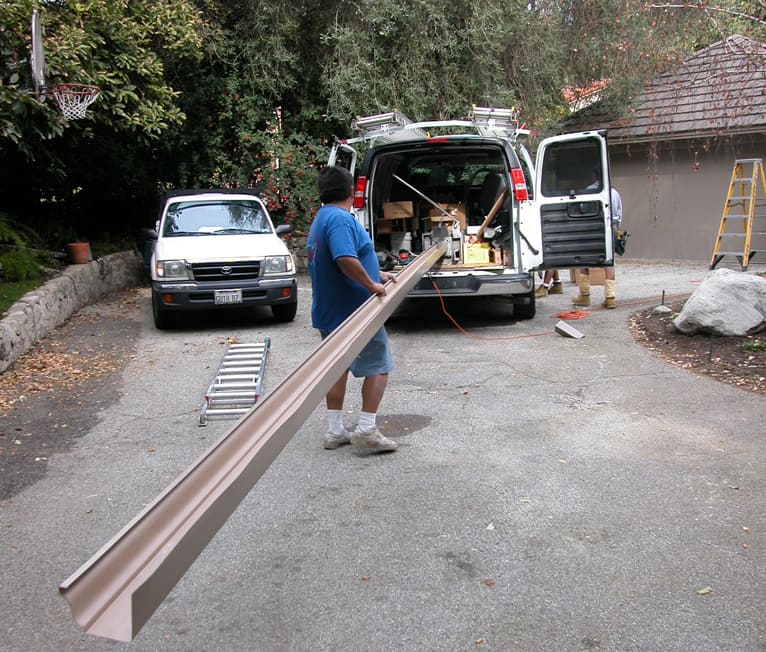
Pluses for aluminum gutters are that they’re relatively inexpensive and will never rust. Steel gutters are sturdier, but this isn’t necessarily an issue unless you live where high winds, trees, or other factors may cause wear and tear on them. Most homeowners opt for seamless aluminum.
According to one gutter installer in Fargo, North Dakota, “In this area, we’re probably 90 percent seamless gutters. I like aluminum because even though downspouts get plugged and you get water sitting in the gutter, you don’t have to worry about rust. Steel will rust out after a time.”
In addition, he says, “I’ve laid them side by side on the ground and dropped a screwdriver on them and the steel dents just as easily [as the aluminum]. Every once in a while, we use steel to match a color that only steel comes in. Steel is a little bit cheaper.”
The price range for steel gutters runs from about $2.50 to $4 per foot, installed. Aluminum gutters cost from $5 to $9 per lineal foot, installed. Coil stock is sold in several thicknesses, including .032, .027, and .025 inch. Be sure to specify the thicker .032-inch material. If you opt for aluminum, ask whether the material is primary or secondary. Primary aluminum is more likely to be of a more consistent quality.
Both aluminum and steel are made in a broad palette of colors. Alcoa produces a faux copper gutter that, at about $9 per lineal foot, installed, offers the look of copper at about half the price of the real thing.
Also keep in mind that anyone who can afford about $20,000 for a seamless gutter machine can start a gutter business, so be sure to check references and get more than one bid. If one bid is considerably lower than another, check the gauge of the material and other details.
Be sure the contractor will hang gutters along a chalk line, snapped to allow the proper slope of 1/4 inch for each 10 feet toward a downspout. That way, your new gutters will flow properly, look good, and add to the value of your house.
Copper & Stainless-Steel Gutters
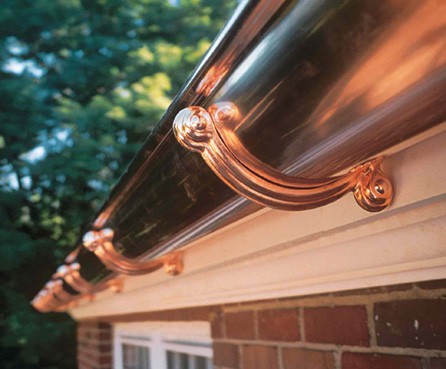
Most people agree that copper makes the ultimate gutter. Handsome, with a natural patina that ages to a verdigris color, it doesn’t require any finish. It will last as long as the house because it doesn’t rust.
Copper gutters are installed either as half-round sectional systems or in the same profiles as seamless aluminum gutters. Sectional systems, fabricated by metal shops and soldered at the joints, are very expensive. Prices fluctuate with the value of copper, but expect to pay $15 to $20 per lineal foot. Seamless copper gutters, typically made from 16-oz. copper, are slightly less—from $13 to $18 per lineal foot, installed. At these values, copper gutters have become a target for thieves in some cities.
For restoration purists, lead-coated copper is also available in some areas. These gutters will last over 75 years. A 5-inch sectional system runs more than $20 per lineal foot, installed.
Finally, though seldom used, stainless steel is another high-end custom material. Like copper, it doesn’t rust and will last as long as the house. It is a little too glitzy for most homeowners, particularly at an installed cost of about $20 per lineal foot.
Wood Gutters
Wood gutters are rarely installed anymore because they are expensive, very heavy, and require considerable maintenance. But, for architectural purists, wood is still an important option.
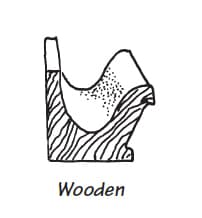
Select lumber dealers specially mill wood gutters and sell them in 10- and 20-foot lengths. Wood gutters are usually used with metal downspouts.
The price range for wood gutters runs from about $12 to $20, depending on the species, profile, and general availability. Redwood and red cedar heartwoods have a natural resistance to decay; Douglas fir is also used.
Wood gutters should be treated with linseed oil once a year to enhance their water resistance. Wood can be painted, but because paint will crack and peel with moisture, painted gutters require periodic repainting.
Rain Gutter Mounting Systems
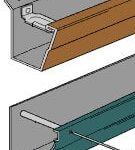
Gutters are attached along a house’s eaves by any of several means, including straps, brackets, and hangers.
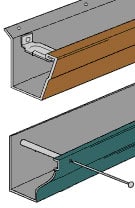
Says one seasoned gutter installer, “We primarily use the hidden hanger method because, over the years, as the wood gets a little older, spikes [of a spike-and-ferrule hanger] tend to pull out. We screw a hanger to the fascia or rafter tail. When we don’t have that alternative because there are no rafters or fascia to attach to, we have to use a strap. If we can’t get the strap under the shingles, we encourage the homeowner to wait and install gutters in conjunction with a new roof.”
A crossbar hanger is particularly sturdy. It clips onto the front, goes over the top of the gutter, and clips on the bracket at the back.
Do-It-Yourself Gutters
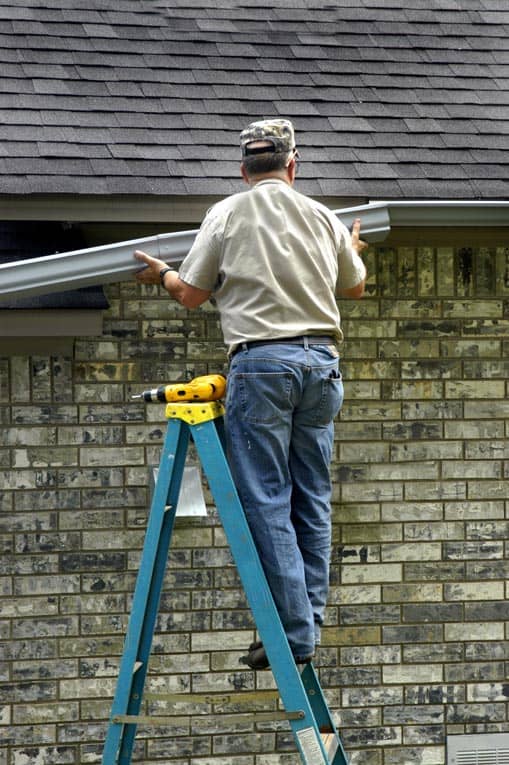
If you’re planning to install your own gutters, DIY vinyl gutters may be your best bet. DIY vinyl gutters are made by a variety of manufacturers. And they’re commonly available at home improvement centers and lumberyards and generally can be installed by homeowners with moderate skills and tools. If you plan to have gutters professionally installed, be sure to check out extruded aluminum gutters, discussed in the Rain Gutters Buying Guide.
Benefits of DIY Vinyl Gutters
Vinyl doesn’t rust, rot, or require a finish, but it can become brittle over the years and crack when the weather is particularly cold. Colors are also limited—white and brown are the most common—and dark tones tend to degrade from exposure to the sun’s ultraviolet rays.
Vinyl sectional gutters are relatively inexpensive at $3 to $5 per 10-foot length, but you must factor in the cost of fittings, which push the overall price per lineal foot up a bit.
Genova and Rain Master, made by Bemis, make vinyl gutters and components with rubber or silicone gaskets that compress to form tight, leak-proof seals. These systems allow the gutters to expand and contract with heat changes. You virtually just plug the entire system together.
DIY Aluminum & Steel Gutters
DIY gutters are made from aluminum, too. Sectional aluminum gutters come in over 25 different colors; if you’re looking to match a particular color of siding or trim, you may have the best success with these.
Sectional galvanized sheet metal gutters are another option. Says one sheet metal manufacturer in California, “Before the last five years, most people chose galvanized gutters, which had to be painted. As a sheet metal contractor, I still prefer to do [sheet] metal products. Aluminum doesn’t hold up substantially to a metal product. Even so, we do mostly aluminum because that’s what people want.
Galvanized steel gutters may be professionally installed or purchased from home improvement centers as do-it-yourself systems like DIY vinyl gutters, but the components must be soldered together, a challenge for the novice. Despite the galvanized finish, if water stands in the troughs, the gutters will eventually rust. And they must be painted periodically.
Suggests the sheet metal manufacturer, “Get bonderized steel gutters—they’re pre-etched, so you just need to get a good red oxidized primer and a high-quality paint. And be sure to get the chemical residues off before painting. Wipe them down with a vinegar or galvanized wash from a hardware store.” Installed, galvanized steel gutters cost from $5.50 to $10 per lineal foot.