This DIY guide discusses the benefits and importance of aerating your lawn, and how to choose the right aerator for aerating your lawn properly.

When it comes to lawn care, two critical activities are aeration and mowing. For more about mowing, see the tabs directly above.
Aeration, also called core cultivation or aerifying, is an important part of any lawn restoration program. It allows grass roots to deeply penetrate the soil, helps fertilizer and organic matter get to roots, allows oxygen to reach the roots, and makes it easier for water to soak into the soil.
Aerate once, in the fall. Avoid aerating during dry summer months because you may damage an already stressed lawn. Also, avoid periods when weed seeds are prevalent, as that could cause weed infestation.

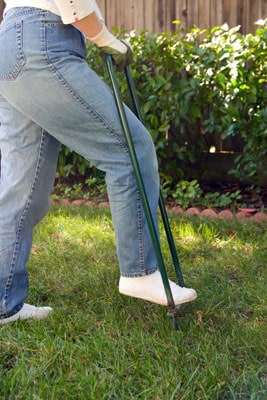
There are several types of aerating tools. Manual aerators (shown above) allow you to do small areas a little at a time and to aerate corners and other tight areas that are difficult to reach with large equipment. You supply the power for these tools by pushing the hollow cylinders or corers into the turf much as you would push in a spade. The tool cuts a plug, or core, that is extracted and deposited on the lawn.
Small power aerators work similarly and are available to rent. Some machines use a rotating tiller-like action that pushes the corers into the soil and extracts small plugs. These lawn mower–size machines will fit into a full-size station wagon, mini-van, or pickup truck, and they require two people to transport them.
The largest aerators will require a truck and several helpers to transport them but do a better job. With these machines, the corers are vertically plunged into the turf to extract a sizable plug. You may opt to have a pro tackle this job. Avoid aerators that only poke holes in the lawn without removing plugs because they are of little value to your lawn.
Aerators penetrate your lawn best when the soil has been moistened by rain or watering; so, unless it rains, water your lawn the day before aerating. When aerating, make several passes in several directions over every square foot of lawn. Next, break up all the plugs extracted by the aerator with the back of a rake or by dragging a metal mesh doormat or section of chain-link fence over the plugs to spread the soil. You can also mix the soil from the plugs with the topdressing you added in Step 5. Then water the lawn thoroughly.
Why Aeration is Good
Over time, lawns can become compacted, which limits the amount of water, oxygen, and nutrition grass can absorb through the roots. When this happens, turf may start to look unhealthy, water runs off or pools on the surface instead of being absorbed, and fertilizers cannot infiltrate the soil and feed the plants.
Aeration not only helps the roots, it helps the earthworms and bugs (microorganisms) that live in the top layers of soil and naturally keep your lawn in shape. Keeping the “good” bugs happy means that your lawn is less likely to be attacked by “bad” bugs, which means you will not have to buy bags of pesticide (which kills both bad and good bugs).
There are several ways to go about aerating your lawn, but the results are generally the same. Most aeration machines (manual or power-driven) will roll over the grass and either punch 3-to-4-inch holes in the turf with spikes, or pull plugs of soil about a quarter-inch in diameter with small pipes.
You can hire a professional service for the task, or rent a unit from your local home care mega-center. For an extra-green approach, strap on a pair of lawn aeration shoes. These tools have 2-inch spikes on the bottom and are ideal for wearing when raking thatch or walking behind the push mower.
Courtesy Yardcare.com