How to Pour a Concrete Slab
Instructions on how to pour a concrete slab, including preparation before having the concrete delivered

pouring concrete cement slab

For footings and/or a slab, you will need concrete. Basic concrete is composed of Portland cement, sand, gravel (also called aggregate), and water. Portland cement is the glue that holds the mix together.
The more cement there is, the stronger the concrete will be. If you are mixing a small amount of concrete or mortar and want to strengthen it, simply add a shovel or two of cement.

When ordering from a ready-mix company, specify how much cement you want; a “six- bag mix” contains six bags of cement per yard of concrete, making it strong enough for most projects. 

If you live in an area with freezing winters, consider ordering air-entrained concrete, which contains tiny bubbles. The bubbles lend the concrete a bit of flexibility, so it is less likely to crack in cold weather. Air- entrained concrete is available only from a concrete truck.

If freezing weather is possible on the day of the pour, you can order an accelerating additive, which makes the concrete harden more quickly. If the weather is hot and dry, think about adding a retardant, which will slow the drying time. If the concrete sets too quickly, you may not have enough time to correctly finish the surface.

Having Concrete Delivered

concrete delivery cement truckBefore you arrange for concrete to be delivered, familiarize yourself with how to pour a concrete slab (see below); you won't have time to read instructions once the work begins.

If the truck driver has to wait more than half an hour, you usually will incur extra expense, so plan to move the concrete quickly.

1) Have all the necessary tools on hand, including two wheelbarrows.

2) Be ready with at least one reliable helper, preferably two.

3) If you want a smooth steel-trowel finish, line up an experienced concrete finisher.

4) Install any isolation joints as well as wire reinforcement beforehand.

5) Run and test wheelbarrow paths, install all forms and guides, and make sure that they are securely anchored.

6) If required, make sure the building inspector has checked the site before you pour. 

7) If your design includes metal post anchors that will be embedded in the slab, make sure to have them on hand. 

Pouring the Slab

A concrete slab may be cast at the same time as footings or after the footings have set up. The slab’s overall dimensions are determined by the size of your new structure.

Before casting a concrete slab, first place any plumbing or electrical conduit that will
run under or through it. After casting the slab, do not allow the surface to dry too quickly or it may crack.

Spray it with a light mist of water, cover it with plastic sheeting, and allow it to cure for three days (longer in cold weather). Begin by marking the slab’s placement on the ground with powdered chalk, or stretch mason’s lines between batterboards to determine the perimeter of the foundation.

A rectangular slab should have corners at precise 90-degree angles. To ensure the corners are square, lay out a triangle with sides 3 feet, 4 feet, and 5 feet long.

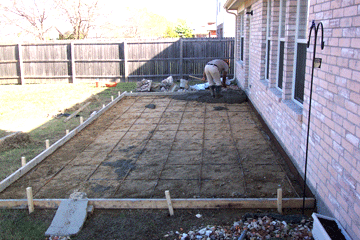
Excavate a flat-bottomed hole for a 4-inch-thick slab; in areas where frost or drainage may be a problem, the slab should be poured over a 4- to 6-inch gravel bed, so dig deep enough to accommodate this.

Build temporary forms from scrap lumber nailed securely to stakes. Make sure the top edges of the forms are level to expedite finishing the concrete later. Pour the gravel bed.

Reinforce the area as required by code (typically with 1/2-inch reinforcing bar around the perimeter and 6-inch-square N. 10-10 welded-wire mesh within the slab area). Support the mesh about 2 inches above the base with small pieces of brick or block.

Thoroughly dampen the soil or gravel. Then, beginning at one corner, place and spread the concrete. Work the mix up against the form, and compact it into all corners with a shovel or mortar hoe by pushing (not dragging) it. Don’t overwork the material or the heavy aggregate may sink to the bottom.

With a helper, move a straight 2 by 4 across the top of the forms to level the concrete, using a zigzag, sawing motion. Fill any voids with more concrete and re-level.

To smooth the surface, move a darby (which you may want to rent) in overlapping arcs and then in overlapping straight, side-to-side strokes. Keep the tool flat—don’t let it dig in. After the water sheen disappears from the concrete, but before the surface becomes really stiff, smooth it once more with a wood or magnesium hand float.

While the concrete is still plastic, install anchor bolts where required by your plan, typically every 3 to 4 feet.

Patio Roofs & Gazebos
All you need to know about building outdoor structures, from an inspirational gallery for unique ways to extend your living space outdoors to step-by-step photo sequences to build an outdoor structure precisely suited to your needs.


Related Articles on HomeTips

DIY & Installation Projects (10)
Repair & Care (4)
How It Works (2)
Buying Guides & Reports (7)