Expert DIY tips on digging trenches for sprinkler pipe irrigation. Learn efficient trenching for sprinkler systems and the best ways to tunnel under concrete.

Once your have mapped out your new sprinkler system and staked your yard with the locations, the task then becomes digging the trenches for the pipes. Start with the one that will connect to the control valves, making it and all subsequent trenches as straight as you can.
Trenching
Trenches need only be 8 to 12 inches deep in mild climates, In areas where hard freezes occur, 18 inches is sufficient. If you live in a very cold climate, consult with your irrigation supplier for the recommended depth below the frost line.

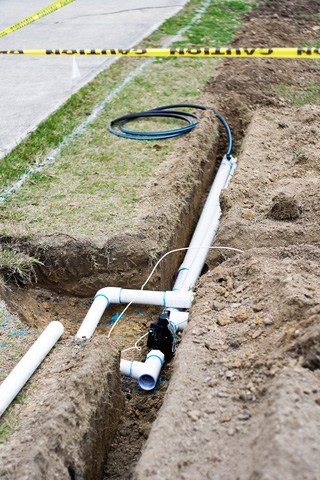
Because digging is arduous work, study your plan one last time for missed efficiencies such as using a single trench for more than one pipe. A pick and shovel are all you’ll need; however, depending upon the extent of your project, you may choose to rent a trenching machine (though this is not an option for flower beds or areas with ground cover because it will destroy the plantings). Water the ground a few days ahead of time to soften it.
Before digging, place plastic sheeting to both sides of each trench you plan to dig. Preserve the sod by gently working the shovel underneath it, peeling it away, and placing it on one of the plastic sheets. Similarly, salvage the soil by placing it on the plastic sheet on the other side. By doing this, replacing both soil and sod becomes a much easier task after you’ve laid the pipe.
If you want to lighten your load even more, you can hire a pipe puller to install the pipes. Using a pipe-pulling machine is not a job for the uninitiated, so do not consider renting one and doing it yourself unless you have had prior experience.
Tunneling Under Concrete
If you are burying PVC pipes outdoors for water supply, sprinklers, or other forms of irrigation, you may arrive at a situation where the pipes must pass under a solid concrete walkway. You don’t want to break or cut the concrete, so what can you do?
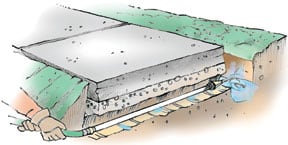
The simplest and often easiest way to tunnel under a masonry path is to blast under it with water. To do this, you’ll need to make a special water-boring tool—a length of steel pipe connected to a hose.
Trench one access hole on each side of the walkway, perpendicular to the path, that will allow you to push the water-boring pipe under from one side to the other. (The chances are good that these holes will be a continuation of the trenches that you will use for running the irrigation pipe later.) Dig right next to the concrete to a depth about 6 inches below the slab, and below the gravel bed if there is one. The idea is to get down to soil that will be easier to burrow through.
Screw a garden hose onto one end of a 3/4-inch steel pipe that is long enough to span under the walk with a little length to spare. On the other end, screw a 3/4-inch to 1/2-inch reducer to ensure a more powerful blast. Turn on the water full-bore, and then use the pipe to erode a tunnel under the walkway. Wear rubber boots and be prepared for a muddy mess!
Once you’ve burrowed all the way under the walk to the access hole on the other side, turn off the water but leave the pipe in the tunnel. Allow the pools of water to seep into the ground or scoop out the water.
Cover one end of a length of PVC pipe with duct tape to seal out dirt. Then duct tape that end to the nozzle end of the steel pipe (or use a 3/4-inch female threaded-to-slip fitting). Have a friend pull out the steel pipe as you push the PVC pipe under the walkway from the opposite direction. Remove the duct tape, and you’re ready to make connections to the PVC pipe at both ends.
NEXT SEE: Laying & Connecting Sprinkler Pipe