Does your dishwasher leaves spots, film, or white residue on dishes? This article explains why and shows you how to solve these problems.

Dishwasher Does Not Clean Dishes
Glassware Has Film or Spots
If a dishwasher washes poorly, a common cause is improper loading—dishes that block or impede the spray arms or prevent the soap dispenser from opening. On the other hand, if your dishwasher has chronic problems with good washing, the problem may not be your dishwasher. A good first step is to vary the amount of dishwasher detergent you’re using and try switching brands.

Other possibilities: Your home’s water pressure may be too low, your water may be too hard, or the water temperature may not be hot enough.
For other dishwasher repairs, see How to Repair Dishwasher Problems.
Dishwasher Does Not Clean Dishes
Problems with getting dishes clean usually have to do with the water pressure, the hardness of the water, or the ability of the spray arms to spin and spray.
Water Pressure Is Too Low
In order for your dishwasher to fill to the appropriate level, water pressure should be from 20 to 120 pounds per square inch. If you suspect that your water pressure may be low, turn off all faucets or other users of water (such as washing machines and sprinklers) and then put a half-gallon jug under the kitchen faucet.
Turn on the hot water full-blast. If the jug doesn’t fill within 14 seconds, your water pressure may be too low for proper dishwasher operation. Call your city water utility to discuss your options, or avoid drawing water elsewhere in the house or yard during dishwasher cycles.
Water Is Too Hard
The right amount of detergent to use depends on how large your load of dishes is and how hard your water is.
According to the United States Geological Survey (USGS) , water hardness is simply defined by “the amount of dissolved calcium and magnesium in the water”. Without defining the various degrees of severity, you can assume you have some level of “hardness” if your dishes are left with white spots after drying.
Hardness is measured in grains of minerals—the more grains per gallon you have, the more detergent you’ll need.
If your water has 12 grains or more of hardness, fill both dishwasher soap cups completely with detergent. If that doesn’t work, consider installing a water softener. For more information, see How to Test for Hard Water.
Water Temperature Is Too Cool
To check water temperature, hold a meat thermometer under the hot water faucet for two minutes; if it doesn’t register a minimum of 140 degrees F., turn up the temperature dial on your hot water heater. (However, if you have a newer dishwasher that heats the water internally, it isn’t necessary to turn up your hot water heater.)
Dishwasher Spray Arms Don’t Work Properly
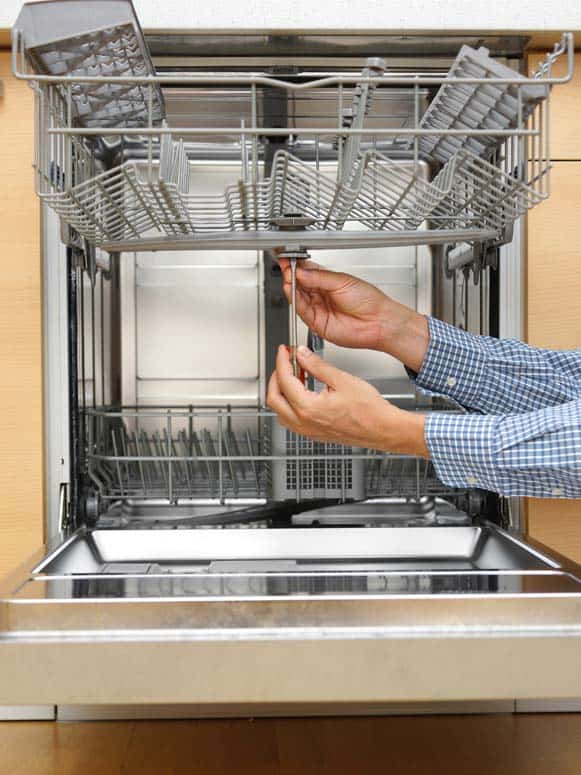
If your dishwasher has worked fine in the past but suddenly your dishes aren’t clean after the dishwasher completes all cycles, listen to the spray arms spinning inside during the wash cycle (these are typically located at the bottom of the machine and under the top dish rack). If the spray arms are spinning poorly or not at all, turn the dishwasher off and allow it to cool down. Make sure nothing is blocking the arms from turning. Check their rotation to see whether they spin freely. If they don’t, remove them by unscrewing the hubcap or hub bolt. Check the bushings. If they’re worn, order replacements and install them.
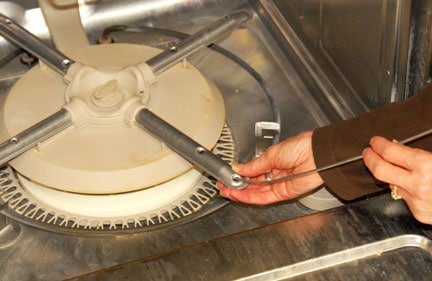
If the arms turn freely, the problem is more likely mineral deposits clogging up their spray holes.
To clean the bottom spray arm, remove the bottom dish rack and use a stiff wire to clean out the holes in the arm.
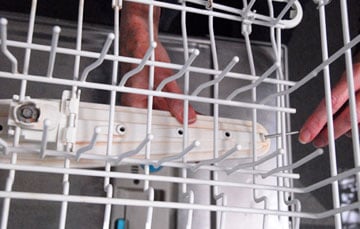
You can often clean the top spray arm without removing it; again, just use a stiff wire to clean out its holes.
Glassware Has Film or Spots
If your dishes or glassware appear filmy or spotted following a complete wash cycle, adjusting the amount or type of detergent you’re using and adjusting your hot water heater’s water temperature may solve the problem. But before you do either of these, put a rinse additive (such as Jet-Dry) in the rinse dispenser to improve the sheeting action of the water.
Next, you’ll have to determine whether the film is removable or permanently etched. To do this, soak a glass in undiluted white vinegar for about 15 minutes. Or, wash the glass with warm water and concentrated dishwasher detergent or a high-phosphate detergent (try Glisten or Glass Magic).
If the film comes off, it is probably caused by hard water minerals, improper amounts of detergent, or unsuitable water temperature. Permanent etching is often caused by a combination of soft water and excessive heat or detergent. If glassware is permanently etched, there isn’t anything you can do to make it clear again. But you can avoid future etching by taking these steps:
1 Be sure hot water entering the dishwasher is no hotter than 140 degrees F. Don’t use extra-hot settings such as “Power Scrub,” and use the “Energy Saver” dry cycle.
2 Adjust the detergent amount. First try using a little more, and then try using less.
3 Don’t pre-rinse your dishes before loading them in the dishwasher. Food particles on the dishes actually help the detergent and drying agents clean better.
NEXT SEE: How to Repair Dishwasher Problems
Featured Resource: Find a Local Appliance Repair Pro