Expert illustrated advice and video on how to clean rain gutters, including DIY roof gutter cleaning techniques and how to hire a gutter cleaning service.

Gutters are an integral part of a home’s drainage system. During a rainstorm, roof gutters route runoff from a very large surface—a home’s roof—to where it can drain away from the house. By doing so, they protect siding, windows, doors, and foundations from water damage and help prevent flooding in basements.
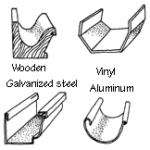
To do their job, gutters and downspouts must be clear of leaves and debris. When gutters clog, drain outlets will dam up and rainwater will fill the gutters. Clogged gutters overflow and eventually pull loose. Water that pools in troughs will rot wood gutters and rust sheet-metal ones.
Plan to clean the gutter system every spring and fall—more often if your roof is directly beneath trees. The best time to clean gutters is after fall winds have blown leaves from the trees but before rain has made the leaves a soggy mess inside gutters.
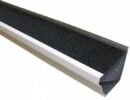
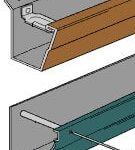
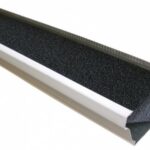
NOTE: Gutter guards and leaf-catchers can be helpful for minimizing the need for cleaning gutters. However, debris eventually settles through the guards, and then they must be removed for gutter cleaning. Before buying a leaf-catching system, be sure it can be easily removed for cleaning.
For more, see How to Buy Gutter Guards & Leaf Catchers.
How Much Does Gutter Cleaning Cost?
The easiest and safest way to clean gutters is to hire a gutter cleaning service. But how much does gutter cleaning cost?
Nationally, the average cost of having a gutter service clean gutters is about $150. This stated, gutter cleaning prices can be as little as $75 or as much as $350 for an entire house, depending upon the region and the extent and nature of the job.
The cost is usually calculated by the linear foot (not square feet). Figure the price of cleaning gutters will run from about $.50 to $1.50 per linear foot. Measure the perimeter of your house to gain a rough idea of how many linear feet of gutter your home has.


The size and height of the roof are big factors in the price of cleaning gutters. If, for a 2- or 3-story house, a gutter cleaning company needs several very tall ladders and special safety equipment, the job is going to cost significantly more than cleaning the gutters on a single-level home. Local labor rates will also affect the price.
If pines or other evergreen trees drop needles onto your roof, this can also increase the price of gutter cleaning. The harder it is to get leaves, needles, and debris out of the gutter troughs, the higher the price.
Gutter guards are another factor. If your gutters are protected by gutter guards, less debris is likely to filter into the gutter troughs. On the other hand, if the gutter guards are difficult to remove and replace for gutter cleaning, gutter guards can add to the price.
The only sure way to know how much cleaning the gutters on you house will cost is to get bids. Ideally, get estimates from two or three gutter cleaning services so you can compare.
How to Clean Gutters — DIY
If you have the necessary equipment and fortitude, DIY gutter cleaning is a money-saving option.
But only take on this task if you can work safely from a ladder or the roof. If your roof is higher than a single story, you’re probably better off hiring a gutter cleaning service pro. Landing in the hospital ER is not worth saving a couple hundred bucks.
When working from a ladder with conventional gutter cleaning tools, choose a sturdy ladder, and place it on a firm, level base. Considering you’ll be moving the ladder frequently, a tall stepladder can be easier to use than an extension ladder.
If you must lean an extension ladder against a gutter, you can protect the gutter from bending by placing a short piece of 2 by 4 inside it. Ladder stabilizers also make it safer.
Stand on the ladder with your hips between the rails, and don’t lean out over the sides. Never stand on the top two rungs. For more safety advice, please see Ladders: The Ultimate Guide to Choice and Safe Use.
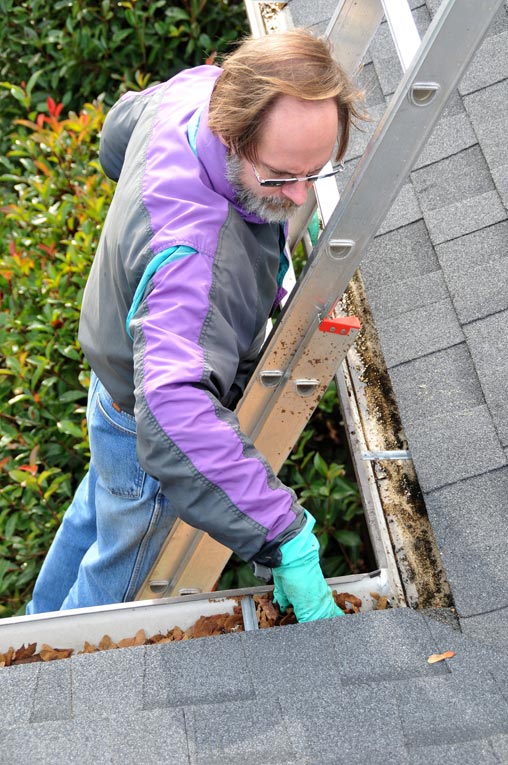
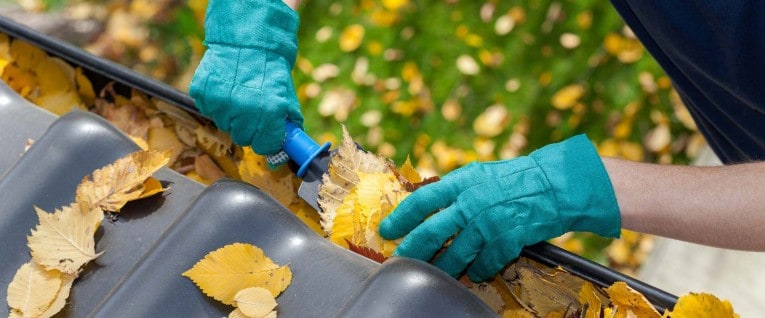
When cleaning gutters, wear heavy work gloves to protect your hands since gutters often have sharp metal parts or screw points sticking out into the troughs.
Also wear safety glasses or goggles. In some situations, it’s helpful to have a bucket for collecting debris and a dropcloth for protecting areas beneath the gutter.
Before you begin, rake or use a leaf blower to blow the leaves and debris off of the roof so the next heavy rain doesn’t wash it down into the gutters, filling them up again. Only do this if you can work safely on the roof and your roof has a very low pitch.
Never work on the roof in wet, icy, or windy conditions. Wear non-slip shoes, and never lean over the edge or work near power lines.
How to Clean Gutters — Step-by-Step
- Scoop out loose debris. Starting at a drain outlet at the low end of a gutter, use a narrow garden trowel or a gutter scoop to scoop out loose debris, working away from the drain outlet.
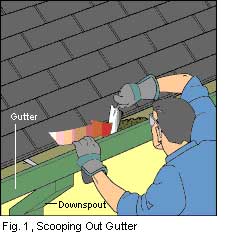
It’s usually easiest to do this when the debris is slightly damp and pliable, not soggy or dried and encrusted. To minimize cleanup later, you can scoop the debris into a plastic bucket or plastic bags.
2. Blast out the gutters with a hose. Using an on-off high-pressure spray nozzle mounted at the end of a water hose, wash out each length of gutter, working toward the drain outlet.
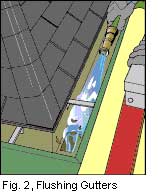
Obviously, this can be a messy job. Do your best to avoid splattering mud all over your house and yourself. If necessary, use a stiff scrub brush to remove encrusted dirt.
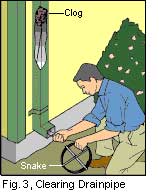
3. Clear obstructions in drainpipes. If water doesn’t drain freely through the drainpipes, try flushing the debris down them with a hose. If that doesn’t work, use a plumber’s auger (snake) to free and pull out the debris from the bottom or, in some situations, to push it through from the top.
Video: How to Clean Gutters From A Ladder
This video does a good job of showing the entire process of cleaning a gutter by hand and with the help of a hose and high-pressure nozzle:
How to Clean Gutters with a Leaf Blower
Almost everyone who has ever cleaned a gutter has tried to come up with a better, easier method. One somewhat inevitable option has been to take the leaf blower—a tool designed to blow leaves on the ground—up to blow leaves out of the gutter. This can be done a couple of different ways.
The Dangerous Gutter Cleaning Option
Although we do not recommend it, a method sometimes used by home handymen is to blow dry debris out of gutters with a leaf blower from the roof. Do not use this method unless the roof is low level and gently sloped! If you use this method, wear goggles and a dust mask, and a roofer’s harness that tethers you to the roof. Be extremely careful when working on top of the roof—this is very dangerous! If you have a handyman or other service do this work, be sure they are insured so you are not held liable if a worker is injured.
The Safer Gutter Cleaning Option: Blowing from Below
A much better option than climbing onto the roof is to use a gutter cleaning kit that fits onto to a leaf blower.
Combined with a powerful leaf blower, this allows you to work from the ground. It works particularly well with low-level gutters filled with dry leaves.
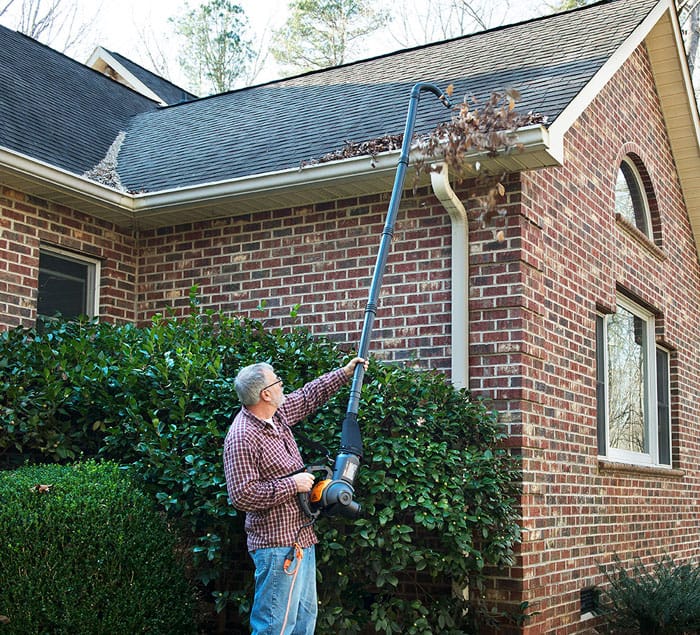
Again, you’ll want to wear goggles and old clothes to protect yourself from the flurry of leaves and debris that could blow down on you.
Here is a helpful video by MarkThomasBuilder about how this leaf blower gutter cleaning kit works:
How to Maintain Rain Gutters
Inspect and clear gutters in both spring and autumn. You also may have to loosen dirt that has blown into the gutters and scrub them with a stiff brush. Flushing gutters with a stream of water from a hose will clear material that has become lodged in the eaves troughs and downspouts.
The slope of gutters may need to be adjusted from time to time to keep water moving toward downspouts. Run water through them, and, if they drain slowly, reposition them so that they slope toward the downspouts at a rate of 1/4 inch for every 10 feet.
Be sure your downspouts expel water well away from your house. If necessary, add downspout extenders to carry the water away (see How to Fix Gutters and Downspouts). Also consider concrete or plastic splash blocks, which are slightly sloped and extend away from the house at least 4 feet.
If your climate delivers abundant rainfall, you may want to have your downspouts run into a dry well. The well should be a hole 2 to 4 feet wide and 3 feet deep or a 55-gallon drum, with both ends removed and filled with rocks, that you’ve buried and punctured with holes. Underground drainage pipes should slope to the dry well, which will effectively keep water away from the house’s foundation. Check local building codes before installing.
Also check downspouts for rust, flaking, or peeling paint, plus leaks, and make sure they are affixed tightly against the fascia boards. Check the fascia boards themselves for dry rot or other damage, and, if need be, replace them with lumber treated with wood preservative that is finished to match the other boards.