Buy the right central air conditioning system with help from this expert, unbiased guide. This article includes anticipating cost, selecting size, scrutinizing warranties, and more.

Need help NOW? Get a Local Air Conditioning Pro Fast!
If you’re thinking about installing or replacing a central air conditioner, you’re probably aware that this is one of the most significant home improvements you can make in terms of comfort. On a hot, humid summer day, few amenities add to quality of life more than central air conditioning.
Air conditioning is also one of the most expensive improvements you’re likely to make, so it pays to do your homework and choose wisely.

Types of Central Air Conditioners
This article is about whole-house air conditioning, not single-room units or heat pumps.
Unlike window, portable, or in-the-wall single room air conditioners, a central air conditioner distributes conditioned air throughout the house.
If you’re not sure whether to buy individual room air conditioners or a central air conditioner, see the article Choosing Central or Room AC, which compares the two. For information on single-room air conditioners, please see How to Buy a Window or Room Air Conditioner.
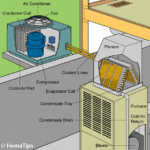
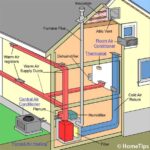
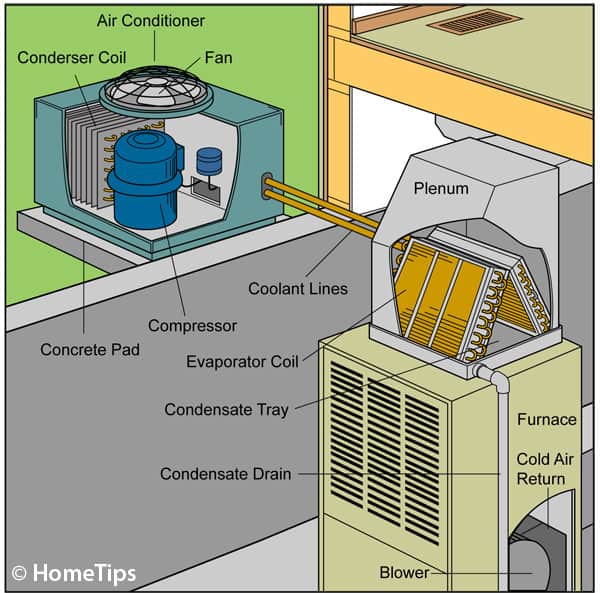
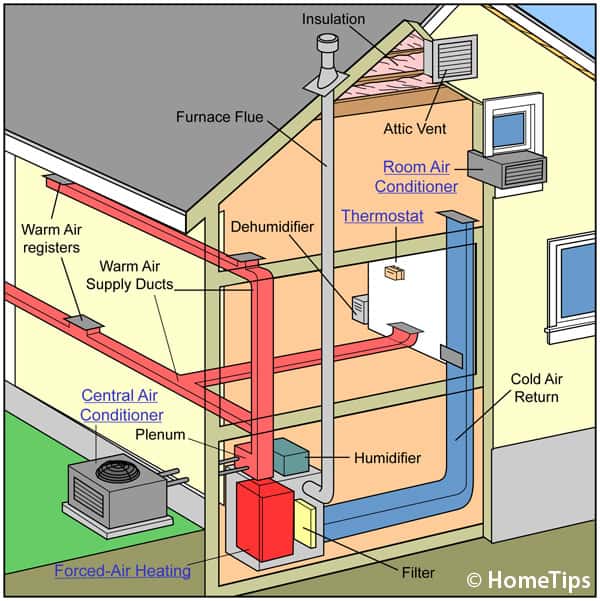
As shown in the diagrams, a central air conditioning system consists of a condenser unit, an air-handling unit with a blower (such as a forced-air furnace) and an evaporator coil, and a system of ductwork for exchanging room air with chilled air.
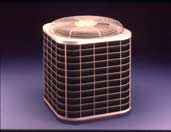
The condenser typically sits outdoors, and the air handler with the evaporator is usually located in the basement, attic, or garage. The ductwork is routed through the basement or attic and walls throughout the house.
The air conditioner uses refrigeration technology to cool the air. (For more about how this works, see How a Central Air Conditioner Works.)
A heat pump is related to an air conditioner. It is essentially a central air conditioner that can be reversed in winter to heat a house. If you’d like to know more, see Heat Pumps Buying Guide.
A/C Sizing & Cost
If you’ve decided that a central AC unit is right for your home, it’s time to dig deeper into the particular size and type of unit, as well as its energy efficiency, features, warranty, and more. These issues are discussed below. For additional help, see:
Central AC Energy Efficiency
Because of today’s high cost of energy, air conditioners are very expensive to operate, and they consume more than their share of our precious energy resources. Because of this, when choosing an air conditioner, the name of the game is efficiency—that is, an air conditioner’s ability to convert energy (electricity) into cooling in the most cost-effective way. You want maximum cooling for minimum bucks.
One note about replacing an aging system: Be sure to replace both the outdoor condensing unit and the indoor evaporator. If you just replace the condensing unit, potential gains of a higher-efficiency unit may be lost.
The SEER Rating
To reduce wasted energy, the U.S. Department of Energy established minimum efficiency standards for air conditioners.
Every AC unit is given an efficiency rating, called a SEER— short for Seasonal Energy Efficiency Rating.
The SEER is listed on the yellow Energy Guide® label posted on each unit. It’s very important to look at these ratings. The higher the number the more efficient the unit and the less it will cost to provide cooling.
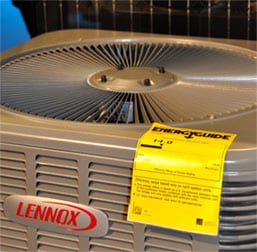
During the past decade, the minimum SEER rating required of new units has continued to rise.
Though old air conditioners may have a SEER as low as 6, models manufactured after January, 2006, must have a SEER of at least 13. The most efficient models have SEER ratings of 15 to 17. Just so you understand the relative scale, a SEER of 13 is 30% more efficient than a SEER of 10.
Energy-Saving Features
To achieve particularly high SEER ratings, air conditioners may have any number of energy-saving features. Look for:
• Large coils for more efficient heat transfer
• A high temperature rating (EER) greater than 11.6 and a thermal expansion valve. When the weather is hottest, this translates to high-efficiency operation.
• A variable-speed blower to reduce electricity consumption, tailoring the usage to the need
• A fan-only switch. This allows you to turn off the cooling but leave the fan running to circulate air for more natural, affordable cooling.
• An automatic delay fan switch, which keeps the fan on long enough to utilize residual cool air that remains after the compressor turns off
• A filter indicator light that lets you know when the filter needs changing. This boosts efficiency by ensuring proper maintenance.
Other Features
Many high-efficiency products combine several of these features and add some of their own. Case in point: The York Stellar Ultra features two compressors that work in tandem when high cooling capacity is needed. The rest of the time, only one of the compressors operates. These, combined with a variable-speed motor, achieve a SEER rating of 16.7.
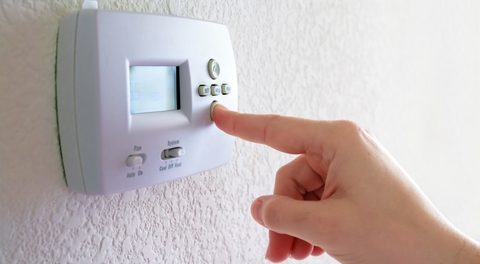
Programmable thermostats also help by offering precise control. For more about these, see Thermostats Buying Guide.
What About Ultra-High Efficiency?
Do you need an ultra-high-efficiency air conditioner? Not necessarily.
Of course, for the sake of the environment—from energy usage to greenhouse-gas emissions—the higher the efficiency the better.
But, in terms of dollars, the savings compared to the premium you will pay may not pencil out for you, particularly if you live in a climate that requires little cooling during the year or if your home isn’t tightly insulated.
On the other hand, where an air conditioner must run frequently during the year, a highly efficient model will pay for itself in energy savings over a period of years.
Central AC Warranties
Air conditioning warranties are key to ensuring that AC systems will last for many years.
Before purchasing central air conditioning, ask for—and read—its warranty and be sure you understand the terms and restrictions.
Air conditioning warranties can vary significantly from one manufacturer to another. A warranty may cover most of the unit under one set of terms or offer differing coverage on various parts of the air conditioner.
For example, Whirlpool covers all parts of the mechanical and refrigeration systems (except the air filter) for five years, including labor.
Carrier covers the air-conditioning unit and authorized labor for repair or replacement for one year. With Carrier, the refrigeration components, including the compressor, condenser, evaporator, connecting tubing, and refrigeration charge—including labor for repair or replacement—are covered for years two through five under an extended warranty.
With many manufacturers, parts may be covered, but the labor for replacing such parts as the motor, solenoid, relays, switches, and fans may not be covered by warranty. Read the fine print.
And then there is the “Limited Lifetime Warranty.” Amana, for example, offers this and will cover the compressor of a high-efficiency air conditioner or heat pump for as long as you own the house.
The bottom line with central air conditioning warranties is to read them carefully and understand what they do and do not cover.
Be advised that a warranty will be void if the air conditioner is worked on by a non-authorized service person and that it does not cover standard maintenance, cleaning, or damage that is caused by neglecting maintenance.
Understanding AC Refrigerants
Refrigerants used in most air-conditioning systems manufactured until recently can be very damaging to the Earth’s ozone layer. Equipment that contains and operates using these refrigerants is being phased out internationally.
When buying new air conditioning system, be sure to buy a current product that utilizes refrigerants that do less damage to the environment.
How do refrigerants pass from AC equipment to the atmosphere? All refrigerant gasses are contained in an air conditioner’s sealed system. The problem is that an aging sealed system may develop leaks and allow the refrigerant to escape. The release of these gasses also occurs during servicing.
AC Refrigerants Being Phased Out
In 1987, an international agreement began a worldwide phase-out of ozone-depleting CFCs (chlorofluorocarbons), eventually stopping production of AC equipment that uses them in 1996.
These were replaced by hydrochlorofluorocarbons (HCFCs). R-22 (also known as HCFC-22 or, more commonly “Freon”) has been the favored refrigerant for residential air-conditioning and heat pump systems. This is less damaging to the Earth’s ozone layer, but still is an ozone-destroying greenhouse gas and, during its manufacture, produces HFC-23, which contributes significantly to global warming.
This is a problem, so the manufacture and import of R-22 AC equipment was phased out by the EPA in 2010 under the Clean Air Act. The manufacturer of the refrigerant R-22 was reduced by 75%, will be further reduced by 90% in 2015, and was scheduled to be stopped by 2020. As a result, R-22 is becoming increasingly expensive.
If you need to have R-22 recharged in existing equipment, be sure to get a price quote first and find out whether the quote includes servicing, which typically costs about $115. Don’t be surprised if the gas costs $100 per pound or more. This price is only going to go up. (Equipment typically only needs to be recharged if it’s leaking—first and foremost, get the leak fixed!)
Alternatives to R-22 Refrigerant
Today, manufacturers of residential air conditioning systems offer AC equipment that uses ozone-friendly refrigerants. For servicing existing equipment, R-22 is still available and will continue to be available for 10 years or more.
The EPA has reviewed a variety of substitutes for R-22. You can see these on these alternatives to R-22 on the EPA website.
A popular substitute for R-22 is R-410A, a blend of hydrofluorocarbons (HFCs). It is manufactured and sold under various trade names, including Puron®, Forane® 410A, GENETRON AZ-20®, and SUVA 410A. It does not deplete the ozone layer but, like R-22, its manufacturer does contribute to global warming. R-407C, another acceptable substitute for R-22, is used in some European residential air conditioners.
NEXT SEE:
• Central AC Overview
• Central Air Conditioning vs Window AC — Which Is Best?
• Sizing a Central Air Conditioner
• How a Central Air Conditioner Works
• Central Air Conditioning Repair & Troubleshooting
This FREE service will help you find a qualified local AC professional.