How to buy asphalt roofing shingles, with details on the parts and composition of laminated, interlocking, and strip shingles for asphalt roofs.


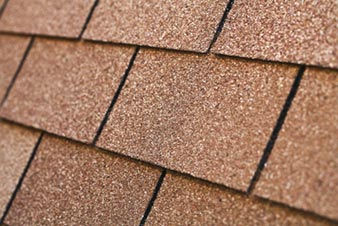
Nearly four-fifths of American homes have asphalt shingle roofs. The two basic types are composition and fiberglass-base shingles. Composition shingles have a core of organic “felt” made from wood and paper fibers. Fiberglass-base shingles have a core of man-made fiberglass matting.
Both composition and fiberglass-base shingles are soaked in asphalt, but the fiberglass base shingles are more fire- resistant than the organic ones. Asphalt shingles have mineral granules embedded in their surfaces to offer protection against wear and the sun’s ultraviolet radiation. When you find these granules washing away it’s a sign that you need to repair or replace your shingles.
Note: For a deep dive into how asphalt shingles are made, why they often fail ahead of their time, check out the new book by our friend, Tim Carter of Ask The Builder, Roofing Ripoff: Why Your Asphalt Shingles Are Falling Apart and What You Can Do About It.
Choosing from the wide assortment of available colors, textures, patterns, and weights can be daunting. Most homeowners prefer premium-weight shingles, which may weigh 430 pounds per square (a 10-by-10-foot roof area), compared with standard shingles at about 230 pounds per square. Because premium-weight shingles are more three-dimensional, they do a better job of mimicking the texture of real wood shingles.
Types of Asphalt Shingles
Four types of asphalt shingles are manufactured: strip shingles, laminated shingles, interlocking shingles, and large individual shingles.
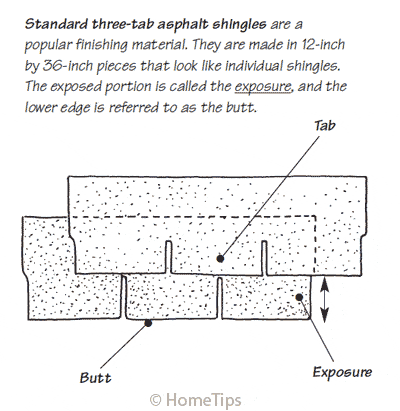
Strip shingles are the conventional type. They’re made in both standard and metric sizes. Those made for the American market are 12 inches wide by 36 inches long. Of these, “three tab” shingles are the most common. With these, a cutout distinguishes each tab, making it look like an individual 12-inch-wide shingle. Depending on how you align these tabs, you can create a variety of patterns of shadow and light on the roof.
Architectural shingles, also known as laminated or three-dimensional shingles, are premium asphalt-based roofing shingles that vary in the size, number, spacing, and thickness of the tabs. They have more character and visual depth than standard strip shingles. Since the first commercially successful asphalt shingle was produced in 1953, manufacturers have endeavored to create shingles that could rival the texture and visual interest of wood, tile, and slate roofing.
Given that an asphalt shingle is essentially a flat, asphalt-saturated cellulose or fiberglass mat coated with mineral granules, the job of making it look natural, textured, and three-dimensional has been a challenge for roofing manufacturers.
Three-dimensional, laminated shingles were first introduced in the 1970s. They were built up from two or more layers of material sandwiched together. The surface granules were colored to imitate shadow patterns.
In recent years, refinements of the three-dimensional shingle have resulted in a new generation of high-quality asphalt roofing products with distinctive, often dramatic, appearances. With these advancements came a new name: architectural shingles.
The top overlay of these shingles is often notched, cut in a sawtooth pattern, and/or offset for definition and interest. Because of their extra thickness, these shingles weigh considerably more than conventional asphalt-based shingles and have longer warranties. Weights run up to about 430 pounds per square (100 square feet of roof area). Limited warranties may be 25 years or longer.
Interlocking shingles, excellent for heavy-wind areas, are designed to fasten to one another.
Large individual shingles are generally used in specialty situations. Their shapes tend to be either hexagonal or rectangular and they don’t have tabs.
Parts of an Asphalt Shingle
As shown in the illustration, the portion of a shingle that shows is called “exposure,” and the lower edge is referred to as the “butt.” Shingles come in a variety of weights. Generally speaking, the heavier the shingles, the longer they last.