A concise, expert explanation of the inner workings of a refrigerator with a detailed diagram


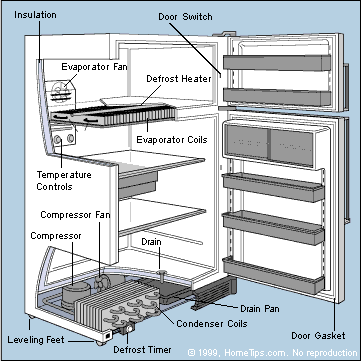
Refrigerators and freezers (as well as air conditioners, heat pumps, and other appliances that produce “cold”) use basic refrigeration principles to extract heat from the air. To remove heat from the air, a compressor pushes a refrigerant through copper tubing between a condenser and an evaporator coil. Both are located in the appliance.
The cycling of this refrigerant through the closed (“hermetically sealed”) system provides continual cooling as it changes from a high-pressure, high-temperature liquid to a low-pressure, low-temperature vapor and liquid, and then back again, absorbing heat.
For the technically minded, here is how the process works. The cool vapor is moved from the evaporator by the compressor and is then compressed into a high-temperature, high-pressure vapor and pumped into the condenser.
In the condenser, the high-temperature, high-pressure gas gives up its heat as cooling air moves through the condenser coils. As it does this, it returns to a high-pressure liquid that cools even more as it moves to a metering device in which it then again becomes a low-pressure, low-temperature gas and liquid to begin the cooling process over again.
The interior of the refrigerator or freezer compartment is essentially a box that is heavily insulated so that very little heat is absorbed from the outside air and very little cold air is allowed to escape.
Most refrigerator/freezers introduce chilled air into the freezer section; from there, the cold air can pass into the refrigerator to keep its interior space cold. Controls regulate how much cold air may pass from the freezer into the refrigerator.
Today, most refrigerators are frost-free. They have automatic defrosting systems so that you don’t have to take everything out of your freezer so you can melt built-up ice there. An automatic defrost system includes a timer, a limit switch, and a heater, which melts away frost.