How to Safely Test an Electrical Circuit

Common electrical circuit problems and how you can troubleshoot their causes and effects
Home electrical circuits may incur a number of problems. Among these are:
• Faulty wiring within the house
• Too many lamps or appliances on a single circuit
• Defective wall switches or receptacles
• Defective cords or plugs
• Defective circuits within appliances
Short circuits happen when a hot wire touches a neutral or ground wire; the extra current flowing through the circuit causes the breaker to trip or a fuse to blow.
Sometimes it’s difficult to tell the difference between an overloaded and a short circuit. For how to pinpoint the problem, see How to Trace a Short Circuit or Overload.
Caution: Never work on a live circuit, fixture, receptacle, or switch! Use an electrical circuit tester to make sure a circuit is not active after you have shut off the power—sometimes more than one circuit is wired through a box.
How to Safely Test an Electrical Circuit
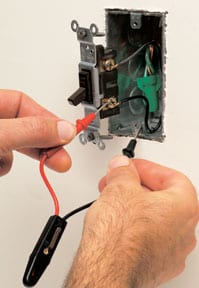
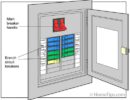
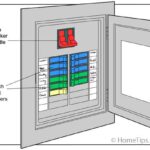
Whenever you work on an electrical circuit, it is critical to first make sure that the circuit is turned off—not just at the switch but at the main panel or subpanel that controls the circuit. Then, before working on the circuit, you must double check the circuit or device to make sure it is indeed off.
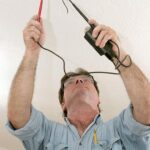
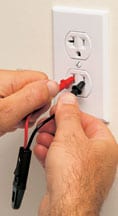
To safely test an electrical circuit, use a circuit tester (as shown at left and enlarged at right) to ensure that no electricity is flowing through it.
Holding the insulated parts of the probes, touch the bare metal end of the black probe to the grounding conductor or the grounded metal box, and then, while holding the probe there, touch the bare end of the other probe to the terminal or bare wire that is normally “hot” (live). This is typically a black or red wire or a white wire wrapped in black tape to designate that it is on the “hot” side of the circuit.
If the circuit is live, the tester will light up (or otherwise signal the presence of electricity, depending on the kind of tester you are using).
Always hold the probes of the tester by the insulation around them. In the event that the right circuit was not turned off, or if the system shorted out, the wires in the circuit could still be hot. Touching wires with your fingers or any metal tool could cause a short circuit and very possibly give you a shock.
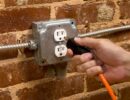
To test whether a receptacle is live or dead, you don’t need to remove the device’s faceplate. Simply insert the tester’s probes into the slots, as shown at right. If the tester lights up, the receptacle is still conducting electricity.