Expert advice on how to test for asbestos in a home, dealing with asbestos problems, and how to hire an asbestos abatement or removal professional.

The first step in determining whether or not asbestos is present and a hazard is identifying the substance itself.

Asbestos is frequently off-white in color, though less common types may be blue or brown. Its appearance generally depends on the material it was mixed with to make it workable: cement, polymers, starch, asphalt, or other binders.
Where Asbestos Is Found
Here’s where to look for asbestos and what to do if you find it:
Heating Ductwork
Some ducts are made largely of asbestos; other ducts, made of metal, may be wrapped with a cellulose-asbestos air-cell insulation. Both look a bit like off-white corrugated cardboard. Asbestos sheeting insulation has a similar appearance but not the corrugation. In addition, registers may have asbestos taping inside.
Ductwork made of asbestos is a major concern because, when the substance begins to deteriorate, the fibers are blown into the house. Talk with an asbestos abatement contractor about removal. (See below for how to hire a qualified asbestos abatement contractor.) Removing ductwork costs $12 to $25 per lineal foot—or $1,000 to $2,000 for a standard-sized basement. Replacing the ductwork is additional.
Wrapped ducts should be removed if the wrapping is friable. A stop-gap measure is to have the ducts encapsulated.
The furnace may have an asbestos lining at the base or sit on an asbestos pad. A special asbestos cloth may join the furnace or boiler to the ductwork. If any of these are exposed to possible damage, they should be encapsulated or removed.
Asbestos in Plumbing
Some pipes, particularly those connected to radiators or steam heat, are jacketed with asbestos. Asbestos pipe wrap, often covered with canvas, has a crumbly white surface. If the pipe wrap has small holes, it’s generally better to repair it than remove it. You can caulk the holes and then wrap the pipe with re-wettable glass cloth. Don’t use duct tape because it will fall off over time.
Wiring
Be wary of old knob-and-tube wires that have a white coating covered with black fabric. If you’re remodeling, do not pull out these wires; instead, bypass them when installing new wiring.
Fireplace Asbestos
Artificial logs manufactured prior to 1978 probably contain asbestos. The ashes are a serious concern; remove them immediately. The logs don’t release fibers unless they are friable. Wood-stove gaskets and protective panels for wood stoves or ovens may look like grayish-white stone. If any of these parts is damaged, remove and replace it with a safe and acceptable material.
Crawlspace or Basement
Keep in mind that fibers may have collected on the ground or floor beneath ductwork or piping. Have these areas cleaned by a trained asbestos abatement professional or—if you must—wet mop them. Never sweep or vacuum asbestos fibers—they are about 1/1000th the thickness of a human hair and will go right through a household vacuum and into the air.
Walls & Ceilings
Sprayed-acoustical, commonly called “cottage cheese,” ceilings generally have a very low percentage of asbestos, though some may contain as much as 40%. Avoid doing anything that will loosen the material (for example, don’t sweep the ceiling). Removal can be quite expensive, from $5 to $30 per square foot, and is generally not necessary if the surface is left alone.
Most patching plaster and drywall joint compounds on the market until 1979 contained a small amount of asbestos. Avoid scraping or sanding them. Some plaster walls in older homes contain blown-in insulation that includes asbestos; it looks like cotton that has hardened. Only have this removed if you’re remodeling.
Flooring that Contains Asbestos
Even recently manufactured vinyl flooring tiles contain a modest amount of asbestos. Because it is ingrained in the material, it does not pose a threat. The tile and its felt backing only become a problem when you’re renovating. Don’t sand or scrape these materials. Rather than removing the old vinyl flooring, the best alternative is to cover it with underlayment and then add the new flooring on top.
Roofing & Siding
Some older shingles are made from asbestos mixed with cement or asphalt. Asphalt-asbestos shingles don’t release fibers easily; asbestos-cement shingles can, so be careful during removal. Avoid breaking or crumbling either kind. Roofing tars and felts also contain asbestos but, again, are unlikely to release fibers unless damaged.
How to Hire an Asbestos Abatement Inspector or Contractor
Qualified asbestos abatement inspectors as well as some plumbing and heating contractors can help locate suspect materials. A lab test of a sample, which generally costs under $50, can provide a definitive answer as to whether or not the sample contains asbestos.
The EPA has a toll-free number you can call for laboratories who do this work, and it also offers instructions for obtaining and packaging the sample.
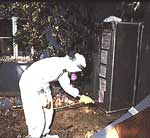
Though some states require licensing of asbestos abatement contractors, others don’t. Unscrupulous contractors might sell you a bill of goods you don’t need or do a shoddy job. They may leave airborne asbestos levels that measure three to four times higher than they did before the job. If this happens, clean-up costs can be astronomical.
Familiarity with the information given here will help you in the interviewing process. You can also contact your regional office of the EPA for information.
Determine the level of training and experience your contractor has had and request references. If your state has a licensing program, be sure your contractor is certified. If no certification program exists, get proof that workers have been trained in an EPA-approved program. Be sure to get several estimates and be wary of any that are very high or low.