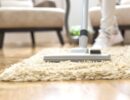
The various carpet materials differ in their ability to resist stains and wear. And the higher a carpet’s pile, the more difficult it is to get all the dirt up when vacuuming. Some materials, such as wool and acrylic, also abrade more easily because the yarn does not hold its integrity as well as some other materials. Finally, some carpet materials fade more easily than others when exposed to sunlight.

Static Electricity in Carpeting
Fixing Carpet Dents & Ripples
Fixing Carpet Seams or Tears
Repairing Carpet Snags
Preventing Faded Carpeting
Carpet Stains & Cleaning
How to Remove a Carpet Stain
How to Remove Pet Odors From Carpeting
Carpet Cleaning Basics
Hot Water Extraction
How to Remove Candle Wax From Carpeting
Tips on how to deal with static electricity, carpet dents, snags, tears, fading, and other carpet problems.
Depending on stains and wear, carpeting may need to be replaced every five to ten years or so-obviously, carpet in less- traveled or less heavily used rooms will show less wear than carpet that is on a direct path from the living room to the kitchen, say.
There is little to be done to repair carpet short of replacing it. Patches look tacky. However, if the seams come up because they weren’t glued down properly, or if the tacking strips come loose from the edges, these problems can be easily remedied.

As a group, carpet installers are more willing than other contractors to take on small jobs and handle minor repairs. They are relatively affordable and are equipped with all the necessary tools and skills, so it usually doesn’t pay to do carpet repair work yourself.
Static Electricity in Carpeting
When you walk across your carpet, are finger shocks and other static electricity problems driving you nuts?
Static electricity is affected by several variables, notably the type of carpet fibers and cushion, the type of shoes you’re wearing, how you walk on it, and the amount of moisture in the air.
In general, nylon carpeting will generate significantly more electricity than polyester or wool. Some new carpets have special fiber blends or treatments built into them that are intended to eliminate static electricity.
Humidity is the very significant because moisture in carpet fibers dissipates electrical charge. In other words, carpeting in a room with very dry air will not contain much moisture in its fibers. As a result, it will be more likely to generate static electricity.
Adding moisture to the air with a humidifier (please see Home Humidifiers Buying Guide) can help. If sufficient water is added to the air, it will eliminate the static problem, but too much moisture can produce condensation problems.
Spray-on anti-static agents are available to deal with static. Just be advised that these are not a permanent solution because they eventually wear off the surface (typically in a few months). Additionally, some are a bit sticky and, as a result, can cause dirt build-up on a carpet’s surface. If you choose to use a spray-on anti-static agent, ask your dealer for one that won’t cause dirt build-up.
Fixing Carpet Dents & Ripples
Carpet dents and ripples are relatively easy to fix. Here’s how to handle these kinds of problems:
Dented carpeting. Heavy furniture can leave indentations in carpet. To prevent this, put furniture glides or furniture leg cups under the furniture legs, or occasionally move your furniture a couple of inches to give your carpet a break.
When areas have become crushed, use a coin to work the carpet pile back upright, and then hold a steam iron not more than 4 inches above the spot (but don’t touch the carpet!) until the iron warms the fibers. Another trick that some people use is to put ice cubes along the carpet dents; if you do this route, test it in an inconspicuous place, if possible.
Tufts need trimming. If a tuft rises above the rest of the carpet pile, do not pull it out. Using a pair of scissors, just snip it flush with the surface. Pulling a tuft can cause a larger area to unravel.
Rippled carpet. If your wall-to-wall carpet suddenly appears to be rippled, it’s probably because of high humidity in your home. Normally, this problem disappears on its own when the climate becomes drier. If it doesn’t, have a carpet installer re-stretch your carpet. You might also want to investigate buying a dehumidifier.
Fixing Carpet Seams or Tears
If your wall-to-wall carpeting is not properly installed, you may find that the seams between sections of carpet will start coming apart (a problem that occurs when the seams are not glued down properly or the seam is located in a high-traffic area). It’s a good idea to glue seams down again as quickly as possible so that they do not fray.

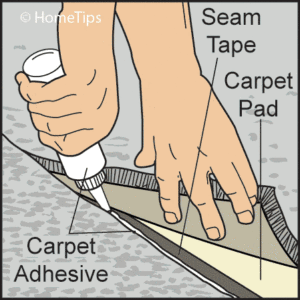
Carpet suppliers and some hardware stores sell carpet seam adhesive. Gently pull away as much loose seam as possible. Apply seam adhesive as directed by the label. Here is a typical method: Apply it to the backing of one edge of the carpet, between the pile and the pad. Do not get the fluid on the pile as it can damage or stain it.
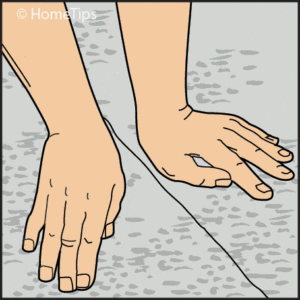
Tug gently on the carpet and pull it as far toward the other edge as possible. Repeat for the other side. Smooth out bubbles and bulges by pressing outward from the seam with your hands.
For tears in wall-to-wall carpeting or if the split seam is extreme, contact a professional carpet installer because the tension of the carpet must be released, a job that requires a few special carpet installation tools plus experience in working with carpeting.
Repairing Carpet Snags
Fixing snags in looped carpets is a relatively easy job with the help of a nailset or small screwdriver and carpet seam sealer.
Count the number of curls along the pulled-out strand and make a single cut to allow the right number of loops for each side of the run. Outline the run with masking tape.
Apply the carpet seam adhesive inside the run, and then, with the nailset or small screwdriver, press the portions of yarn that have old adhesive stuck to them back down into the backing, creating properly sized loops.
Preventing Faded Carpeting
When floors and furnishings are becoming faded due to sunlight, you can control the fading by blocking the sun with shades or curtains, but then, of course, you’ll lose the natural light.
Fading is caused by ultraviolet light, heat, and visible light from the sun. Overhangs, awnings, and shade trees can help, but the best solution is to apply clear UV-protective window film—it’s designed to block UV rays, reflect heat, and slightly reduce visible light.
Sold in rolls online or at home improvement centers, window film tint is a thin, plastic-like material. It is easy to apply to the inside surfaces of windows, using a soapy solution of water (directions come with the film). See How to Buy & Apply Widow Film for complete information.
Choose reflective low-e films to cut back on UV rays and heat; beware of the darker films—with these, you’ll sacrifice natural light.
Carpet Stains & Cleaning
Stains are the most frequent and common problem that affects carpets.
Most synthetic carpets have some degree of stain resistance—name-brand nylon carpeting generally has excellent stain resistance. In addition, any carpet that has been treated with a stain-resistance treatment such as ScotchGard™ will do a good job of rejecting stains.
Whenever a spill occurs on carpeting, the key is to try and remove it as quickly as possible. Results are always best before the stain gets a chance to dry.
Sponging water over the affected area will help dilute the stain, but be careful not to spread the stain.
How to Remove a Carpet Stain
1. Immediately following a spill, remove any semi-solid material with a spoon and place a clean, white absorbent material such as paper towels, a kitchen towel, or a sponge over the spot and press to draw the liquid away from the carpet fibers.
The idea is to blot, not scrub.
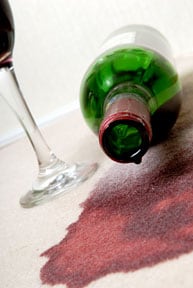
Scrubbing will spread the stain and drive it deeper into the material you’re trying to clean. As soon as the absorbent materials are wet, replace them with dry ones and weight them down with a heavy object. Replace them when they grow wet.
2. Apply a carpet cleaner directly to the stain. Ideally, you would first apply it to a small test spot in a less conspicuous part of the stain and leave on for 10 seconds. This will assure you if the cleaner is safe for your carpet.
3. You may need to treat the area more than once if it is an especially stubborn stain; some stains will never completely come out.
4. When the carpet is clean and has had a chance to dry, gently brush it to restore the carpet pile.
How to Remove Pet Odors from Carpeting
If the odors are from a pet that still lives in the house, trying to eliminate odors is probably a waste of time and money; most pets will continue to revisit their favorite spots. Ridding carpets of odors from pet urine is expensive, time consuming, and not always effective. Nevertheless, try the following:
1. At a pet store, buy a liquid enzyme-based odor remover and ask to rent a black light.

2. Go over the carpet and through the room with the black light to locate every trace of urine, which should show up under the light. Circle the areas with chalk.
3. Saturate the marked areas with the enzyme, following label directions. Allow to dry completely, for several days.
4. If necessary, have the carpet professionally cleaned.
If necessary, continue with the following steps:
5. Call a carpet installer and have the carpet and pad removed; dispose of the pad and order a new one..
6. Seal the subfloor with a stain blocker, such as KILZ.
7. Have a new pad and the carpet reinstalled.
Carpet Cleaning Basics
Eventually every carpet needs some type of cleaning to remove soil that sticks to the fibers. How often depends on the amount of use the carpet gets; some areas will need cleaning before others.
Basic methods are dry absorbent powder, foam, shampooing, and hot water extraction. Each method has advantages and disadvantages. Costs in dollars, time, and energy vary, as do the skills needed to do a good job. For environmentally friendly carpet cleaning, please see Eco-Friendly (Green) Carpet Cleaning.
Always vacuum thoroughly before starting any cleaning method. Following are some general precautions for all methods:
• Pretest on inconspicuous area first.
• Protect the carpet from rust stains by putting aluminum foil, wax paper, or plastic wrap under furniture legs until the carpet is dry.
• Follow the cleaner and equipment instructions as directed.
• Do not over-wet the carpet. Excessive moisture can cause shrinkage, streaks, or mildew.
• Keep mechanical action to a minimum to avoid carpet damage or streaks.
Hot Water Extraction
Though hot water extraction is called “steam cleaning.” steam isn’t actually used in the process. This process involves spraying a mixture of hot water and detergent onto the carpet under pressure, and then immediately extracting the solution with a special vacuum. The result dislodges and releases dirt and soil.
Extraction is an excellent way to clean carpeting that’s heavily soiled, and it’s easy to measure how clean the carpet is by viewing the solution in the machine. The carpet typically dries more quickly than it does when shampooed.
On the downside, the equipment is heavy and bulky to handle, and the process is more expensive than shampooing. You have to be careful not to saturate the carpet.
How to Remove Candle Wax from Carpeting
Candles make for beautiful, soft indoor lighting. However, the by-product of burning candles is an excess of liquid wax.
When wax pools on many hard surfaces, it can be easily removed. However, when it gets onto a fabric surface such as carpeting, it presents a much greater challenge.
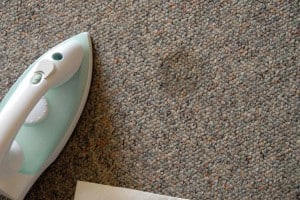
To remove wax from carpeting (as well as tablecloths and upholstery), you’ll need a household iron, paper towels, home dry-cleaning solvent, and a mild detergent.
First, lay a dry, absorbent paper towel across the wax stain. Then, press a medium-heated iron lightly against the surface. This will re-melt the wax, which will then get absorbed by the paper towel. Make sure not to leave the iron in one place for long, as it can burn the carpet beneath the paper towel without you seeing it.
If the surface still shows signs of wax residue after this procedure has been repeated a few times, try taking a small amount of home dry-cleaning solvent and applying it with a slightly damp sponge or cloth. Blot the affected area, using as little of the solvent as possible so as not to damage the carpet backing.
You can also try mixing a mild detergent with a small amount of warm water and blotting the affected area with a cloth or sponge. Make sure the detergent contains no bleach or alkalides, as this will damage the carpet.
More About Carpet Repairs & Cleaning
For more about handling specific carpet issues, please see: