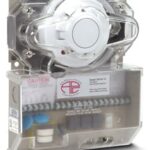

Expert advice on how to replace or change a smoke detector battery, including a helpful diagram of a smoke detector’s main parts.
Nearly every type of smoke detector makes a chirping sound to let you know when it’s time to change the battery. Inevitably, that first chirp just happens to sound at about 3 AM, when you’re deep asleep.

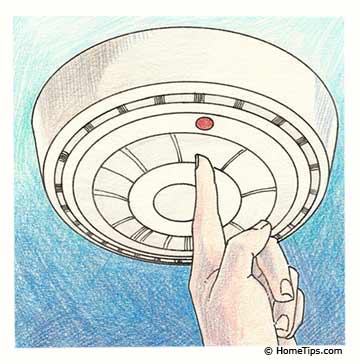
If you would rather not risk being awakened by the chirp, you can beat it to the punch by proactively replacing the battery on a regular schedule.
Most detectors will operate about 6 months on a battery, so the strategy is to replace batteries twice a year. A good time to replace all of your smoke detectors’ batteries, because it serves as a twice-yearly reminder, is on the weekends when we set our clocks forward for daylight savings time and back to standard time.
Smoke detectors may be either battery powered or wired directly into a home’s electrical system. But nearly all smoke detectors, including those that run on household current, do contain a battery. Detectors that are hard-wired to the home’s electrical system use this battery to provide backup power in case a fire knocks out the house’s electrical power.
Both battery-operated and household-current smoke detectors sound the previously-mentioned beeping or chirping low-battery alarm. This alarm is different than the deafening, blaring fire alarm that occurs during a fire: It is a sporadic chirp or beep, not a constant blast.
Sometimes it can be tricky to figure out which smoke detector in your house is chirping. As a rule, the lower the battery gets, the more the detector chirps. So, once it starts to chirp, you either have to station yourself (and, possibly, other family members) near each detector and wait for the next chirp, or you have to let the battery grow weaker until the chirps sound frequently. Obviously, the second alternative is far from ideal because you risk the possibility of the detector ceasing to work. That’s why it makes sense to change all of the batteries semi-annually at a convenient time.
Step-by-Step Instructions
If you hear the beeping or chirping low-battery alarm, do not ignore it, and do not ever remove the battery without replacing it with a new one. Smoke detectors with fully-functional batteries are critical to the safety of your family and home. Sadly, news reports of tragic fires often point out that the home had smoke detectors but those detectors had been disabled.
In this video, Don gives a quick lesson on changing smoke detector batteries:
@yelp Homeowner hack: how often should you change smoke detectors? @hometips.com #hometips #smokedetectors #safety #tips