If your home has ever lost electrical power during a storm or other type of electrical outage, you’re probably well aware of how dependent we’ve become on electrical power.

Without electricity, practically nothing works, from appliances and lights to computers and air conditioners. Even some types of phones and heating equipment become worthless. Electricity is integral to our way of life.
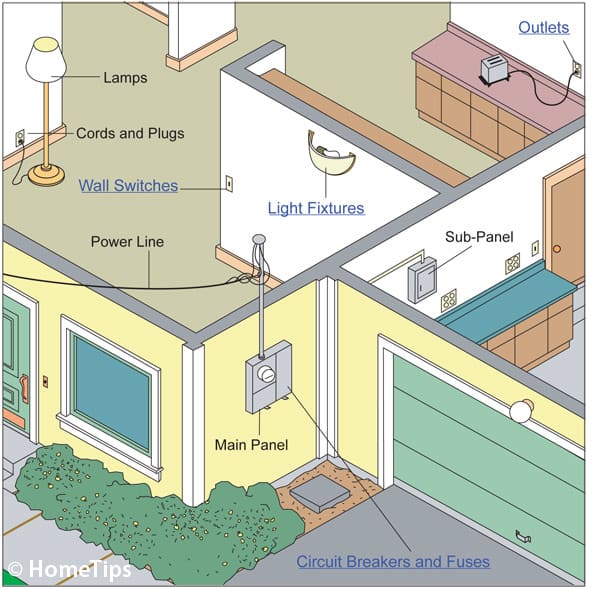
A home’s electrical system includes incoming power lines, an electric meter, a service panel, subpanels, household wiring, electrical boxes, receptacles (outlets), switches, and, of course, the appliances, lights, and equipment that put the power to work.
Other electrical systems in a house include wiring for home entertainment, such as cable television, home theaters, and audio systems, not to mention wiring for home communications such as telephones, security systems, doorbells, and intercoms.

Working on home electrical systems can be justifiably intimidating.
Home wiring can be dangerous, depending upon the type. Standard-voltage electrical wiring, which serves electrical outlets, lights, and appliances must be handled carefully to avoid shock or electrocution (see below).
But, if you follow expert instructions and turn off the power to circuits and devices before working on them, you can do this type of work safely. Low-voltage wiring for cable television, speakers, and security systems is very safe for do-it-yourselfers to handle.
This section of HomeTips offers information and instruction on a house’s electrical system.
Buying Guides
To safely work on your home’s electrical system, you need the right tools. All are common and inexpensive. In the Electrical Tools Buying Guide, we take you through 8 tools that will allow you to work on virtually any electrical repair or project.
How An Electrical System Works
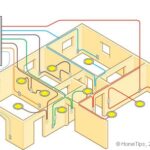
A home electrical system is an intricate maze of wiring designed to deliver power from a local utility to your home safely and efficiently. How a Home Electrical System Works is an overview that includes a diagram of the various components and some of the devices they serve.
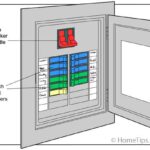
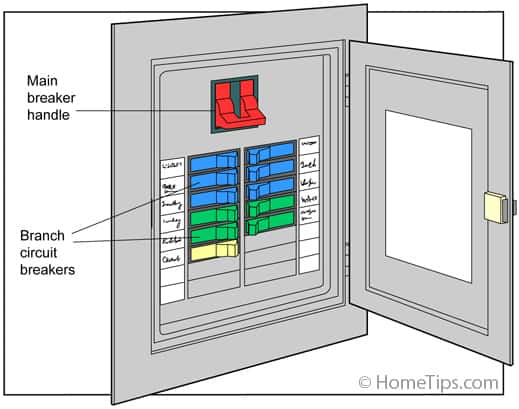
From there, we start off with a primer of electrical terms and then take you through how your electrical service works, an understanding of your electric meter, and detailed descriptions of your main electrical panel and branch panels.
Repair & Care of an Electrical System
If you have any discomfort working with your electrical system, you should not hesitate to call in a professional. Still, if your system is having problems, you may be able to easily troubleshoot the cause. In Troubleshooting Home Electrical Problems, we detail the most common problems and how to diagnose them.
One of the keys to safely working on an electrical system is to ensure that all circuits are properly grounded. For more information on this, see Electrical Grounding.
Here is a brief explanation:
Electrical current travels in a continuous closed path from the source (your home’s electrical panel) through a device that uses the power, such as a light, and then back to the source.
But electricity doesn’t have to flow through wires for the return trip to the source. It can return to the source through any conductor—including a person. The conductor just has to contact the earth directly or touch a conductive material (such a water or metal) that goes to the earth.
If you accidentally become the conducting link in an electrically live circuit, you’ll get a shock—or worse.
The key here is “link.”
You can get an electrical shock if you are touching a live wire or device at the same time you’re touching a grounded object (or another live wire).
This may sound unlikely, but if you’re touching any metal plumbing fixture, standing on the ground or anything connected to the ground, on a damp patio, or with your feet in water, you’re in contact with a grounded object. That’s when you’ll get a shock if you touch a live wire.
Always make sure that the circuit you intend to work on is not turned on…then you won’t have to worry whether or not you are going to become a conductor.
Installing Electrical Components
Even if you have no desire to work on your electrical system, for safety reasons you should know how to turn off the electricity to your house. Fortunately, it is an easy process, detailed in How to Turn Off Your Home’s Electricity.
Part of your home’s electrical system functioning safely is having the capacity to power all the appliances and devices you have or plan to purchase. We show you how to calculate your home’s energy usage. Then, in How to Map House Electrical Circuits, we discuss why it’s a good idea to have a map of your home’s electrical system.
A Short Glossary of Electrical Terms
What you should know about how volts, amperes, watts, conductors, and resistance work
Ampere (or amp)
How much current moves through a wire in one second is measured in amperes. Basically, the larger the size of wire, the greater the ampere capacity. This unit is based on the number of electrons flowing past a given point per second.
Branch Circuit
Any one of many circuits distributing electricity throughout a house.
Circuit
Two or more wires providing a path for electrical current to flow from the source, through some device using electricity, and back to the source.
Conductor
Anything that allows electricity to flow through it is called a conductor. Copper wire is an excellent conductor since it allows a free flow of electricity with very little resistance. Less expensive alternatives are aluminum and aluminum clad with copper.
Current
The movement or flow of electrons through a conductor; measured in amperes.
Ground
Any conducting body, such as a metal cold-water pipe or a metal rod driven solidly into the earth, that gives electrical current a path to the ground.
Gounding wire
Conductor that grounds a metal component but does not carry current during normal operation.
Hot wire
Ungrounded conductor carrying current forward from the source. Usually identified by black or red insulation, but may be any color other than white, gray, or green.
Kilowatt-hour (KWH):
Unit used for metering and selling electricity. One kilowatt-hour equals 1,000 watts used for one hour.
Neutral wire:
Grounded conductor that completes a circuit by providing a return path to the source. Neutral wires are always identified by white or gray insulation.
Pigtail splice:
A connection of three or more electrical wires.
Resistance
Anything in an electrical circuit that impedes the flow of current is referred to as resistance, or impedance. Resistance is measured in what are called ohms.
Volt
Just as water pours from a faucet when the spigot is turned on, so does electricity move through a wire when a switch is turned on. In both cases, the release of pressure causes the flow of energy, and, in the case of electricity, this flow is measured in volts. Utility companies usually set the voltage level for households at 120, though current can vary from 115 to 125.
Watt
The amount of electricity consumed per second is measured by what are called watts, calculated by multiplying volts times amps. Most household electrical usage is billed in kilowatt hours, or the amount of hours times 1,000 watts.