An expert buying guide for light switches, covering the different types of light switches, remote controls, and central lighting control systems.

In recent years, there has been nothing less than a renaissance in light switches.
New switches offer a variety of options, such as full-range dimmer switches, a delayed fade from on to off, dimmers that remember a range of different pre-settings, occupancy switches that automatically turn lights on when a person enters a room, and central lighting control systems that can operate lights anywhere in the house. You can also control lights with hand-held, infrared, wireless remote controls.
Such options can deliver not only personalized control but also energy savings.
Some switches are operated with keys, timers, flat rockers, or, in the case of an outdoor switch, a waterproof lever. They may be signaled by photoelectric eyes that sense light. Some switches are paired with receptacles (“combination” switches), and others have a pilot light that lights when the switch is on.
Dimmers, which control the amount of electricity that flows and the amount of light available, can be operated with a toggle, dial, slide, switch, touch pad, or button (special dimmers are needed for compact fluorescent or halogen lights and loads greater than 1000 watts).
Central lighting control systems allow you to operate all the lights in the house from one room, such as the master bedroom or living room, and can be programmed for lighting in different zones of the house at different times
Switches should match the ampere and voltage ratings for the circuit. And if your home has aluminum wiring, be sure the switches are designated “CU-AL” for compatibility.
Types of Light Switches
For more about buying various types of switches, please see:
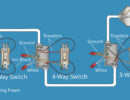
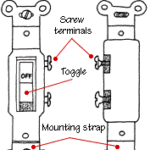
- Standard Light Switches. Conventional light switches—the types mounted in nearly all North American homes—include the single-pole switch, three-way switch, and four-way switch. For an explanation of these, READ MORE.
- Lighting Dimmer Switches. The most familiar enhanced-control device, the dimmer switch lets you lower or raise light levels so that they’re appropriate to the need. For example, a bathroom dimmer…READ MORE
- Occupancy & Motion-Sensing Switches. As if by magic, when you approach your house, lights go on. Then, once you are inside, living room sconces gradually brighten…READ MORE
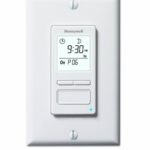
- Timer Light Switches. Timer switches can be great energy savers if you often forget to turn lights off when you leave a room. Timer light switches are designed…READ MORE
Remote Controls for Lighting
Remote controls can turn on room lights and even many appliances. You can buy hand-held, infrared remotes that work just like a television remote to dim and operate lights, ceiling fans—even window shades—from your easy chair or bedside. Or you can utilize any of several different “wireless” systems that use a combination of transmitter/receiver technology and your home’s wiring to give you increased control. Most of these are based on the X-10 Powerhouse system that has been in use for several years.
Typical plug-in products offer a range of different plug-in modules that receive signals from a remote control or switch. With these, you can control living room lighting, televisions, stereos, ceiling fans, and the like from the control. You can accessorize the system with hand-held controls, keychain remotes, security consoles, a set-back thermostat, and even a telephone responder that lets you control the system by phone.
Leviton also has an in-wall system based on X-10 protocol that offers all-lights-on security lighting at the touch of a button, centralized switching, and thermostat control. The nice thing about these systems is that you don’t have to do any special wiring—they work with what you have.
Lamsom Home Products makes a wireless ceiling fixture switch that will turn on any overhead incandescent light or ceiling fan from up to 50 feet away; a wireless wall switch that will turn on a lamp, television, or similar appliance; and a wireless three-way switch for hallways and stairways where wiring isn’t set up for control from both ends.
Central Lighting Control Systems
The ultimate in multi-station controls is a central lighting system. Based on commercial lighting systems, these are sophisticated, microprocessor controls. Made by several major manufacturers, they let you monitor and control many different switches and dimmers throughout the house from a central control panel. At a glance, you can tell which lights are on, and, with the touch of a single button, you can turn all of the lights on or off.
Some can be configured so that you can control any light from any switch. Most are meant for new, custom-built homes—the house’s wiring generally must be installed specially for the system.
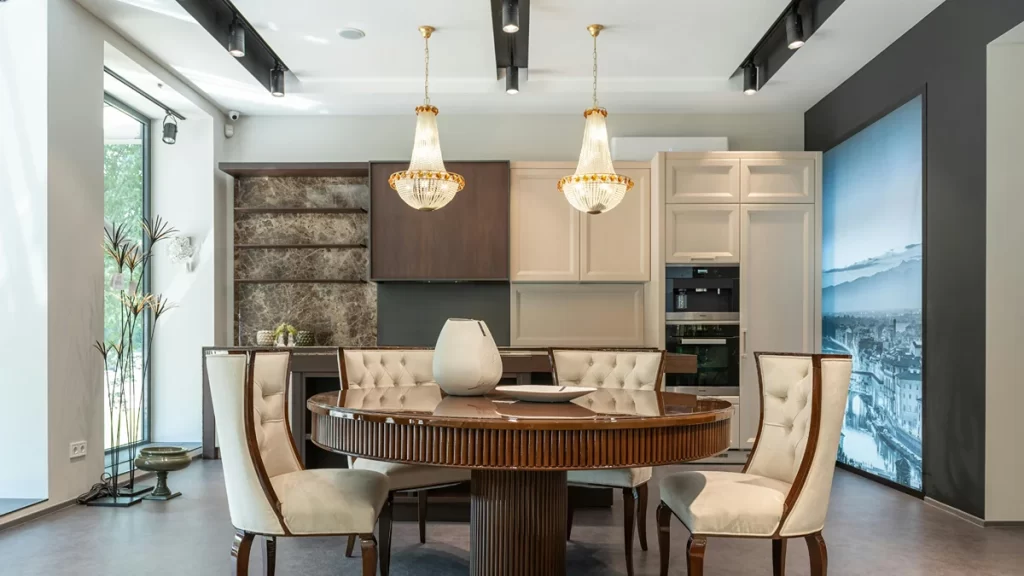
Some models are the same size as a normal light switch cover but operate several different circuits. Multiple-station controls can be pre-set so that, with a single touch, they provide candle-like atmosphere in the dining room; relaxed, tranquil lighting in the living room; and bright, activity lighting in the kitchen.


Similar controls can be programmed to handle several circuits in one room—Lutron’s Grafik Eye, for example, switches or dims up to six different lighting zones. With it, you can pre-set light levels for each zone based on activities such as “Party,” “Reading,” “Cozy,” and “Family,” and then just push one button to activate those settings. You can set up fade times, create paths of light, and operate the system with a remote control.
Some central controls, such as those by AMX, Honeywell, Plexus, and Unity are the brains for a complete home-automation system. They handle heating and air, security systems, audio and video systems, and more.