Expert, unbiased advice on how to buy the best bathroom sink, including shape, style, color, and material considerations

If your powder room needs a face-lift or it’s time to master the master bath, you’re about to discover that plumbing fixture designers have created an array of high-style bathroom sinks that turn what was once a mundane fixture into a show stopper.

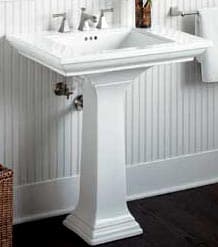
First, let’s clarify the terminology. The correct term for a bathroom sink is “lavatory,” a word rooted in the Latin word lavare, meaning “to wash.” In the industry, “lavatory” is often shortened to “lav” or, in contractor lingo, “lavvy.” The term “sink” fits if the lavatory tops a pedestal, as in “pedestal sink.” Then again, the commonly known term is “sink,” so that’s what we’ll use.
Costs of bathroom sinks are all over the map. Low-end, value-priced fixtures can be purchased at home improvement centers for under $100. At the high end, the sky is the limit. Most large manufacturers offer fixtures in a wide range of price points.
Bathroom Sink Materials & Shapes
From white porcelain classics to glass contemporaries, bathroom sinks are made from several materials in hundreds of styles and finishes. Most are made from vitreous clay, but you’ll also find glass, metal, and almost anything that holds water.
Bath sinks are made in a wide variety of shapes and styles, including ovals, rounds, modern angular forms, flowing curves, shell-like patterns, and Victorian reproductions.
One of the popular looks in lavs is glass. “An exciting direction at Porcher is the line of Glacier Glass Bowls and Pedestals,” says a spokesperson. “These are a special kind of glass. They have an etched bottom so water spots don’t show up.”
Kohler also offers lavs made of glass, which is hand-spun, highlighted by the air bubbles and imperfections characteristic of hand-blown glassware. Notes a spokesperson, “These imperfections give the glass an extra level of translucence. They capture light in the interior, creating more reflectance and refraction as light passes through.” These sinks are produced as part of Kohler’s series called the Vessels Collection. According to the spokesperson, “There are a lot of different influences feeding into this line, including Persian, vase design, Japanese, and even a traditional American look reminiscent of the pan and pitcher.”
A collection of above-counter ceramic lavatory bowls, Vessels cuts loose the imagination. You can combine these elegantly styled bowls with practically any type of countertop material, from natural stone to structural glass. The starting price is about $300.
Hand-painted bathroom sinks are increasingly popular for adding character to bathrooms. American Chinaware offers a variety of hand-painted Old World designs and thematic designs for various sports and interests. Porcher will hand-paint family crests or other emblems on fixtures, based on sketches or photos customers provide. This costs from about $250 to $1,200, depending upon the intricacy of the design and the number of colors used.
In its Absolute Collection, American Standard features hand-painted countertop sink bowls with nursery rhyme themes, colorful fishbowl paintings, and classic ornamentation. Barclay’s hand-decorated sink bowls are great for perking up a children’s bathroom with colorful handprint designs, bi-planes, or yellow rubber ducks.
Styles of Bathroom Sinks
During a bath makeover, the challenge is to select fixtures that are both beautiful and appropriate. You may love the look of a pedestal sink, but if you have a bathroom that’s going to be used by several family members, seek out a style that offers enough counter space to store everyone’s personal items. Save your design statement for your powder room or low-use guest bath.
It’s often helpful to get professional guidance from a designer, preferably a Certified Bath Designer (CBD), which means that he or she has met the guidelines established by the National Kitchen & Bath Association.
Bathroom sinks are categorized by their support method: the familiar pedestal sinks, wall-mounted lavs, sink basins, as well as console sinks, which rest on an open table base. The latter are popular for their vintage style and furniture-like look.
Bathroom sinks combined with a countertop and vanity cabinet are the most common type. The vanity cabinet hides exposed plumbing and provides hidden storage. This setup also allows for plenty of counter space, often enough for two sinks with counter to spare. Vanities come in all sizes and shapes, including corner models. A vanity is often called a “bowl-base cabinet” by manufacturers. (For more about vanities, see Bathroom Cabinets.)
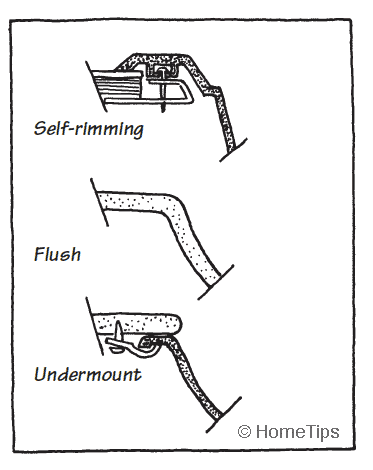
When it comes to countertop-mounted sinks, the sink bowl may sit on top of the counter or drop into a countertop hole. Though sinks that sit on top of a counter have been popular the last few years, the type that goes into a hole in the countertop is much more common. There are a couple of ways these are constructed.
Self-Rimming Sinks
A self rimming sink has a molded lip that overhangs the countertop, providing support. This type of sink is especially popular because installation is relatively easy. Basically, it just involves cutting a hole in the countertop and dropping the sink in place. The only downside is that the raised lip around the sink’s perimeter makes countertop clean-up a little harder.
Integral Sinks
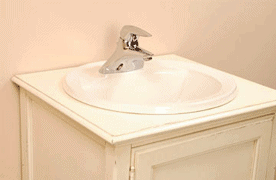
A flush integral sink is supported by metal strips around the perimeter or is an integral part of the countertop material. An integral bowl that is part of a solid-surface countertop is low maintenance since the countertop flows seamlessly into the bowl. These maximize workspace and minimize water splashing onto the countertop.
“For the busy bathrooms that need strong functionality, I’m a big fan of Corian. We do a lot of integral bowls,” says designer Steven M. Levine of Euro-Plus Designs. “I believe that most families are stressed to the max, so simplicity is key,” says Levine. “An integral top maximizes the available work surface and minimizes the problem of splashing water spilling onto the counter because you don’t have a raised lip on the sink to prevent water getting back to the drain. And the materials, if we’re dealing with Corian, are virtually stain-proof. You get the best possible combination of features for the easiest lifestyle.”
A stone-like acrylic, solid-surface material doesn’t fade or wear away, may be cleaned with a damp sponge, resists stains and scratches, and burns may simply be buffed out. You can also achieve a variety of looks with these products. Wilsonart Gibraltar, for example, makes three oval bathroom vanity bowls in three shades of white—almond, platinum, and ivory. These may be combined with 24 colors and patterns available in countertops.
Undermount Sinks
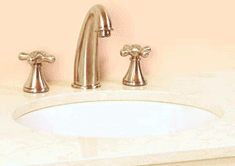
A bathroom lav may be an undermount sink that attaches to the underside of the countertop; with this type, the edge of the countertop cut-out hole must be finished. Undermount sinks, though a little trickier to install than other types, are also popular because they allow easy clean-up of the counter and sink. They can be installed in practically any type of counter: tile, wood, marble, stone, laminate, or solid surface.
Designer Sandra Steiner-Houck often specifies granite and marble countertops. “I like granite for its durability, marble less because it is not quite as resistant to staining. Tile is often used on countertops to create a very interesting look for less money than a stone product, and it tends to be durable. I try to avoid a white grout. We often work with warmer colors and blend the grout with the tile.”
Above-Counter Sink Bowls
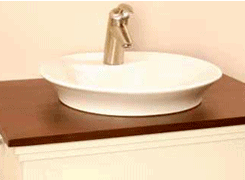
In recent years, a very popular—and highly decorative—approach to bathroom sink design is placing the sink bowl on top of the counter. With this style, the bowl itself can be quite sculptural or colorful, essentially creating the look of a decorative ceramic or metal bowl sitting on the counter. Installation is relatively easy—you just cut a hole for the plumbing in the countertop. One advantage—particularly for tall people—is that this type of sink is a little higher than other types.
Pedestal Sinks
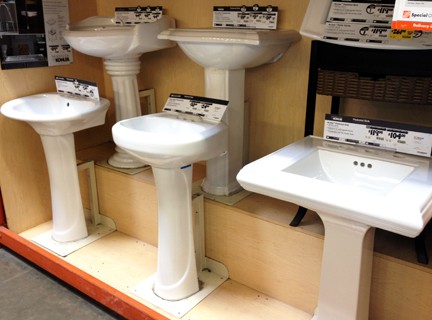
Pedestal sinks are a perennial favorite because of their classic styling. They work particularly well in small-space bathrooms where a cabinet would take up too much room or be visually bulky. On the downside, they don’t offer countertop area or storage, though they can be surrounded by any of the stylish modular bathroom cabinets.
Console Bathroom Sinks
As an alternative to countertop sinks, manufacturers are producing elegant console bathroom sink models.
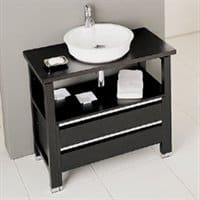
Watercolors offers avant-garde European imports that, as president Joyce Blum puts it, “are more like furniture than a sink.” Among Watercolors’ offerings are intricately curved wrought-iron frames, finished in a variety of tones. These support china and even terra-cotta bowls that have glazed finishes. How pricey are they? According to Blum, “About $1,200 and up.”
Eljer Plumbingware’s Mardi Gras lavatory, which brings the flavor of New Orleans’ historic metal and wrought-iron detailing into the bathroom, is a console that features an intricate scroll design on its metal base and a generous vitreous-china basin.
Barclay Products Limited’s Versailles is an elegant, French-style wall-mount sink with two front corner legs.
Hastings Tile & Il Bagno Collection offers a variety of artistic console sinks that utilize chrome, glass, polished copper, and more. “Most people would consider our products to be contemporary,” says a company spokesperson, “but it’s really more of an eclectic kind of look. People are intermixing a variety of different mediums with these interesting pieces.” At the upper end of the market, these sinks run from $1,000 up to $6,000.